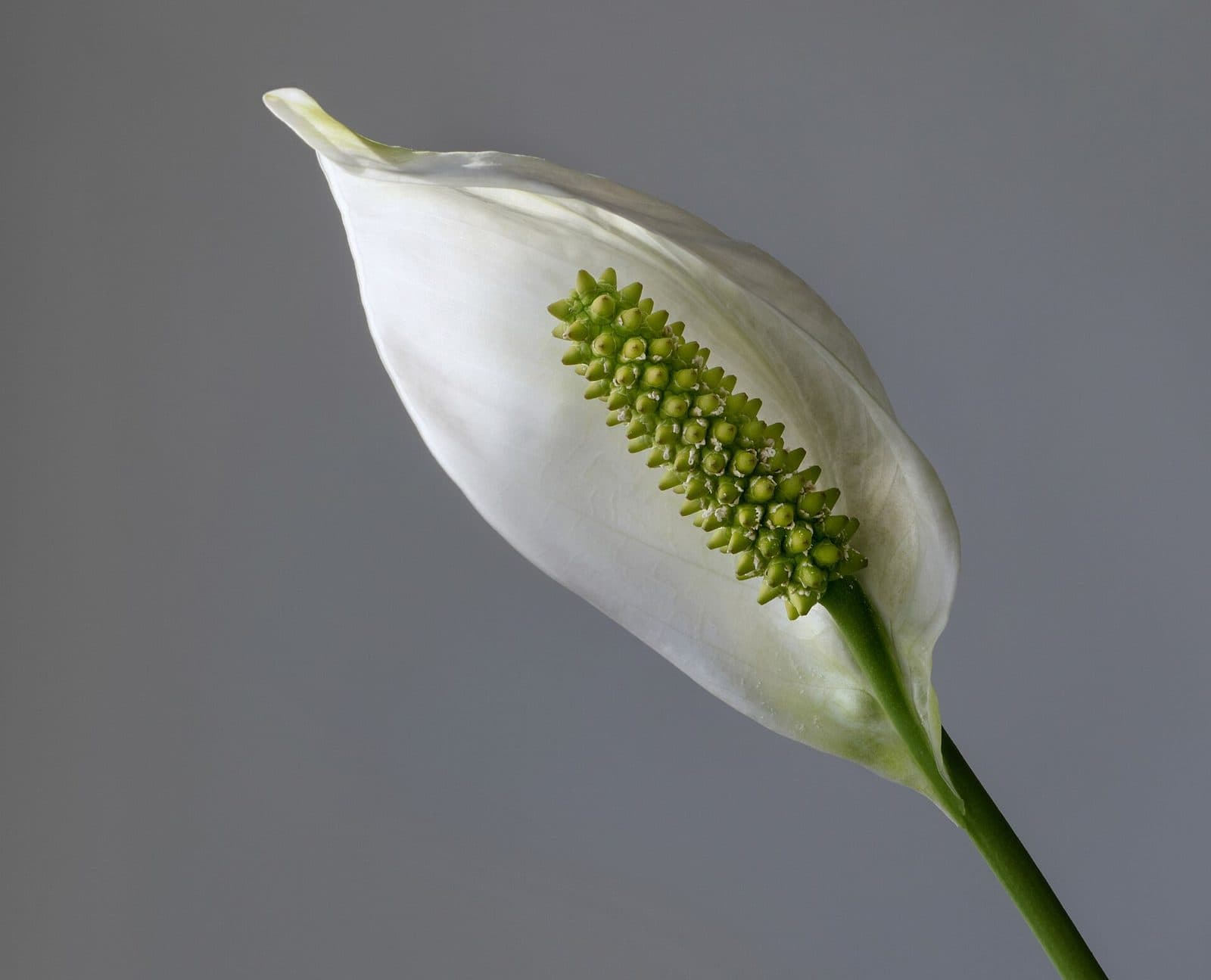
W.carter / CC BY-SA 4.0, via Wikimedia Commons
Peace lily: complete guide
Spathiphyllum wallisii
Want to see Peace lily: complete guide in your garden?
Full design in HD: €7.99
Look after your Peace lily with the GardenWorld app
Identify plants with your camera and get a care calendar with reminders for this plant.


Overview
The peace lily (Spathiphyllum wallisii) has earned its place on windowsills and office desks for one simple reason: it flowers reliably in conditions where most flowering plants give up. In the wild it grows on the floor of humid tropical forests in Colombia and Venezuela, in dappled light beneath taller trees, rooted in leaf litter that never quite dries out. Bring that picture indoors and you already know most of what it needs: steady warmth, bright but indirect light and evenly moist compost. It belongs to the arum family (Araceae), alongside monstera, anthurium and the ZZ plant.
The species stays compact, reaching 30 to 60 cm in height and spread. Garden centres also stock larger selections such as 'Sensation', which can reach 100 cm, and dwarf forms like 'Chico' at around 30 cm for a desk or narrow sill. If you would like to see how your indoor greenery could link up with the garden outside, gardenworld.app can put together a design that treats both spaces as one.
One point belongs right at the start. Every part of the plant contains needle-shaped calcium oxalate crystals, which are toxic to cats, dogs and small pets and irritate the mouth and skin of people too. A cat chewing a leaf will drool, paw at its mouth and may vomit. A peace lily is not a true lily, so it does not cause the kidney failure that Lilium species cause in cats, but it should still stand well out of reach of animals and small children.
Appearance and bloom
The leaves are glossy, dark green, lance-shaped to elliptic and 15 to 30 cm long, carried on long stalks that rise straight from the rhizome. Together they form a dense, fountain-like clump. A healthy plant holds its leaves firm and upright. If they suddenly droop, the plant is almost always thirsty, and you will see it perk up within a few hours of a thorough drink.
What looks like a single white flower is actually a spathe: a modified leaf 10 to 15 cm long that wraps like a sail around an upright spadix covered in tiny true flowers. The spathe opens creamy white, turns bright white and slowly fades to green after three or four weeks. Most plants put on their main show between March and June, and a well-kept peace lily often produces a smaller second flush in autumn.
Plants bought in full flower have usually been treated by the grower with a hormone that triggers blooming. A quiet spell of a few months afterwards is perfectly normal.
Ideal location
Aim for bright light with no harsh sun. A spot 1 to 2 metres from an east or west window is ideal. A north-facing window works too, though flowering will be lighter. Direct midday sun through glass scorches the leaves, leaving pale patches and brown edges.
The plant is happiest between 18 and 25 °C with humidity of 50 per cent or more. Keep it away from radiators and from the cold draught of a door that is opened often in winter. A bathroom with a window is excellent, because the moist air keeps leaf tips green. In summer you can move it outdoors to a fully shaded, sheltered corner as long as nights stay above 15 °C, which in most of the UK means roughly mid June to late August.
Soil
Use a light houseplant compost with a pH between 5.5 and 6.5. Mixing about one third perlite or fine bark into standard compost keeps it open, so excess water drains quickly while the roots still find moisture. A pot with a drainage hole is essential. If the plant sits in a decorative outer pot, tip away any water that collects there fifteen minutes after watering.
Repot every one to two years in March or April into a pot 2 to 4 cm wider. A pot that is too large stays wet for too long and holds back flowering. Repotting is also the time to divide a big clump: pull or cut it into two or three sections, each with several leaves and a healthy piece of root, and you have new plants for other rooms.
Free preview
Want to see Peace lily: complete guide in your garden? Make a free preview of your design.
Watering
Watering is where most peace lilies succeed or fail. Keep the compost evenly moist but never soggy, and water when the top 2 cm feels dry. In summer that often means twice a week, in winter once a week or less. Use water at room temperature. Rainwater or tap water left to stand overnight is better than cold tap water, as the plant is sensitive to chlorine, fluoride and lime. Brown leaf tips usually point to hard water or dry air.
Too much water does more harm than too little. Compost that stays wet for days leads to root rot: leaves yellow, stalks go soft and the plant no longer recovers after watering. When in doubt, wait a day. The peace lily will tell you when it is thirsty by letting its leaves hang.
From March to September, feed every two to three weeks with a liquid houseplant fertiliser at half strength. Stop feeding from October to February. Mist the foliage now and then and wipe the leaves with a damp cloth once a month to remove dust.
Pruning
There is no real pruning to do. Cut spent flower stems as low as possible, right at the base, once the spathe turns green or brown, so the plant puts its energy into new leaves and fresh flowers. Remove yellow or damaged leaves at the base in the same way. Brown tips can be trimmed with clean scissors, following the natural shape of the leaf and staying out of the green tissue.
Wear gloves if your skin is sensitive, because the sap can irritate. Bin the trimmings straight away so pets cannot chew them.
Maintenance calendar
- January and February: water sparingly, no feeding, keep away from cold glass and radiators.
- March: start feeding again; repot or divide if roots are pushing out of the pot.
- April and May: main flowering; water regularly and remove faded stems.
- June: check for spider mite and mealybug, especially in dry air.
- July and August: optionally outdoors in deep, sheltered shade; water more often.
- September: bring indoors before nights drop below 15 °C; last feed of the year.
- October to December: less water, no feeding, keep leaves clean; a second flush of flowers is common in autumn.
Winter hardiness
The peace lily is not frost hardy at all. It belongs in USDA zones 11 to 12 and is damaged below about 12 °C; under 10 °C leaves collapse and the rhizome can rot. In Britain and Ireland it is therefore a year-round houseplant and, at most, a summer visitor to a shady patio.
The main winter challenge is dry air from central heating. Stand the pot on a tray of wet gravel, group it with other houseplants, or keep it in a cool but bright room at 16 to 18 °C. Make sure the leaves do not touch cold window glass. Water less, as the plant barely grows and the compost dries more slowly.
Companion plants
A peace lily looks good with other shade-tolerant houseplants. The ZZ plant copes with the same low light but needs far less water, so pair them for the contrast of thick glossy foliage and white flowers while giving each its own watering routine. Monstera deliciosa adds height behind a low peace lily. The flamingo lily is a close relative with red or pink spathes and very similar needs, and Chinese evergreen brings silver-marked leaves to a darker corner.
If you share your home with cats or dogs, bear in mind that all these arum relatives contain the same oxalate crystals. The spider plant is regarded as non-toxic to pets and makes a safe green partner where animals roam.
Closing
A peace lily repays very little effort: glossy leaves all year, white spathes in spring and often again in autumn, and a plant that shows you clearly when it wants water. Give it bright light without harsh sun, an airy compost that never dries out completely, soft water and a warm spot away from draughts, and it will stay handsome for years. Just keep it out of reach of pets. To see your houseplants and garden planned together, gardenworld.app helps you build a design where every plant gets the spot it needs.
Frequently asked questions about Peace lily
Is Peace lily winter hardy?
The peace lily is not frost hardy at all. It belongs in USDA zones 11 to 12 and is damaged below about 12 °C; under 10 °C leaves collapse and the rhizome can rot.
When and how do you prune Peace lily?
There is no real pruning to do. Cut spent flower stems as low as possible, right at the base, once the spathe turns green or brown, so the plant puts its energy into new leaves and fresh flowers.
How much water does Peace lily need?
Watering is where most peace lilies succeed or fail. Keep the compost evenly moist but never soggy, and water when the top 2 cm feels dry.
Where does Peace lily grow best?
Aim for bright light with no harsh sun. A spot 1 to 2 metres from an east or west window is ideal.
What soil does Peace lily need?
Use a light houseplant compost with a pH between 5.5 and 6.5. Mixing about one third perlite or fine bark into standard compost keeps it open, so excess water drains quickly while the roots still find moisture.

See it in your garden
See Peace lily in your garden
One photo of your garden and a few questions. You see the result in about a minute.
Try it with a photoIdentify this plant in your own garden. Identify a plant
Similar plants
Chlorophytum comosum: complete guide
Chlorophytum comosum
Discover everything about Chlorophytum comosum (spider plant). Learn care requirements, propagation, location and maintenance for thriving indoor plants.
ZZ plant: complete guide
Zamioculcas zamiifolia
Discover Zamioculcas zamiifolia, the easy-care money plant from Africa. Growing and care tips for indoors.
Monstera deliciosa: complete guide
Monstera deliciosa
Discover the fruit-salad plant (Monstera deliciosa) - a popular houseplant with characteristic holes in leaves. Professional care and growing tips for success.
