
User:WeFt / CC BY-SA 3.0, via Wikimedia Commons
ZZ plant: complete guide
Zamioculcas zamiifolia
Want to see ZZ plant: complete guide in your garden?
1 minute, no credit card
Overview
Zamioculcas zamiifolia, commonly known as the ZZ plant or money plant, is an elegant houseplant from East Africa. Despite its exotic origin, this plant is incredibly easy to care for and nearly indestructible. Thanks to its glossy, feathered foliage and compact growth, it is perfect for offices, living rooms, and hospitals.
The plant belongs to the Araceae family, the same as philodendrons. In its homeland, it grows along forest edges and in dry mountain regions, where it survives long periods without water. This makes it ideal for forgetful plant owners!
Appearance and Bloom
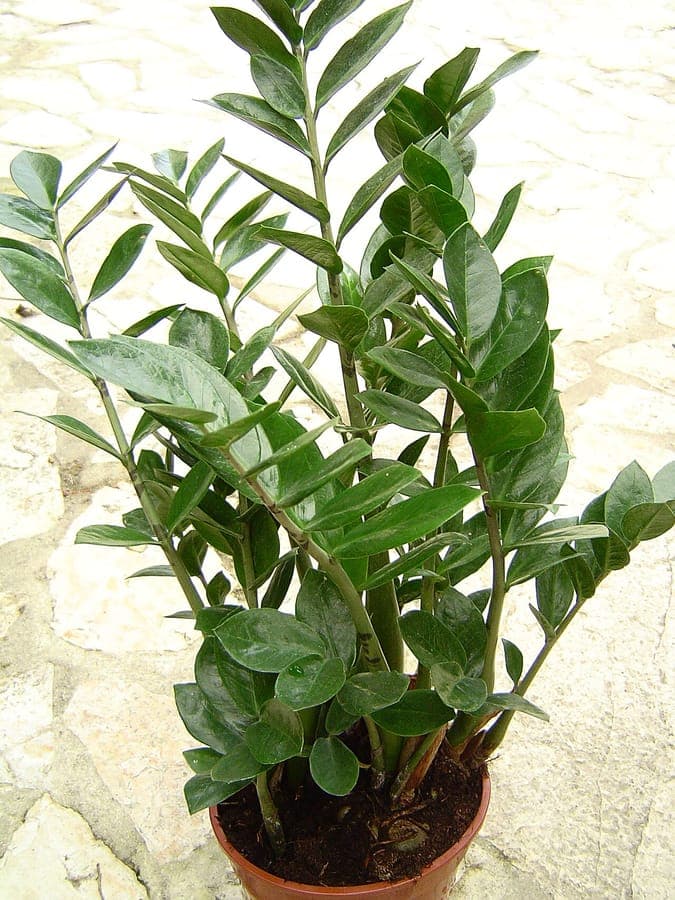
The ZZ plant grows in a compact, vase-like form with multiple stems that grow upright. Along each stem grow 8-16 paired, glossy green leaflets in feather arrangement (pinnate). These leaves are smooth, waxy-textured, and beautifully reflect light.
The plant can reach 60-90 cm tall in a pot, though it grows slowly. Flowers are subtle - small yellowish spathes with white flowers appear at the center. Many people don't even know this plant for its flowers, since it rarely blooms indoors.
The plant produces underground tubers (thickened roots) that store water and nutrients. This is why it can survive long periods without water - it lives off its reserves!
Ideal Location
The ZZ plant grows best in indirect light but also tolerates full shade. It can survive months without direct sunlight, though it grows faster with some light. A spot by a window without direct sun is perfect.
Indoors it works well in living rooms, offices, bathrooms (with a window), and bedrooms. It doesn't suffer from dry indoor air like many other houseplants. Due to its toxic sap, keep it out of reach of small children and pets.
The plant has no special placement preference - it accepts wherever you place it. This makes it ideal for decoration in diverse spaces.
Soil
The ZZ plant grows best in well-draining potting soil. Standard houseplant soil works fine, but you can do better by mixing your own: 50% houseplant soil, 30% perlite or pumice, and 20% orchid bark.
This blend simulates the dry, well-draining environment of its homeland. Waterlogging is the primary cause of ZZ plant death, so drainage is crucial. A pot with drainage holes is essential.
pH is not critical - it grows in neutral to slightly acidic soil. If you have houseplant soil, you're ready.
Watering
This is where the ZZ plant shines. It tolerates months without water. During the growing season (April to October), water when the top 2-3 cm of soil feels dry. This might be monthly or every two weeks, depending on humidity and temperature.
In winter (November to March), water much less, perhaps only 1-2 times per month. If you doubt whether to water: don't! The plant survives drought but not waterlogging.
A useful trick: place the pot in a basin of water for 10 minutes if the soil feels completely dry. Let it drain well afterward. This method helps prevent overwatering.
Free design
Want to see ZZ plant: complete guide in your garden? Make a free design now.
Pruning
Pruning is not really necessary for ZZ plants. They grow slowly and compactly. If you do want to prune (for example to propagate), cut just below a node. The plant will then sprout from underlying nodes.
Remove dead or damaged leaves by gently peeling them from the stem. This doesn't stimulate new growth but keeps the plant tidy.
Cuttings can easily grow from individual leaflets. Plant loose leaf petioles in moist potting soil, place them in partial shade, and wait patiently (months!). They will form small tubers and then sprout new plantlets.
Maintenance Calendar
March to October is growing season. Check monthly whether the soil is dry. Feed once monthly with half-strength liquid fertilizer.
April to June: watch for spider mites (fine webbing between leaves). Spraying with water solves this.
July to September: ensure adequate indirect light. Rotate the pot monthly so the plant receives light from all sides.
November to February is rest period. Water minimally. No feeding needed.
March: resume feeding and gradually increase watering frequency.
Winter Hardiness
The ZZ plant is not winter hardy at all and grows only indoors in temperate and cold climates. It cannot tolerate temperatures below 10 degrees Celsius. It grows best in warm homes (18-24 degrees).
Ensure you don't place the plant near cold air streams (open windows, air conditioners). A sudden temperature drop can cause leaf drop.
Companion Plants
The ZZ plant pairs well in groups with other low-maintenance houseplants. Combine it with pothos (climbing ivy), sansevieria (snake plant), ficus benjamini, or spathiphyllum (peace lily). All tolerate the same dryness.
In a planter you can place low-growing plants underneath: Hedera helix (ivy) or Scindapsus. They grow from the same pot without hindering each other.
Summary
Zamioculcas zamiifolia is the perfect plant for busy people, offices, and anyone wanting effortless plant care. With minimal attention it grows beautifully for years. It also purifies indoor air, making it even more valuable.
The plant is available at nearly all garden centers and plant shops. For better selections, check local plant nurseries.
Start today with a ZZ plant and discover the joy of a nearly indestructible housemate. Gardenworld.app can also help with spatial design for indoors - share your interior photo and receive free plant recommendations!
Want to see ZZ plant: complete guide in your garden? Make a free design now.
Upload a photo, pick a style, and get a photorealistic design with plant list in under a minute.
No credit card required


Similar plants
Arrowhead vine: complete guide
Syngonium auritum
Everything about Syngonium auritum, the tropical five-fingers houseplant. Care, location, watering, and pruning explained clearly for beginners and enthusiasts.
Minute duckweed: complete guide to Lemna perpusilla
Lemna perpusilla
Everything about Lemna perpusilla, the minute duckweed: ecology, pond management, water quality and care in garden water features.
Dead horse arum lily: complete guide
Helicodiceros muscivorus
Everything about the dead horse arum lily (Helicodiceros muscivorus): growing conditions, spectacular bloom, thermogenesis, and care for this Mediterranean aroid.