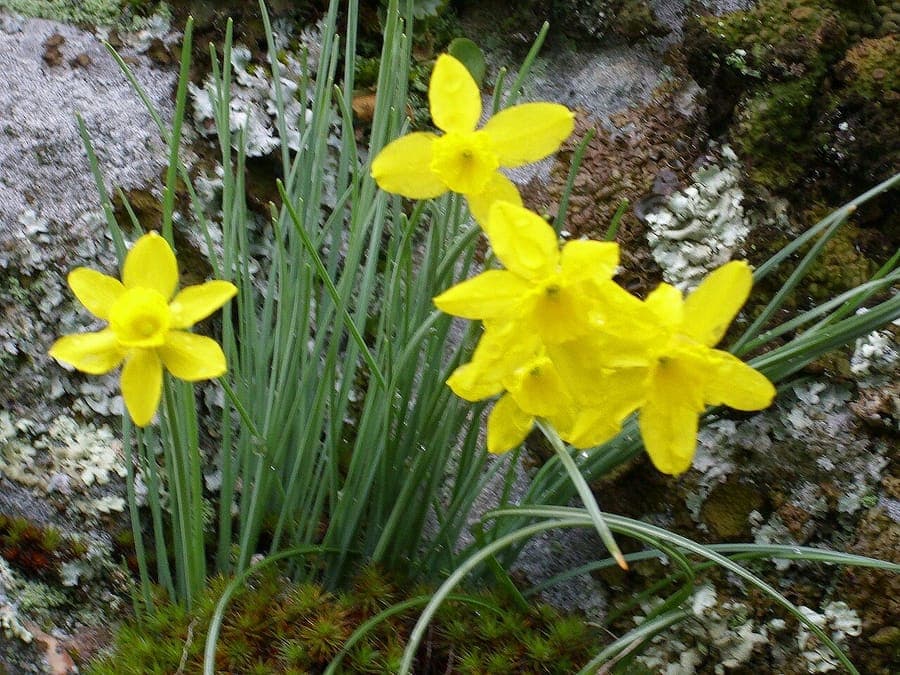
Javier martin / Public domain, via Wikimedia Commons
Rock narcissus: complete guide
Narcissus rupicola
Want to see Rock narcissus: complete guide in your garden?
Full design in HD: €7.99
Look after your Rock narcissus with the GardenWorld app
Identify plants with your camera and get a care calendar with reminders for this plant.


Overview
Narcissus rupicola, the rock narcissus, is an exceptionally rare dwarf daffodil native to rocky mountain regions of northern Spain and Portugal. This delicate alpine gem is prized by specialized alpine and botanical gardeners for its refined botanical characteristics. Its pale yellow flowers are exquisitely refined.
Appearance and flowering period
This diminutive narcissus reaches merely 10-20 centimeters in height. Fine, grass-like foliage is extremely compact and neat. Individual flowers are tiny, approximately 1.5 centimeters wide, with narrow, refined petals in pale yellow. The flowering period extends from March through May, depending on conditions. Each bulb typically produces one or two flowers.
Ideal location
Plant this alpine specialist in full sun to very light shade. In containers, full sun is acceptable given superior drainage control. It grows best in warm, very well-drained rocky sites. For garden integration, position in rocky, dry slopes, scree, or alpine troughs. Protect from physical damage and excessive moisture.
Soil requirements
Alpine rock plants demand excellent drainage and gritty structure. Mix 50% fine gravel or lava stone, 30% well-rotted leaf mould, 20% coarse sand. Avoid peat entirely; this specialist requires mineral-dominant substrate. Neutral to slightly acidic pH preferred.
Free preview
Want to see Rock narcissus: complete guide in your garden? Make a free preview of your design.
Watering
After autumn planting, water sparingly; this plant tolerates drought better than wetness. Apply regular, light watering during growth period (February-April). After flowering, reduce almost to dry. This replicates rocky alpine conditions. Summer dryness is normal and beneficial.
Pruning
No pruning applicable. Allow spent flowers to naturally detach. Yellowed foliage may be carefully removed after complete browning.
Maintenance calendar
September-October: Plant in drainage-rich alpine mix. November-January: Keep dry, minimal watering. February: Begin careful watering as growth signals appear. March-April: Regular moisture application; avoid saturation. May: Reduce watering. June-September: Keep very dry; plant dormant.
Winter hardiness
Narcissus rupicola is hardy to USDA zone 4-5 (-25 to -28degC). Across Netherlands and Belgium, it thrives outdoors in warm, excellently-drained rocky corners. In less temperate regions, container cultivation with winter protection is essential. Snow accumulation and waterlogging are intolerable.
Companion planting
This plant is primarily a specialist's collector piece. Grow in alpine troughs, scree gardens, or in containers filled with fine gravel/tufa. Pairing with fellow dwarf alpine narcissi and sempervivums creates thematic alpine collections.
Closing
Narcissus rupicola is for the dedicated alpine enthusiast. With proper drainage and dry summers, it grows reliably. Available from specialized alpine nurseries. For more botanical design inspiration, visit gardenworld.app.
Frequently asked questions about Rock narcissus
Is Rock narcissus winter hardy?
Narcissus rupicola is hardy to USDA zone 4-5 (-25 to -28degC). Across Netherlands and Belgium, it thrives outdoors in warm, excellently-drained rocky corners.
When and how do you prune Rock narcissus?
No pruning applicable. Allow spent flowers to naturally detach.
How much water does Rock narcissus need?
After autumn planting, water sparingly; this plant tolerates drought better than wetness. Apply regular, light watering during growth period (February-April).
Where does Rock narcissus grow best?
Plant this alpine specialist in full sun to very light shade. In containers, full sun is acceptable given superior drainage control.
What soil does Rock narcissus need?
Alpine rock plants demand excellent drainage and gritty structure. Mix 50% fine gravel or lava stone, 30% well-rotted leaf mould, 20% coarse sand.

See it in your garden
See Rock narcissus in your garden
One photo of your garden and a few questions. You see the result in about a minute.
Try it with a photoIdentify this plant in your own garden. Identify a plant
Similar plants
Agapanthus campanulatus: the hardy bell agapanthus
Agapanthus campanulatus
Agapanthus campanulatus is a deciduous African lily with blue bell-shaped flowers in summer. Learn about position, watering, winter care and good companions.
Agapanthus inapertus: the drooping African lily
Agapanthus inapertus
Agapanthus inapertus is a tall African lily with drooping, barely open tubular flowers in deep blue and violet. A guide to position, watering and winter care.
Tree onion: complete guide
Allium × proliferum
Everything about the tree onion (Allium × proliferum): planting, harvesting bulbils, dividing and overwintering. A perennial onion, toxic to dogs and cats.
