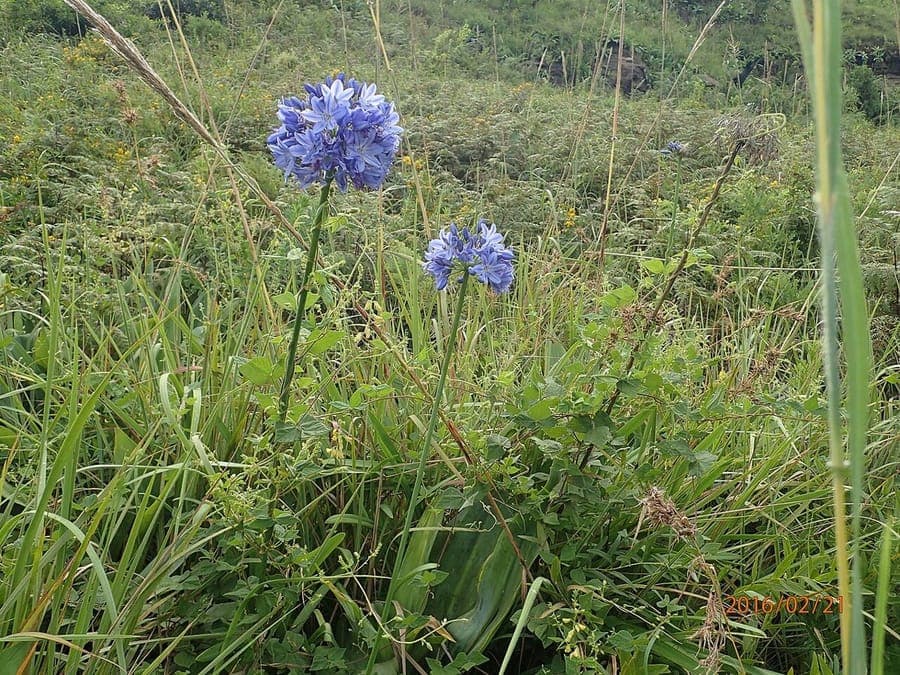
no rights reserved / CC0, via Wikimedia Commons
Agapanthus campanulatus: the hardy bell agapanthus
Agapanthus campanulatus
Want to see Agapanthus campanulatus: the hardy bell agapanthus in your garden?
Full design in HD: €7.99
Look after your Agapanthus campanulatus with the GardenWorld app
Identify plants with your camera and get a care calendar with reminders for this plant.


Overview
Agapanthus campanulatus is an African lily in the family Amaryllidaceae, and one of the best choices if you want an agapanthus that can simply stay in the garden. Unlike the evergreen species often grown in large pots, this one is deciduous: the leaves die back in autumn and the plant spends the winter as a clump of fleshy roots below ground. That makes it considerably tougher in a cool, damp climate.
It comes from South Africa and Lesotho, chiefly the Drakensberg and the surrounding uplands. There it grows on grassy mountain slopes and in damp meadows, often near streams, where summers are wet and winters dry and cold. That origin explains its needs in the garden: plenty of water and food during the growing season, and a drier rest in winter. The photograph shows exactly that kind of wild setting, with two blue flower heads rising above grasses and ferns.
The name campanulatus means "bell-shaped" and refers to the flowers, which is why it is known in English as bell agapanthus or bell African lily. If you want to see how a blue summer perennial like this fits into your own border, you can have a garden design made at gardenworld.app that takes your soil and aspect into account.
Appearance and bloom cycle
The plant forms clumps of narrow, strap-shaped leaves 20 to 40 cm long and 1 to 2 cm wide. The foliage is grey-green and fairly upright. In July and August sturdy, leafless flower stems appear, 50 to 100 cm tall, each carrying a rounded or half-rounded head of twenty to forty flowers.
The individual flowers are bell-shaped to widely open, 2 to 3 cm long, and usually pale to mid blue with a darker stripe down the centre of each petal. White forms exist too, such as var. albidus, and subspecies patens has flowers that open even wider. After flowering, green seed capsules form and later turn the colour of straw. They are decorative in a winter border and in dried arrangements.
Bees and bumblebees visit the flowers eagerly, and as a cut flower agapanthus lasts well over a week in a vase.
Ideal location
Give Agapanthus campanulatus the sunniest spot you have. At least six hours of full sun are needed for good flowering; in shade the plant mainly produces leaves. A position against a south-facing wall or in a sunny, sheltered border is ideal. The soil there warms up quickly in spring and the plant is a little better protected in winter.
Plant 30 to 45 cm apart. Agapanthus often flowers better when clumps are slightly congested, so there is no need to give them lots of room. In pots the principle is even stronger: an agapanthus in a slightly snug pot usually flowers more freely than one with plenty of root space.
Soil requirements
The ideal soil is fertile and humus-rich, moisture-retentive in summer yet well drained. Wet, stagnant soil in winter is fatal, because the fleshy roots rot. On heavy clay, work compost and grit into the top 30 cm or plant on a slightly raised spot. On poor sandy soil, add plenty of compost so the ground does not dry out too quickly in summer.
Plant in spring, in April or May, once the soil has warmed up. Set the clump so that the crown sits 2 to 3 cm below the surface. In pots, use a mix of loam-based compost with a third coarse grit or fine gravel, in a container with a good drainage hole.
Watering
Because this species comes from a summer-rainfall region, it needs more water during the growing season than the evergreen patio agapanthus. Keep the soil evenly moist from May to the end of August, especially in dry spells and in the weeks before and during flowering. During that period, feed every two to three weeks with a fertiliser for flowering plants that is relatively high in potassium. Too much nitrogen mostly gives leaves.
From September, reduce watering. In winter, when the plant has no leaves, the soil should be on the dry side rather than wet. Move pots under cover or into a cold, frost-free space so they stay out of the rain.
Free preview
Want to see Agapanthus campanulatus: the hardy bell agapanthus in your garden? Make a free preview of your design.
Pruning
Cut faded flower stems back to just above the foliage, unless you want to keep the seed heads as winter decoration. You can sow the seed, but seedlings take three to four years to flower and do not always resemble the parent. Let the leaves die back in autumn; once they are yellow and limp, cut them away, or leave them as natural protection until spring and tidy up then.
Every four or five years, divide congested clumps in spring. Lift the clump, split it with a sharp spade or two forks into pieces that each have a few growing points, and replant. Plants usually flower a little less in the first year after dividing.
Agapanthus contains saponins. The sap can irritate the skin, and eating parts of the plant may cause nausea or vomiting. The same goes for dogs and cats: symptoms usually stay limited to stomach upsets, but ask your vet if you are worried. Wear gloves when dividing.
Maintenance calendar
March and April: Clear away old leaf remains and any winter mulch. Divide congested clumps.
May: Plant new specimens. Start watering as soon as the leaves are growing.
June: Begin feeding. Watch out for slugs, which eat young shoots. In Britain, also check for agapanthus gall midge, which causes swollen, misshapen buds that fail to open.
July and August: Flowering time. Water generously in dry weather. Cut stems for the vase.
September: Stop feeding and water less. Cut back faded stems or leave them standing.
October and November: The leaves die back. Spread a layer of mulch over the root zone and keep pots dry.
December to February: Dormant season. Keep the soil dry and check the mulch is still in place.
The planting calendar at gardenworld.app helps you carry out these jobs at the right moment.
Winter hardiness
Agapanthus campanulatus is one of the hardiest agapanthus species. The RHS rates it H4, which means roughly -10 °C. In a dry, sheltered spot under a thick mulch it often survives harder frosts in practice, because the roots sit deep and the leafless crown stays dry. In most of Britain and the Low Countries it can therefore stay in the ground. In November, spread a 10 cm layer of straw, leaf mould or bark over the plant and remove it again in March.
Pots are a different story, as the root ball freezes much more quickly. In winter, move pots into a cold, frost-free garage or shed, or wrap them well and stand them against a sheltered wall. They need hardly any water during that time.
Companion plants
The blue heads of Agapanthus campanulatus call for partners that belong in the same sunny, fertile border. Red hot poker (Kniphofia uvaria) gives an exciting colour contrast with its orange and yellow spikes. Geranium 'Rozanne' flowers for months in violet-blue at the foot of the clumps and hides the agapanthus foliage when it starts to look tired later in the season. Balkan clary (Salvia nemorosa) repeats the blue in a different shape, and golden oats (Stipa gigantea) adds airy, golden plumes above the border. If you would also like an evergreen agapanthus on the patio, pair this species with Agapanthus praecox in a large pot.
Final thoughts
Agapanthus campanulatus is the ideal African lily for anyone who does not want to haul heavy pots indoors every autumn. With a sunny position, fertile soil that stays moist in summer and dry in winter, and a mulch in the coldest months, it will flower faithfully every year with its blue bells. It looks exotic, yet it is surprisingly easy.
Frequently asked questions about Agapanthus campanulatus
Is Agapanthus campanulatus winter hardy?
Agapanthus campanulatus is one of the hardiest agapanthus species. The RHS rates it H4, which means roughly -10 °C.
When and how do you prune Agapanthus campanulatus?
Cut faded flower stems back to just above the foliage, unless you want to keep the seed heads as winter decoration. You can sow the seed, but seedlings take three to four years to flower and do not always resemble the parent.
How much water does Agapanthus campanulatus need?
Because this species comes from a summer-rainfall region, it needs more water during the growing season than the evergreen patio agapanthus. Keep the soil evenly moist from May to the end of August, especially in dry spells and in the weeks before and during flowering.
Where does Agapanthus campanulatus grow best?
Give Agapanthus campanulatus the sunniest spot you have. At least six hours of full sun are needed for good flowering; in shade the plant mainly produces leaves.
What soil does Agapanthus campanulatus need?
The ideal soil is fertile and humus-rich, moisture-retentive in summer yet well drained. Wet, stagnant soil in winter is fatal, because the fleshy roots rot.

See it in your garden
See Agapanthus campanulatus in your garden
One photo of your garden and a few questions. You see the result in about a minute.
Try it with a photoIdentify this plant in your own garden. Identify a plant
Similar plants
Kniphofia uvaria: complete guide
Kniphofia uvaria
Learn about red-hot poker (pokerplant) - exotic summer bloomer, full sun requirements, drainage, frost protection, and vibrant color.
Geranium 'Rozanne': complete guide
Geranium 'Rozanne'
Everything about Geranium 'Rozanne' (Rozanne cranesbill): planting, care, bloom time and combinations. Practical tips for the longest-flowering perennial.
Stipa gigantea: complete guide
Stipa gigantea
Giant feather-grass is a striking ornamental grass with feathery seed heads and golden shimmer. Learn how to grow this monumental grass successfully in your garden design.
