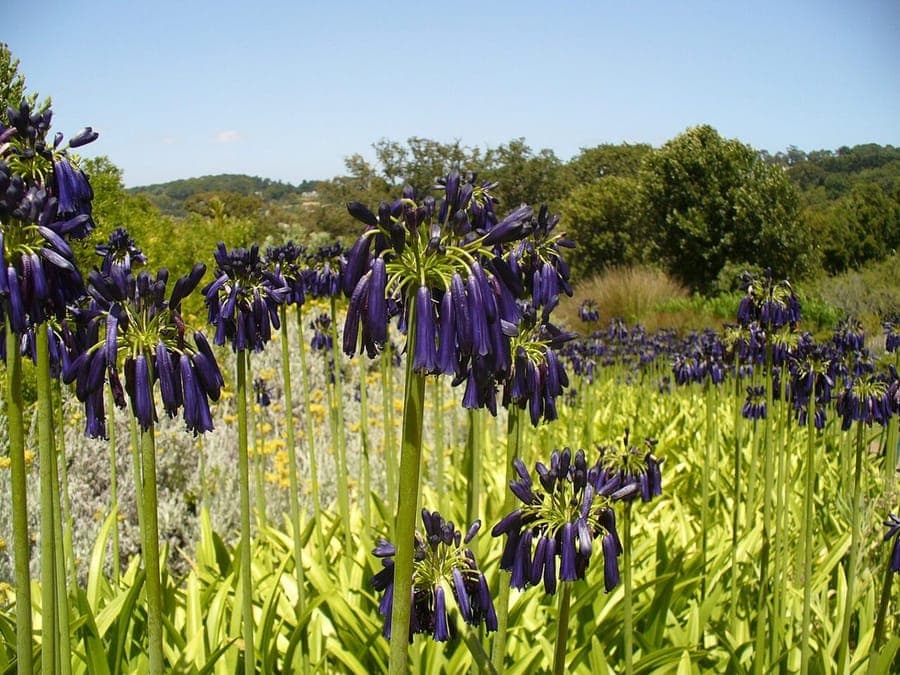
Andrew Massyn / Public domain, via Wikimedia Commons
Agapanthus inapertus: the drooping African lily
Agapanthus inapertus
Want to see Agapanthus inapertus: the drooping African lily in your garden?
Full design in HD: €7.99
Look after your Agapanthus inapertus with the GardenWorld app
Identify plants with your camera and get a care calendar with reminders for this plant.


Overview
Agapanthus inapertus is the odd one out among African lilies. Where most species spread their flowers outwards as open trumpets or stars, this one lets them hang down as slender tubes that barely open. That is where the name comes from: inapertus is Latin for "not opened". The result is a plant with a silhouette all of its own, rising above the late summer border with dangling bells in deep blue to rich violet.
It belongs to the family Amaryllidaceae and comes from north-eastern South Africa, chiefly Mpumalanga and Limpopo, and from Eswatini. There it grows on grassy and rocky slopes in a region with warm, wet summers and dry winters. Like Agapanthus campanulatus it is deciduous: the leaves die back in autumn and the fleshy roots rest underground through the winter. In English it is often called drooping agapanthus.
It is a substantial plant. The flower stems reach 1 to 1.5 metres, sometimes more, so it belongs in the middle or towards the back of a border rather than at the front. If you want to fit such a vertical plant in well, you can have a garden design made at gardenworld.app that balances the heights and flowering times across your borders.
Appearance and bloom cycle
The clumps are made up of upright, grey-green, strap-shaped leaves 30 to 70 cm long. The foliage is often slightly broader and bluer than in other deciduous species. From late July into September the tall, bare flower stems appear. Each one carries a loose head of tubular flowers 3 to 5 cm long, hanging down on thin stalks.
The colour is usually a deep violet-blue to almost inky blue, but pale blue, grey-blue and white forms exist too. Botanists recognise several subspecies, including subsp. hollandii, subsp. intermedius and subsp. pendulus, which differ in the angle and width of the flowers. In nurseries you will find, among others, 'Sky' (pale blue, a selection of subsp. hollandii) and 'Graskop' (deep violet, from subsp. pendulus). The photograph shows a mass of dark violet, drooping flowers held high above the foliage, with wooded hills in the background.
After flowering, seed capsules form and turn straw-coloured, standing well into winter. Bees visit the flowers, although the narrow mouths make them work for their nectar.
Ideal location
Full sun is essential. Agapanthus inapertus needs warmth to flower well; in too much shade it produces few stems or none at all. Choose the sunniest, warmest part of the garden, ideally sheltered from strong wind, as the tall stems can be blown over in a gale. A south-facing border in front of a wall or hedge is ideal.
Plant 40 to 50 cm apart. It also does well in a large container at least 35 to 40 cm across, which is often the safest choice in colder areas. Make the pot as heavy and stable as possible, because with stems one and a half metres tall it catches a lot of wind.
Soil requirements
Provide fertile, humus-rich soil that holds moisture in summer but drains freely. Water must not stand around the roots in winter, or they will rot. On heavy clay, work compost and coarse grit or fine gravel into the top 30 cm. On light sandy soil, add extra compost so the ground does not dry out in summer. Slightly acidic to neutral soil is ideal.
Plant in April or May, once the soil has warmed. Set the crown 2 to 3 cm below the surface. In pots, use a sturdy loam-based compost with around a third coarse grit, so that the container is not too light and drains well.
Free preview
Want to see Agapanthus inapertus: the drooping African lily in your garden? Make a free preview of your design.
Watering
During the growing season, from May to September, this summer-rainfall plant needs regular water. Keep the soil evenly moist, especially in the weeks before flowering when the stems are forming. Drought at that stage costs flowers. Every two to three weeks, give a potash-rich feed for flowering plants.
After flowering, gradually reduce watering. In winter the plant is dormant and the soil can be on the dry side. From October, move pots under cover or into a cold, frost-free space, giving only a very occasional splash of water so the root ball does not dry out completely.
Pruning
Cut faded stems back to just above the foliage, or leave them standing if you like the seed heads. Let the leaves turn yellow in autumn, then cut them off. Divide congested clumps in spring every four to five years. Do not do this too often, as agapanthus flowers best when it is left undisturbed for a while.
Agapanthus contains saponins. The sap can irritate skin, and eating parts of the plant may cause nausea, vomiting or diarrhoea in people and pets. The risk is usually small, but wear gloves when dividing and keep an eye on dogs and cats that like to chew plants.
Maintenance calendar
March and April: Remove the winter mulch and clear old leaf remains. Divide if needed.
May: Plant new specimens and move pots back out to their sunny spot. Start watering.
June and July: Feed regularly and keep the soil moist. In windy gardens, add discreet support to the tallest stems.
August and September: Flowering time. Keep watering during dry spells.
October: Stop feeding and watering. Move pots to a frost-free place.
November to February: Spread a thick mulch over plants in the ground. Let the plant rest.
With the planting calendar at gardenworld.app you will not miss a step, from the first watering in May to the mulch in November.
Winter hardiness
Agapanthus inapertus is less hardy than Agapanthus campanulatus. The RHS rates several selections, such as 'Sky', as H4, which means roughly -10 °C, and advises a good mulch in cold areas or growing the plant in a container. In milder parts of Britain and the Low Countries, particularly in towns and near the coast, it usually survives the winter in a sheltered, dry spot under a thick mulch. In colder, wetter gardens a container is the safer option.
Cover the plant in November with 10 to 15 cm of straw, leaf mould or bark, and remove it in March so the new shoots get light. More important than the covering is dry soil. Cold and wet together are far more dangerous to the fleshy roots than dry frost.
Companion plants
The dark violet of Agapanthus inapertus looks stunning beside silver-grey and soft yellow. Russian sage (Perovskia atriplicifolia) gives a haze of lavender-blue over grey foliage, while purpletop vervain (Verbena bonariensis) floats small purple heads at the same height among the drooping flowers. Red hot poker (Kniphofia uvaria) adds a warm orange contrast, and fountain grass (Pennisetum alopecuroides) forms a soft, feathery underplanting that holds its shape well into autumn. On a patio, an evergreen Agapanthus africanus in a pot alongside flowers earlier and extends the season.
Final thoughts
Agapanthus inapertus is no ordinary African lily, and that is exactly its strength. With its hanging, dark flowers on tall stems it brings vertical drama and a touch of mystery to the late summer border. Give it full sun, fertile soil that is moist in summer and dry in winter, and a sheltered spot or a container in cold areas, and it will reward you year after year with its remarkable flowers.
Frequently asked questions about Agapanthus inapertus
Is Agapanthus inapertus winter hardy?
Agapanthus inapertus is less hardy than Agapanthus campanulatus. The RHS rates several selections, such as 'Sky', as H4, which means roughly -10 °C, and advises a good mulch in cold areas or growing the plant in a container.
When and how do you prune Agapanthus inapertus?
Cut faded stems back to just above the foliage, or leave them standing if you like the seed heads. Let the leaves turn yellow in autumn, then cut them off.
How much water does Agapanthus inapertus need?
During the growing season, from May to September, this summer-rainfall plant needs regular water. Keep the soil evenly moist, especially in the weeks before flowering when the stems are forming.
Where does Agapanthus inapertus grow best?
Full sun is essential. Agapanthus inapertus needs warmth to flower well; in too much shade it produces few stems or none at all.
What soil does Agapanthus inapertus need?
Provide fertile, humus-rich soil that holds moisture in summer but drains freely. Water must not stand around the roots in winter, or they will rot.

See it in your garden
See Agapanthus inapertus in your garden
One photo of your garden and a few questions. You see the result in about a minute.
Try it with a photoIdentify this plant in your own garden. Identify a plant
Similar plants
Perovskia atriplicifolia: complete guide
Perovskia atriplicifolia
Russian sage is a semi-shrub with purple-blue flowers and grey-green foliage that blooms from July to October. Perfect for dry gardens and landscape design.
Kniphofia uvaria: complete guide
Kniphofia uvaria
Learn about red-hot poker (pokerplant) - exotic summer bloomer, full sun requirements, drainage, frost protection, and vibrant color.
Pennisetum alopecuroides: complete guide
Pennisetum alopecuroides (L.) Spreng.
Pennisetum alopecuroides, also called Chinese fountain grass, is a stunning ornamental grass with striking feathery plumes. Learn how to grow it successfully.
