Kurt Stüber [1] / CC BY-SA 3.0, via Wikimedia Commons
Tree onion: complete guide
Allium × proliferum
Want to see Tree onion: complete guide in your garden?
Full design in HD: €7.99
Look after your Tree onion with the GardenWorld app
Identify plants with your camera and get a care calendar with reminders for this plant.


Overview
The tree onion (Allium × proliferum) is one of the oddest and most useful plants you can grow in a vegetable garden. It is a perennial onion that does not flower like an ordinary onion. Instead, it produces a cluster of small onions at the top of its stalk. From those bulbils a second stalk sometimes grows with yet more bulbils, so the plant builds storeys, which is why it is also called the Egyptian onion or the walking onion. That last name comes from its habit of toppling over under the weight of its head: the bulbils touch the ground, take root and the plant slowly walks across the bed.
Botanically, the tree onion is a hybrid between the common onion (Allium cepa) and the Welsh onion (Allium fistulosum). From the Welsh onion it inherits its toughness and its perennial nature; from the common onion its robust flavour. Once planted, it stays put for years with no need to sow or replant. On gardenworld.app you can have a garden design made that gives perennial vegetables such as tree onion, chives and rhubarb a permanent, logical home.
Appearance and bulbils
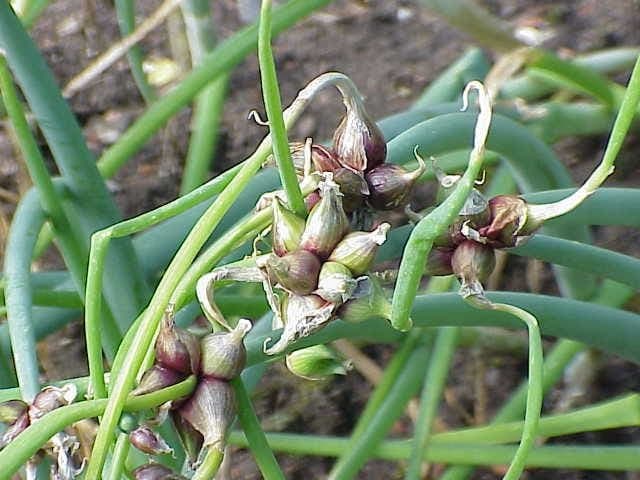
The plant forms clumps of hollow, tubular, blue-green leaves 60 to 90 cm tall. Below ground sit small, elongated bulbs clustered together, rather like shallots. In early summer a sturdy hollow stalk appears, topped by a papery sheath. When that splits, there is no ball of flowers inside but a group of five to twenty bulbils, 1 to 3 cm across and often reddish purple, sometimes with a few small sterile flowers mixed in.
The photo above shows just such a head, with reddish-brown bulbils already sending out new green shoots. That is typical: the bulbils often sprout while still attached to the plant. By late summer the stalks become too heavy, bend over and bring the bulbils into contact with the soil, where they root.
Ideal location
Tree onions want a sunny spot with at least six hours of sun a day. They will grow in partial shade, but then form fewer bulbils. Because the plant stays in the same place for years, it is best grown at the edge of the vegetable plot, in a dedicated bed for perennial crops or in a large container. That way it is never in the way when you dig over or rotate the rest of the garden.
Bear in mind that the tall, hollow stalks can be flattened by wind and heavy rain. A sheltered spot or a few canes and some string will help. If you would rather the plant did not wander, harvest the bulbils before the stalks fall over.
Soil requirements
Like most onions, the tree onion likes a free-draining, fertile soil with a pH between 6 and 7.5. In wet, heavy clay the bulbs rot over winter. On heavy ground, work in some grit and garden compost, or grow it in a slightly raised bed. Improve sandy soil with well-rotted compost so it does not dry out too fast in summer.
In spring, spread a 2 to 3 cm layer of compost around the clumps. Avoid fresh manure, which attracts onion fly and produces soft, disease-prone growth. Plant bulbils from August to October or in March, 2 to 3 cm deep, 15 to 20 cm apart in the row, with 30 cm between rows.
Watering
Once established, tree onions need little attention. In the first year, water during dry spells so the young plants settle in well. After that, extra water is only needed during long dry periods in spring and early summer, when the plant is producing leaves and bulbils. Give one thorough soaking a week rather than a little every day.
In late summer and autumn the soil can be somewhat drier. Wet feet in winter are far more dangerous than a dry month. A mulch of straw or grass clippings keeps the soil cool and moist in summer, but remove it in autumn, because slugs and rot thrive under a soggy layer.
Free preview
Want to see Tree onion: complete guide in your garden? Make a free preview of your design.
Pruning and propagation
Real pruning is not needed. In autumn or early spring, cut away dead and yellowing leaves. After harvesting the bulbils, cut the old stalks back to just above ground level.
Propagation could not be easier. Every bulbil is a new plant: press it a few centimetres into the soil and it will root within weeks. You can also lift and divide the clumps every three to four years in spring or early autumn. Replant the pieces where no onions, leeks or garlic have grown in recent years, to give diseases such as onion rust and white rot no chance.
Harvesting and uses
The tree onion is one of the first vegetables of the year. As early as February or March, while the rest of the plot is still dormant, you can cut the young green leaves and use them like spring onions, or finely snipped as a punchier alternative to chives. Never cut all the leaves at once, so the plant keeps its strength.
In July and August, harvest the bulbils once the papery skin around the head has split and they feel firm. They are sharp, somewhere between shallot and garlic. Peel them and use them raw in salads, braised, fried or pickled in vinegar like cocktail onions. Fresh, they keep for a few months somewhere cool and dry; longer is rare, because they want to sprout. The bulbs below ground can be lifted in autumn or early spring and used like shallots.
A word of caution for pet owners. Like all Allium species, the tree onion is toxic to dogs and cats, and to horses too. Its sulphur compounds damage red blood cells and can cause anaemia, even when the onion has been cooked. Symptoms such as lethargy, pale gums, vomiting and red urine often appear only a few days later. Never give pets leftovers containing onion, and contact your vet if your animal has eaten any. For people, it is simply an edible onion.
Maintenance calendar
February–March: Cut the first green leaves. Spread compost around the clumps. Plant new bulbils.
April–May: Weed and water in dry spells. Watch out for onion fly; insect mesh keeps it off.
June: Stalks with bulbils appear. Support them if they threaten to topple.
July–August: Harvest the bulbils. Replant some straight away for next year.
September–October: Every three to four years, divide and replant the clumps. Clear away dead leaves.
November–January: Dormant period. The plant stays outdoors; no protection is needed.
Winter hardiness
Allium × proliferum is very hardy. It tolerates hard frost well below -20 °C and needs no protection anywhere in the British Isles or the Low Countries. The leaves partly die back in winter, but the bulbs below ground shoot again at the first mild spell. The greatest danger is not cold but water lingering around the bulbs, so free-draining soil matters more than a sheltered spot. In a large container it can also overwinter outdoors, provided the pot has enough drainage holes.
Companion plants
Tree onions do well next to carrots (Daucus carota): the onion scent is said to confuse carrot fly, while the carrots in turn may keep onion fly at bay. Strawberries (Fragaria × ananassa), beetroot (Beta vulgaris) and lettuce also make good neighbours. Chives (Allium schoenoprasum) and Welsh onion (Allium fistulosum) form, together with the tree onion, a perennial onion corner with something to harvest all year.
Keep it away from beans and peas. Onions and legumes hold each other back and grow less well together. Also avoid planting it where onions, leeks or garlic have grown in previous years.
Final thoughts
The tree onion is a vegetable you plant once and then harvest for years. It gives green leaves early in the year and pungent bulbils in summer, and asks for little more than sun and soil that does not stay wet. It is also a great talking point: anyone who sees it for the first time can hardly believe onions grow in mid-air. Just keep pets away from the bulbils and leaves.
Want to know the best time to plant, harvest and divide? The plant calendar on gardenworld.app lines it all up for you, so your tree onions give a full harvest year after year.
Frequently asked questions about Tree onion
Is Tree onion winter hardy?
Allium × proliferum is very hardy. It tolerates hard frost well below -20 °C and needs no protection anywhere in the British Isles or the Low Countries.
When and how do you prune Tree onion?
Real pruning is not needed. In autumn or early spring, cut away dead and yellowing leaves.
How much water does Tree onion need?
Once established, tree onions need little attention. In the first year, water during dry spells so the young plants settle in well.
Where does Tree onion grow best?
Tree onions want a sunny spot with at least six hours of sun a day. They will grow in partial shade, but then form fewer bulbils.
What soil does Tree onion need?
Like most onions, the tree onion likes a free-draining, fertile soil with a pH between 6 and 7.5. In wet, heavy clay the bulbs rot over winter.

See it in your garden
See Tree onion in your garden
One photo of your garden and a few questions. You see the result in about a minute.
Try it with a photoIdentify this plant in your own garden. Identify a plant
Similar plants
Welsh onion: complete guide
Allium fistulosum
Allium fistulosum, or Welsh onion, is a hardy, edible perennial with hollow stems and white flowers. Grows well in full sun, ideal for veg patches and ornamental borders.
Chives: complete guide
Allium schoenoprasum
Allium schoenoprasum, commonly known as chives, is a hardy perennial herb ideal for sunny gardens and containers. Easy to grow and harvest year after year.
Carrot: complete guide
Daucus carota
Learn how to successfully grow Carrot (Daucus carota) in your garden. Tips on sunlight, soil, watering, and companion planting.
