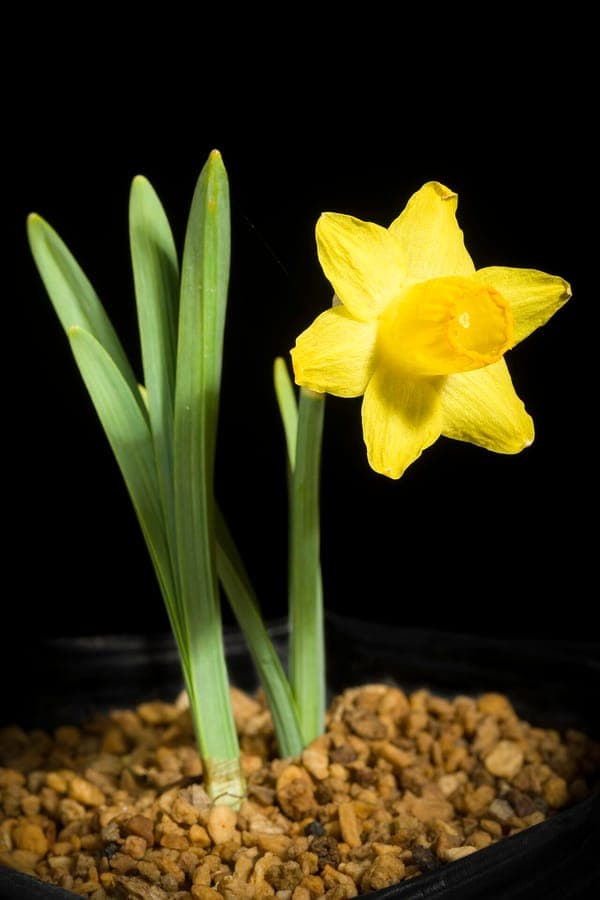
sunoochi from Sapporo, Hokkaido, Japan / CC BY 2.0, via Wikimedia Commons
Lesser daffodil: complete guide
Narcissus minor
Want to see Lesser daffodil: complete guide in your garden?
Full design in HD: €7.99
Look after your Lesser daffodil with the GardenWorld app
Identify plants with your camera and get a care calendar with reminders for this plant.


Overview
Narcissus minor, the lesser daffodil, is a charming early-spring bloomer native to Pyrenean and northern Spanish mountains. This compact, delicate bulb with cheerful yellow flowers is ideal for rock gardens, alpine troughs, border edges, and naturalized woodland plantings. Despite its diminutive stature, it delivers bold early-season color.
Appearance and flowering period
Lesser daffodil reaches merely 15-30 centimeters, making it exceptionally suitable for small gardens and container cultivation. Fine, grass-like foliage emerges in earliest spring. Individual pure yellow flowers feature a small trumpet corona surrounded by larger yellow petals. Each bulb produces one to two flowers. Blooming extends from March through April, depending on location and weather.
Ideal location
Narcissus minor thrives in full sun to light shade. Provide minimum four hours direct sunlight for optimal flowering. The bulb tolerates dry to moderately moist sites equally well. It excels in rock gardens, scree, dry borders, and even naturalized grass meadows. In wilder garden schemes, it creates striking spring accents.
Soil requirements
Lesser daffodil accepts diverse soils from sand to clay. Light, fertile soil suits it well. For maximum bloom, add balanced bulb fertilizer at planting. Drainage is critical: waterlogging causes rot. Slightly acidic to neutral pH (6.5-7.5) is optimal.
Free preview
Want to see Lesser daffodil: complete guide in your garden? Make a free preview of your design.
Watering
After autumn planting, keep soil lightly moist until shoots emerge. During growth (February-April), water if drought occurs. After flowering (May-June), gradually reduce watering to allow bulb ripening. Extended summer dryness is tolerated and actually promotes dormancy.
Pruning
No pruning is necessary. Leave spent flowers on the plant until naturally shed. Do not cut flowering stems until foliage yellows, as nutrients flow back to the bulb. Remove yellowed foliage after natural senescence.
Maintenance calendar
September-October: Plant bulbs. November-January: Minimal care. February: Protect young shoots from hard frosts. March-April: Monitor moisture, water only if very dry. May-June: Allow foliage yellowing; limit watering. July-August: No care required; bulbs dormant.
Winter hardiness
Narcissus minor is fully hardy to USDA zone 3 (-35degC). This alpine/Pyrenean native tolerates cold, snow, and frost without protection. No winter safeguards needed throughout Netherlands and Belgium.
Companion planting
Plant bulbs in clusters of 10-25 for striking visual impact. Combine with fellow early bloomers like Crocus, Chionodoxa, and Hyacinthus. For naturalistic effects, scatter bulbs randomly in grass meadows or rock garden corners. Perennializing bulbs return reliably for years.
Closing
The lesser daffodil delivers refined yellow beauty in earliest spring. With minimal care, it reliably returns year after year. Available at major garden centers. Discover more design inspiration on gardenworld.app.
Frequently asked questions about Lesser daffodil
Is Lesser daffodil winter hardy?
Narcissus minor is fully hardy to USDA zone 3 (-35degC). This alpine/Pyrenean native tolerates cold, snow, and frost without protection.
When and how do you prune Lesser daffodil?
No pruning is necessary. Leave spent flowers on the plant until naturally shed.
How much water does Lesser daffodil need?
After autumn planting, keep soil lightly moist until shoots emerge. During growth (February-April), water if drought occurs.
Where does Lesser daffodil grow best?
Narcissus minor thrives in full sun to light shade. Provide minimum four hours direct sunlight for optimal flowering.
What soil does Lesser daffodil need?
Lesser daffodil accepts diverse soils from sand to clay. Light, fertile soil suits it well.

See it in your garden
See Lesser daffodil in your garden
One photo of your garden and a few questions. You see the result in about a minute.
Try it with a photoIdentify this plant in your own garden. Identify a plant
Similar plants
Agapanthus campanulatus: the hardy bell agapanthus
Agapanthus campanulatus
Agapanthus campanulatus is a deciduous African lily with blue bell-shaped flowers in summer. Learn about position, watering, winter care and good companions.
Agapanthus inapertus: the drooping African lily
Agapanthus inapertus
Agapanthus inapertus is a tall African lily with drooping, barely open tubular flowers in deep blue and violet. A guide to position, watering and winter care.
Tree onion: complete guide
Allium × proliferum
Everything about the tree onion (Allium × proliferum): planting, harvesting bulbils, dividing and overwintering. A perennial onion, toxic to dogs and cats.
