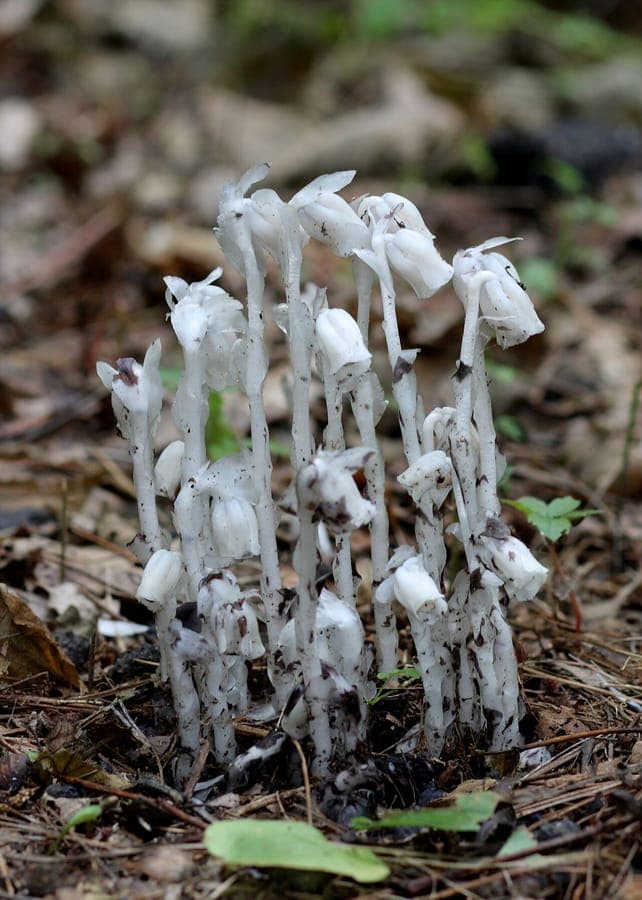
Sage Ross / CC BY-SA 3.0, via Wikimedia Commons
Monotropa uniflora: complete guide
Monotropa uniflora
Want to see Monotropa uniflora: complete guide in your garden?
Full design in HD: €7.99
Look after your Monotropa uniflora with the GardenWorld app
Identify plants with your camera and get a care calendar with reminders for this plant.


Overview
Monotropa uniflora, commonly called Indian Pipe or Ghost Plant, is one of the most unusual plants in North America and Asia. This completely white, non-photosynthetic plant belongs to the Ericaceae family and is an obligate parasite on fungi, occupying a fascinating biological niche in forest food chains. Unlike virtually all other plants, Monotropa uniflora contains no chlorophyll and relies entirely on an underground relationship with fungi and trees.
Growing this plant is practically impossible in traditional garden situations, but understanding its unique biology is valuable for nature enthusiasts and gardeners wanting to know more about ecological relationships. While Monotropa uniflora is not suitable for front yard design on gardenworld.app, its remarkable properties deserve exploration.
Appearance and bloom
Monotropa uniflora is immediately recognizable by its striking whiteness. The entire plant, from roots to flowerheads, is milk-white or cream-colored, with some specimens displaying light pink tinges. The absence of green chlorophyll gives the plant an ethereal look, as if carved from snow.
The plant grows between 15 and 30 centimeters tall with a single, upward-curving stem. The leaf-like structures are actually scale-like, disc-shaped leaves arranged along the stem. At the apex appears a single nodding flower, typically between June and August in the Northern Hemisphere. The small flower requires pollination, though many plants produce viable seeds without effective cross-pollination.
After flowering, a small seed pod matures. Unlike many plant seeds that darken, these remain milky-white, aiding dispersal by wind.
Ideal location
Monotropa uniflora grows in deeply shaded environments, usually beneath the same tree canopy where its underground hosts grow. In North America, it is found in spruce, fir, and larch forests, often in mountainous areas. In Asia, it occupies similar forest habitats.
The plant is indifferent to sunlight availability, since it performs no photosynthesis. However, it prefers specific forest types where particular fungal species exist. Creating such environments in gardens is practically impossible, requiring the simulation of complex underground fungal networks that develop over years.
Soil
The critical factor for Monotropa uniflora growth is not soil composition, but rather the presence of suitable fungi. The plant develops no ordinary roots; instead, it forms tuberous fungal-root structures that surround fungal mycelium, which extracts nutrients from large trees.
The plant thrives in forest soils rich in organic matter, mulch, and established forest floor debris from many years of leaf fall. If you attempt seriously to grow Monotropa uniflora, you would need to try seed cultivation on stony, humus-rich, very acidic soils (pH around 4.0 to 5.0). Even then, success is extremely uncertain.
Free preview
Want to see Monotropa uniflora: complete guide in your garden? Make a free preview of your design.
Watering
Watering Monotropa uniflora would seem strange, since the plant lacks true roots. If you attempt to propagate one, water should be applied regularly, especially for seedling establishment. Keep growing media moister than you would expect for dry forest plants.
Watering established wild plants is somewhat a non-factor; they absorb water via their fungal associations. In places where they grow naturally, they function best with consistent forest floor moisture, neither dry nor waterlogged.
Pruning
Monotropa uniflora requires no pruning. In fact, any manipulation of the plant would likely kill it. Fortunately, its limited vegetative mass makes pruning irrelevant anyway.
If you ever find a wild Monotropa uniflora plant, I recommend looking and leaving it untouched. This protects both the plant and its delicate fungal association.
Maintenance calendar
January: Not applicable - plant is underground.
May: Young shoots may begin breaking through.
July: Bloom peak. Observation only, no maintenance.
August: Seed development appears.
September to December: Plant returns underground; soil organics accumulate.
Winter hardiness
Monotropa uniflora is extremely hardy, withstanding the harshest winters of North America and Asia. This is a non-issue, since it lives underground in forest habitats protected by snow cover and forest soil insulation.
Companion plants
In wild forest environments where Monotropa uniflora grows, many shade-loving plants inhabit the vicinity:
- Trillium species for larger red flowers
- Hepatica for early-spring blue blooms
- Oxalis oregana for quilted ground cover
- Maianthemum dilatatum for small white flowers
Gardenworld.app cannot truly help with Monotropa uniflora integration, since the plant will almost certainly fail in cultivation.
Closing
Monotropa uniflora represents the wonders of forest ecology and underground fungal symbiosis. While this plant is unsuitable for typical garden use, its existence commands admiration as an ecological marvel. If you are an avid forest visitor and encounter this rare plant, observe it at a distance: gaze upon its mysterious white flowers and wonder at the underground networks sustaining its life. For more conventional garden designs, visit gardenworld.app and discover shade-loving plants that actually thrive in front yard situations.
Frequently asked questions about Monotropa uniflora
Is Monotropa uniflora winter hardy?
Monotropa uniflora is extremely hardy, withstanding the harshest winters of North America and Asia. This is a non-issue, since it lives underground in forest habitats protected by snow cover and forest soil insulation.
When and how do you prune Monotropa uniflora?
Monotropa uniflora requires no pruning. In fact, any manipulation of the plant would likely kill it.
How much water does Monotropa uniflora need?
Watering Monotropa uniflora would seem strange, since the plant lacks true roots. If you attempt to propagate one, water should be applied regularly, especially for seedling establishment.
Where does Monotropa uniflora grow best?
Monotropa uniflora grows in deeply shaded environments, usually beneath the same tree canopy where its underground hosts grow. In North America, it is found in spruce, fir, and larch forests, often in mountainous areas.
What soil does Monotropa uniflora need?
The critical factor for Monotropa uniflora growth is not soil composition, but rather the presence of suitable fungi. The plant develops no ordinary roots; instead, it forms tuberous fungal-root structures that surround fungal mycelium, which extracts nutrients from large trees.

See it in your garden
See Monotropa uniflora in your garden
One photo of your garden and a few questions. You see the result in about a minute.
Try it with a photoIdentify this plant in your own garden. Identify a plant
Similar plants
Redvein enkianthus (Enkianthus campanulatus): complete guide
Enkianthus campanulatus
Redvein enkianthus (Enkianthus campanulatus): shrub for acid soil with hanging cream bells in May and fiery autumn colour. Site, soil, pruning, hardiness and companions.
Darley Dale Heath: complete guide
Erica × darleyensis
Everything about Darley Dale heath (Erica × darleyensis): planting, position, soil, pruning and care. Months of winter flowers in pots and borders.
Prickly heath (Gaultheria mucronata): growing guide
Gaultheria mucronata
Prickly heath (Gaultheria mucronata, formerly Pernettya) carries white, pink or red berries from autumn to spring. Dioecious and toxic: how to grow it well.
