KENPEI / CC BY-SA 3.0, via Wikimedia Commons
Redvein enkianthus (Enkianthus campanulatus): complete guide
Enkianthus campanulatus
Want to see Redvein enkianthus (Enkianthus campanulatus): complete guide in your garden?
Full design in HD: €7.99
Look after your Redvein enkianthus with the GardenWorld app
Identify plants with your camera and get a care calendar with reminders for this plant.


Overview
Redvein enkianthus (Enkianthus campanulatus) is a shrub that steals the show twice a year. In May its branches are hung with clusters of small, creamy-yellow bells finely veined in red, and in October the leaves blaze orange, scarlet and gold. In between it is a graceful, understated shrub with a distinctive tiered structure. Its common name comes from those red veins in the flowers.
The species is native to Japan, where it grows in mountain woodland and along forest edges on acidic, humus-rich soil. It belongs to the heather family (Ericaceae), alongside rhododendrons, pieris and blueberries, and shares their need for lime-free ground. In gardens it forms a deciduous shrub 2 to 4 m tall and 1.5 to 3 m wide. Growth is slow, so it stays compact for many years and suits smaller gardens too.
If you already grow rhododendrons, azaleas or Japanese maples, Enkianthus campanulatus is an ideal addition. It brings more delicate flowers and far stronger autumn colour than most evergreen members of the heather family.
Appearance and bloom cycle
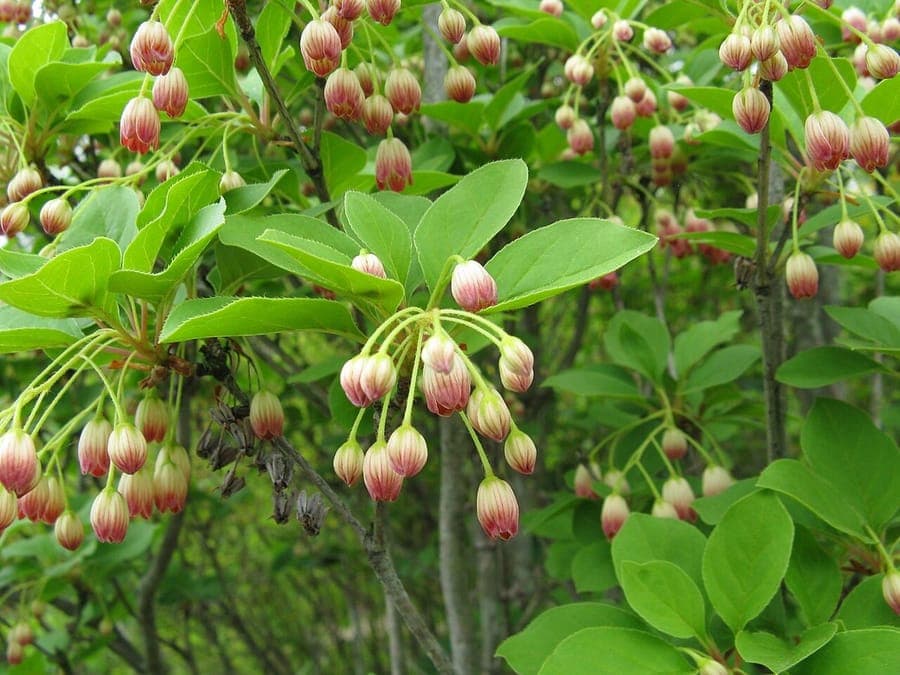
Flowering comes in May, occasionally in late April. Hanging clusters of 5 to 15 bell-shaped flowers, each about 1 cm long, appear at the tips of the shoots. They are creamy white to pale yellow, with red to pink veins and a pinkish-red rim. The photograph shows how they dangle in groups on slender, curved stalks beneath the fresh green leaves. The individual flowers are small, but a mature shrub carries hundreds, so the effect is both delicate and generous. Bumblebees and bees visit them eagerly.
The leaves are elliptical, 3 to 7 cm long, finely toothed and arranged in whorls at the ends of the shoots. The branches themselves are carried in tiers, giving the shrub an elegant, pagoda-like silhouette in winter. Autumn brings the highlight: the foliage turns from yellow and orange to deep scarlet, often with several shades on the same plant at once. Colour is strongest in a sunny position.
Several fine selections are available. 'Red Bells' has slightly deeper-coloured flowers and stays more compact. Var. palibinii has entirely dark red flowers, while 'Albiflorus' bears pure creamy-white bells.
Little is known for certain about its toxicity. Related members of the heather family, such as rhododendron, pieris and leucothoe, contain grayanotoxins and are poisonous to people and pets. It is sensible to treat Enkianthus with the same caution and keep children and animals from eating any part of it.
Ideal location
Enkianthus campanulatus grows well in partial shade to sun, provided the soil stays moist. Morning sun with light afternoon shade is ideal, giving plentiful flowers and intense autumn colour. In deep shade the leaves stay green in autumn and flowering is sparser. In full sun on dry soil the foliage scorches in summer.
A sheltered spot away from cold, drying easterly winds protects the young shoots and flower buds from late spring frosts. Plant it where its autumn colour can be appreciated, for instance against a dark backdrop of conifers or evergreen shrubs, or where the low autumn sun shines through the leaves.
Soil requirements
Acidic soil is essential. The ideal pH is between 4.5 and 6. On alkaline ground the leaves turn yellow through iron deficiency and the plant gradually declines. If your soil is neutral or slightly chalky, plant it in a generous hole filled with ericaceous compost, or grow it in a raised bed or large container of ericaceous compost.
The soil should also be rich in humus, moisture-retentive and well drained. Like rhododendrons, Enkianthus has a shallow, fibrous root system. Avoid digging beneath the shrub and keep the root zone cool with a 5 cm mulch of leaf mould, pine needles or chipped bark. In April, give a small feed of fertiliser for acid-loving plants.
Free preview
Want to see Redvein enkianthus (Enkianthus campanulatus): complete guide in your garden? Make a free preview of your design.
Watering
Its shallow roots make Enkianthus sensitive to drought. During the first year, give 10 litres a week in dry spells. Later on, you will still need to help out in dry summers, as the soil should never dry out completely. Use rainwater, because hard tap water gradually raises the pH around the roots.
Drought in late summer causes a double problem. The leaves drop early without colouring well, and next year's flower buds develop poorly. Pay extra attention to watering in August and September. The plant does not like waterlogging either, so ensure good drainage on heavy soil.
Pruning
Enkianthus campanulatus needs hardly any pruning. Its natural, layered shape is one of its greatest assets. Simply remove dead, damaged or crossing wood straight after flowering, in June.
If an old shrub has become too large or bare at the base, remove one of the oldest branches low down each year over several years. The plant responds slowly to pruning, so rejuvenate it gradually and never all at once. Do not prune in autumn or winter, as you would remove the flower buds already waiting at the shoot tips.
Maintenance calendar
January–February: Dormant season. Enjoy the tiered silhouette of the bare branches.
March: Renew the mulch. Plant new shrubs as soon as the ground is no longer frozen.
April: Give a light feed for acid-loving plants. If night frost threatens emerging buds, protect young plants with fleece.
May: Full flowering of the hanging bells.
June: Light pruning straight after flowering, if needed.
July–September: Water with rainwater in dry spells. Next year's buds are forming.
October–November: Autumn colour. Also a good time for planting. Leave fallen leaves in place as mulch.
December: Nothing to do except admire its winter outline.
Use the plant calendar on gardenworld.app as a reminder: it shows each month which jobs are due in your garden.
Winter hardiness
Enkianthus campanulatus is fully hardy. Established plants tolerate frost down to about -25 °C (roughly USDA zone 5) and need no winter protection anywhere in the UK or the Low Countries. It also grows without difficulty in colder parts of central Europe.
The only real risk is late frost in April, when the young leaves and flower buds are emerging. A sheltered position limits the damage, and fleece over young plants helps on a cold night. Container plants are more vulnerable because their roots freeze more easily. Stand pots against the house wall in winter and wrap them in hessian or bubble wrap.
Companion plants
Enkianthus campanulatus belongs in a garden with other acid-loving plants. Japanese maple (Acer palmatum) shares its refined Japanese character and adds a second layer of autumn colour. The yellow azalea (Rhododendron luteum) flowers at the same time, is deliciously scented and also turns orange and red in autumn. Pieris japonica and mountain laurel (Kalmia latifolia) provide evergreen structure so the border does not look bare in winter.
For a slightly taller backdrop, the Japanese dogwood (Cornus kousa) offers white bracts in June and good autumn colour too. Beneath the shrub, ferns and shade-tolerant ground cover are ideal, as long as they do not compete with the shallow roots.
Final thoughts
Enkianthus campanulatus is one of the most underrated shrubs for acidic soil. It is hardy, compact and needs little pruning, yet gives two highlights a year: delicate bell-shaped flowers in May and autumn colour that rivals the finest maples. Acidic, moist soil is the only real requirement.
Do you have that kind of soil and are you looking for a characterful member of the heather family? On gardenworld.app you can have a garden design created that places Enkianthus campanulatus alongside maples, azaleas and pieris, tailored to your soil and light. That way your garden will flower and glow from spring until late autumn.
Frequently asked questions about Redvein enkianthus
Is Redvein enkianthus winter hardy?
Enkianthus campanulatus is fully hardy. Established plants tolerate frost down to about -25 °C (roughly USDA zone 5) and need no winter protection anywhere in the UK or the Low Countries.
When and how do you prune Redvein enkianthus?
Enkianthus campanulatus needs hardly any pruning. Its natural, layered shape is one of its greatest assets.
How much water does Redvein enkianthus need?
Its shallow roots make Enkianthus sensitive to drought. During the first year, give 10 litres a week in dry spells.
Where does Redvein enkianthus grow best?
Enkianthus campanulatus grows well in partial shade to sun, provided the soil stays moist. Morning sun with light afternoon shade is ideal, giving plentiful flowers and intense autumn colour.
What soil does Redvein enkianthus need?
Acidic soil is essential. The ideal pH is between 4.5 and 6.

See it in your garden
See Redvein enkianthus in your garden
One photo of your garden and a few questions. You see the result in about a minute.
Try it with a photoIdentify this plant in your own garden. Identify a plant
Similar plants
Japanese Maple: complete guide
Acer palmatum
Everything about Japanese Maple (Acer palmatum): planting, pruning, cultivars and autumn colour. Expert tips for a spectacular ornamental tree in your garden.
Yellow azalea: complete guide
Rhododendron luteum
Grow Rhododendron luteum successfully: ideal location, soil needs, watering, pruning. Perfect for woodland gardens in USDA zones 5–8.
Japanese pieris: complete guide
Pieris japonica
Complete care guide for Japanese pieris (Pieris japonica): ideal location, soil, watering, pruning and companion plants. Perfect for shaded, acidic gardens.
