
Chrumps / CC BY 3.0, via Wikimedia Commons
Yellow azalea: complete guide
Rhododendron luteum
Want to see Yellow azalea: complete guide in your garden?
1 minute, no credit card
Overview
Rhododendron luteum, commonly known as yellow azalea, is a deciduous shrub that brings bold colour and rich fragrance to gardens every late spring. Native to regions like the North Caucasus, Turkey, and Ukraine, it thrives in cool, temperate climates and is especially suited to woodland-style gardens. Unlike many evergreen rhododendrons, this species drops its leaves in autumn, but not before putting on a fiery display of fall colour. Part of the Ericaceae family, it shares cultural needs with blueberries, heathers, and mountain laurel.
With gardenworld.app, you can design a shaded garden layout that highlights the seasonal rhythm of yellow azalea, from bloom to fall foliage.
Appearance & bloom cycle
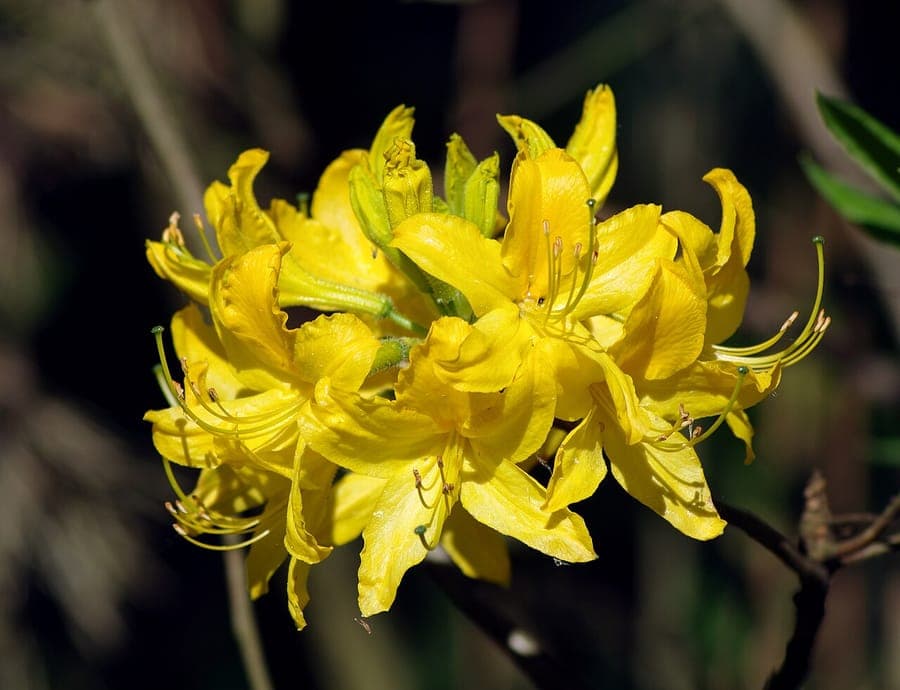
Mature plants reach 5–6.5 feet (1.5–2 m) tall and 4–6 feet (1.2–1.8 m) wide, growing at a rate of about 4–6 inches (10–15 cm) per year. The bloom period runs from late May to early June, when clusters of bright golden-yellow, funnel-shaped flowers cover the tips of branches. Each bloom is about 1.5 inches (4 cm) across and emits a strong, sweet, honey-like fragrance - most intense in the afternoon sun. Unlike some azaleas, R. luteum flowers are typically spot-free.
These blossoms are a magnet for pollinators, especially bees and bumblebees. After flowering, seed capsules form, but propagation is usually done via cuttings or layering for consistency. The leaves are lance-shaped, 2–4 inches (5–10 cm) long, and turn a brilliant mix of yellow, orange, and red in autumn (starting mid-September), making this one of the most colourful deciduous azaleas.
Ideal location
This azalea prefers partial to full shade, especially protection from hot afternoon sun. An east- or north-facing spot is ideal. It grows best under light-canopy deciduous trees like birch, beech, or oak, where it benefits from dappled shade and leaf litter. Avoid planting near conifers - their root competition and acidic needle drop can dry out the soil too much.
Wind exposure should also be minimized, as it can desiccate the shallow root system. On gardenworld.app, you can simulate light patterns in your yard to find the perfect microclimate for your azalea.
Soil requirements
Like all ericaceous plants, yellow azalea demands acidic soil with a pH between 4.5 and 5.5. The soil must be well-drained yet moisture-retentive, rich in organic matter. If your soil is alkaline or clay-heavy, create a raised bed filled with ericaceous compost or peat-free acid mix. Incorporate pine bark fines or leaf mold to improve structure.
Never use lime, wood ash, or alkaline fertilizers. Tap water high in calcium can raise pH over time - use rainwater when possible.
Free design
Want to see Yellow azalea: complete guide in your garden? Make a free design now.
Watering
The shallow roots dry out quickly, so consistent moisture is critical - especially during the first two growing seasons and in dry summers. Water deeply twice a week during droughts, aiming for 1 inch (2.5 cm) per week. Avoid overhead watering; instead, apply water at the base to prevent fungal issues.
Mulch with 2–3 inches (5–7 cm) of pine needles, oak leaves, or wood chips to conserve moisture and keep roots cool. Replenish mulch annually in spring.
Pruning
Pruning is rarely needed, but if shaping is required, do it immediately after flowering - no later than late June. This prevents cutting off next year's flower buds, which form in summer. Use sharp bypass pruners to cut back long or leggy stems. Never use hedge trimmers; they damage the soft wood and leave ragged wounds.
Remove any dead or crossing branches at any time to improve airflow.
Maintenance calendar
- Jan–Feb: Check for winter damage. Protect young plants with burlap in harsh zones.
- Mar: Begin feeding with slow-release ericaceous fertilizer when soil warms to 45°F (7°C).
- Apr: Keep soil moist. Hand-pull weeds gently to avoid root disturbance.
- May: Bloom begins. Avoid pruning. Water during dry spells.
- Jun: Bloom ends. Prune now if needed. Apply fresh mulch.
- Jul–Aug: Maintain consistent moisture. Watch for lace bugs or powdery mildew.
- Sep: Fall colour develops. Stop fertilizing by mid-month.
- Oct: Add winter mulch. Inspect for pests.
- Nov–Dec: No action needed in mild winters. In zone 5, ensure mulch is in place.
Winter hardiness
Yellow azalea is hardy in USDA zones 5 to 8 (-20°F to 20°F / -29°C to -7°C). In zone 5, young plants may suffer from freeze-thaw cycles that heave roots. Apply a thick mulch layer after the ground cools to stabilize soil temperature. Avoid late-season fertilizing, which encourages tender growth vulnerable to frost.
Companion plants
Pair with other acid-loving, shade-tolerant plants: mountain laurel (Kalmia latifolia), foamflower (Tiarella cordifolia), native ferns like Dryopteris marginalis, and woodland phlox (Phlox divaricata). Avoid lavender, Russian sage, or other alkaline-tolerant species.
Closing
Rhododendron luteum is a standout for gardeners who value fragrance, seasonal drama, and low upkeep. With the right conditions, it becomes a long-lived centerpiece in naturalistic plantings. Purchase from trusted garden centres during bloom season (May–June) to see the flower colour firsthand. Look for healthy root balls - moist, not dry or circling. With a little care, this azalea will deliver year after year of golden blooms and fiery foliage. Plan your layout with gardenworld.app to ensure it shines in your garden's ecosystem.
Want to see Yellow azalea: complete guide in your garden? Make a free design now.
Upload a photo, pick a style, and get a photorealistic design with plant list in under a minute.
No credit card required


Similar plants
Zenobia pulverulenta: complete guide
Zenobia pulverulenta
Everything about Zenobia pulverulenta (honeycup): siting, acid soil, pruning and the fragrant white bells, in this complete care guide.
Dwarf huckleberry: complete guide
Gaylussacia dumosa
Everything about dwarf huckleberry (Gaylussacia dumosa): acidic soil, partial shade, pruning and care for this compact North American berry shrub.
Drooping leucothoe: complete guide
Leucothoe fontanesiana
Everything about drooping leucothoe (Leucothoe fontanesiana): shade tolerance, soil, watering, pruning, hardiness and companion plants.