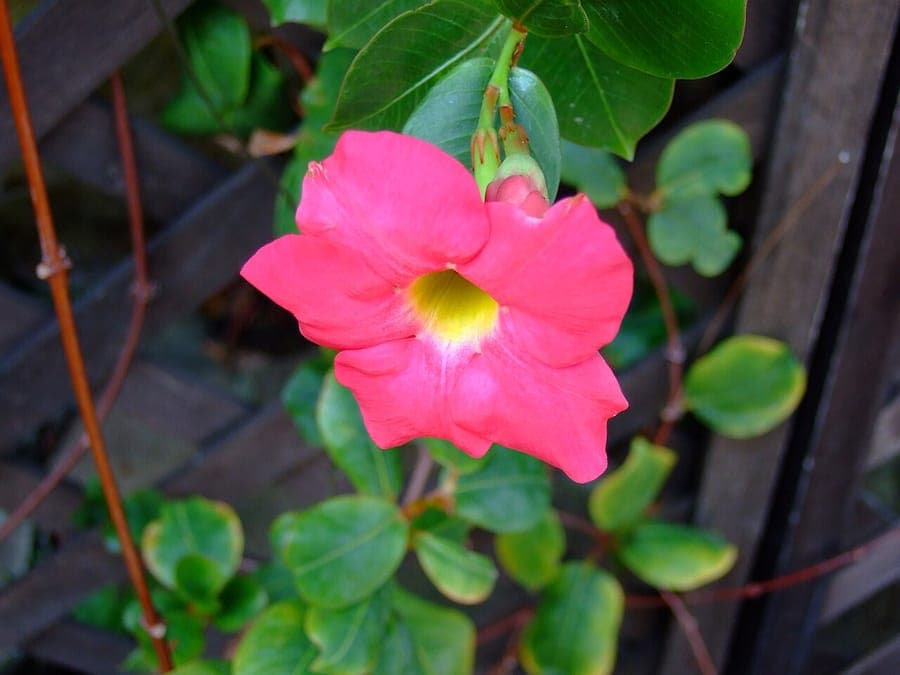
日:Jnn / CC BY 2.1 jp, via Wikimedia Commons
Mandevilla sanderi: complete guide to dipladenia, Brazilian jasmine vine
Mandevilla sanderi
Want to see Mandevilla sanderi: complete guide to dipladenia, Brazilian jasmine vine in your garden?
Full design in HD: €7.99
Look after your Mandevilla sanderi with the GardenWorld app
Identify plants with your camera and get a care calendar with reminders for this plant.


Overview
Mandevilla sanderi, also known as Dipladenia or Brazilian jasmine, is a spectacular flowering vine native to Brazil. This plant is prized for its stunning pink or red flowers and glossy green foliage. It is popular as a container plant, vine, and indoor specimen due to its long flowering period.
This plant produces large, trumpet-shaped flowers up to 5 cm across. The flowers appear in clusters and bloom continuously from summer through fall.
Appearance and bloom
Mandevilla sanderi grows as a climbing vine but can be trained as a shrub. The plant can reach 2-4 meters in height when supported. The leaves are glossy, elliptical, and deep green.
The flowers are the highlight of this plant. They are large, approximately 4-5 cm across, trumpet-shaped, and typically pink to red in color. Some selections are white or bicolor. Flowers appear in clusters at branch tips.
Blooming begins in May-June and continues through October or after the first frost. This makes it an exceptionally long-blooming plant.
Ideal location
Mandevilla sanderi grows best in full sun to partial shade. The plant produces more flowers with more sun, so 6-8 hours of direct sunlight is ideal. In very hot climates, light afternoon shade may be beneficial.
Indoors, the plant can grow in bright windows, though supplemental grow lights help. Outdoors, it can be trained on trellises, pergolas, or against walls.
Good air circulation is important, though avoid harsh winds.
Soil
Mandevilla sanderi grows best in fertile, well-draining potting soil. Use a mix of garden soil, perlite, and humus. For containers, use premium potting mix with extra organic matter.
The plant prefers slightly acidic soil (pH 6.0-7.0). Add compost for better moisture retention and nutrients.
Excellent drainage is essential; avoid heavy, waterlogged soils.
Free preview
Want to see Mandevilla sanderi: complete guide to dipladenia, Brazilian jasmine vine in your garden? Make a free preview of your design.
Watering
Mandevilla sanderi is moisture-loving and requires regular watering during the growing season. Water so the soil remains moist but not waterlogged. During summer, water more frequently.
Allow the top 1-2 cm of soil to dry between waterings. In containers, water more frequently than in-ground plants.
Reduce watering in fall and winter. Avoid leaving water on leaves for extended periods.
Pruning
Mandevilla sanderi should be pruned regularly for a full shape. Cut back branch tips in early spring to encourage lateral growth.
Remove dead or diseased wood. After flowering, long branches can be shortened to maintain shape.
The plant responds well to aggressive pruning and will regrow with more branches.
Maintenance calendar
March-April: Spring pruning, resume growth. May-June: Blooming begins, regular watering. July-August: Peak blooming, frequent watering and feeding. September-October: Continued blooming, reduce watering. November-February: Winter rest, minimal watering.
Winter hardiness
Mandevilla sanderi is frost-sensitive. The plant dies back at temperatures below 10 C. In warm climates (zone 10+), it can overwinter outdoors. In cooler regions, it must be brought indoors.
Container-grown plants can easily be moved indoors. Allow the plant to rest with minimal watering and light cooling (10-15 C).
Companion plants
Mandevilla sanderi works well with other summer bloomers. Combine with Ipomoea (morning glory), Passiflora (passion flower), or Clematis in a garden.
In containers, pair with white Euphorbia, Petunia, or Bacopa for color contrast. Silvery-gray plants like Senecio cineraria also work well.
Closing remarks
Mandevilla sanderi is a beautiful choice for anyone wanting long, spectacular blooming. With sufficient sun, water, and support, this plant thrives and flowers abundantly. The pink blooms and glossy foliage make it a true showstopper.
This plant is available at garden centers across North America and Europe. For more information, visit gardenworld.app.
Frequently asked questions about Mandevilla sanderi
Is Mandevilla sanderi winter hardy?
Mandevilla sanderi is frost-sensitive. The plant dies back at temperatures below 10 C.
When and how do you prune Mandevilla sanderi?
Mandevilla sanderi should be pruned regularly for a full shape. Cut back branch tips in early spring to encourage lateral growth.
How much water does Mandevilla sanderi need?
Mandevilla sanderi is moisture-loving and requires regular watering during the growing season. Water so the soil remains moist but not waterlogged.
Where does Mandevilla sanderi grow best?
Mandevilla sanderi grows best in full sun to partial shade. The plant produces more flowers with more sun, so 6-8 hours of direct sunlight is ideal.
What soil does Mandevilla sanderi need?
Mandevilla sanderi grows best in fertile, well-draining potting soil. Use a mix of garden soil, perlite, and humus.

See it in your garden
See Mandevilla sanderi in your garden
One photo of your garden and a few questions. You see the result in about a minute.
Try it with a photoIdentify this plant in your own garden. Identify a plant
Similar plants
Arkansas bluestar: complete guide
Amsonia hubrichtii
Everything about Arkansas bluestar (Amsonia hubrichtii): position, soil, watering, cutting back and hardiness. A prairie perennial with pale blue stars and golden autumn colour.
String of hearts (Ceropegia woodii): care guide
Ceropegia woodii
How to grow string of hearts (Ceropegia woodii): light, watering, potting mix, propagating from tubers, winter care and whether it is safe for cats and dogs.
Wax plant (Hoya carnosa): complete guide
Hoya carnosa
Everything about the wax plant (Hoya carnosa): light, watering, flowering spurs, a cool winter rest, cuttings and toxicity. Not toxic to cats and dogs.
