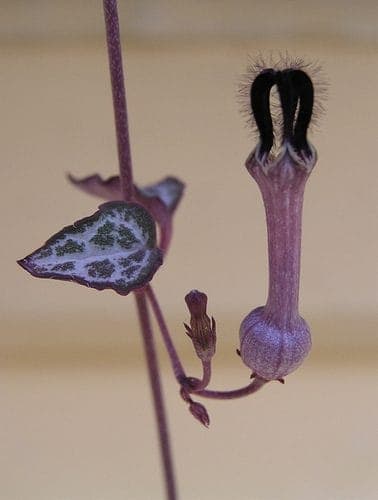
Photo: Dr. David Midgley / CC BY-SA 2.5, via Wikimedia Commons
String of hearts (Ceropegia woodii): care guide
Ceropegia woodii
Want to see String of hearts (Ceropegia woodii): care guide in your garden?
Full design in HD: €7.99
Look after your String of hearts with the GardenWorld app
Identify plants with your camera and get a care calendar with reminders for this plant.


Overview
String of hearts (Ceropegia woodii) is one of the most graceful trailing houseplants you can grow. Fine, wiry stems spill over the edge of the pot and carry pairs of small heart-shaped leaves marbled in silver and grey-green. It is also sold as rosary vine or chain of hearts, and on a high shelf it forms a soft curtain that moves gently with every draught.
The botany has shifted a little in recent years. Many botanists now treat the plant as a subspecies of a close relative and write Ceropegia linearis subsp. woodii, but nurseries and garden centres almost always label it Ceropegia woodii. Both names refer to the same plant. It belongs to the dogbane family (Apocynaceae), which now also absorbs the old milkweed family where it used to sit.
In the wild it grows in southern Africa, from South Africa to Zimbabwe, scrambling over rocks and through shrubs in a climate of warm, wet summers and a pronounced dry season. That background explains most of its behaviour indoors. It stores water in its slightly fleshy leaves and in tubers, copes with drought far better than with wet roots, and loves bright light. If you plan to move houseplants onto a balcony or into a conservatory for the summer, you can have a garden design made on gardenworld.app to work out which spots suit which plants.
Appearance and bloom cycle
The stems are thin, purplish to greyish brown and can reach 2 to 3 m in a few years, although most growers keep them shorter. Each leaf is 1 to 2 cm long, slightly succulent and heart-shaped. The upper surface is dark green with silvery patterning, the underside a purple-red. The more light the plant receives, the stronger that purple tone becomes and the closer together the pairs of leaves sit.
At the base the plant forms a woody tuber, and over time small round tubers also appear along the stems where the leaves join. These are perfectly normal storage organs and make propagation remarkably easy.
Flowers appear mainly from late summer into autumn, though a plant in good light can produce the odd bloom at almost any time of year. Each flower is 2 to 3 cm long: a swollen pink to lilac base, a narrow tube and, at the top, five dark, hairy lobes that stay joined at their tips to form a little cage. In the wild this is a trap for tiny flies, which are held briefly inside and leave carrying pollen. Indoors pollination rarely happens, so seed pods are uncommon. The flowers have no noticeable scent.
Ideal location
Give string of hearts as much light as you can without the full force of summer midday sun through glass. An east- or west-facing windowsill is ideal; a south-facing window works if there is a sheer curtain or the plant stands half a metre back from the pane. In poor light the stems stretch, the gaps between leaves lengthen and the silver marbling largely disappears.
Because the stems hang down, place the plant high: in a hanging pot, on a bookcase or on a plant stand. Keep long trails clear of doors and opening windows. From May to September it can go outdoors in a sheltered spot with light shade, for instance under a canopy or on a covered balcony. Bring it in before night temperatures drop below 10 °C.
Potting mix
Use a light, free-draining mix. Cactus and succulent compost works well, or blend ordinary houseplant compost with about a third perlite or fine grit. A pot with a drainage hole is essential, and terracotta is a sensible choice because it lets the mix dry out more quickly. Choose a pot on the small side: the tubers and roots need little room, and a large volume of compost stays wet for too long.
Repotting is only needed every two or three years, in spring. Keep the main tuber at the same depth as before; a tuber buried deep in damp compost is far more likely to rot.
Free preview
Want to see String of hearts (Ceropegia woodii): care guide in your garden? Make a free preview of your design.
Watering
This is where most problems start. String of hearts is a succulent and tolerates dry spells easily, but it hates standing water. During the growing season, from April to September, water only when the mix is almost completely dry, which usually means every ten to fourteen days. Then water thoroughly and let the excess drain away. Never leave the pot sitting in a saucer of water.
In winter growth slows right down. Water much less, roughly every three to four weeks, just enough to stop the leaves shrivelling. Thin, wrinkled leaves mean the plant is thirsty. Yellow, glassy leaves and soft stems near the base point to overwatering. Feed from April to August once a month with half-strength liquid cactus fertiliser; too much feed produces long, weak growth.
Pruning and propagation
Pruning is not essential, but you can trim at any time. If the plant becomes leggy or bare on top, cut back a few stems in spring; it often branches more freely near the pot afterwards, and the cuttings give you new plants.
There are three easy ways to propagate. Lay a stem with tubers on a small pot of moist, gritty compost, press the tubers in lightly and leave the stem attached to the parent plant; after a few weeks they root and you can snip the link. Alternatively, cut a 10 cm length of stem with at least two pairs of leaves and stand it in water or barely moist compost. Or simply pick off the tubers and set them half into the compost. Put several cuttings in one pot for a fuller plant more quickly. April to August gives the best results.
Maintenance calendar
- January and February: keep cool, bright and on the dry side. No feeding.
- March: gradually increase watering once you see fresh growth.
- April: repot if needed, trim and take cuttings. Start feeding.
- May: move outdoors to a sheltered, lightly shaded position if you wish.
- June to August: water when dry, feed monthly, take more cuttings.
- September: bring indoors before cold nights and check for mealybug.
- October to December: water sparingly, no feeding after August, give the plant the brightest spot you have.
The plant calendar on gardenworld.app lets you keep track of tasks like these month by month, so repotting or bringing plants back inside never slips your mind.
Temperature and overwintering
String of hearts is not a garden plant and will not survive frost. Ordinary room temperatures of 18 to 24 °C suit it during the growing season. In winter it is happy a little cooler, between 12 and 16 °C, and that cooler, drier rest encourages flowering the following year. Below roughly 10 °C it starts to suffer, especially if the compost is wet.
Avoid placing it directly above a radiator in winter. Hot, dry air makes the leaves thin and attracts spider mite and mealybug. A cool bedroom window or a bright, frost-free porch often works better. Mealybugs show up as white fluff in the leaf joints; dab them off with a cotton bud dipped in surgical spirit.
Toxicity to pets
Good news for cat and dog owners: Ceropegia woodii is listed by the ASPCA as non-toxic to cats, dogs and horses, which makes it one of the better trailing plants for a home with animals. That does not make it a toy. Cats love batting at long, swaying strands, and eating a large amount of any plant can upset the stomach. Hang it out of reach, if only to protect the plant.
No toxicity to people is known either, though it is sensible to keep small children away from the tubers, as with any houseplant.
Companion plants
String of hearts looks lovely alongside other plants with a trailing or delicate habit. Burro's tail (Sedum morganianum) shares its needs for bright light and little water. Inch plant (Tradescantia zebrina) gives a striking colour contrast in a row of hanging pots, though it likes a little more water. Chinese money plant (Pilea peperomioides) and spider plant (Chlorophytum comosum) are tough, easy companions for the same bright windowsill. Avoid sharing a pot with plants that want constantly damp roots, such as ferns, as their watering regime is too much for the tubers.
Final thoughts
Ceropegia woodii gives a great deal for very little effort: a delicate cascade of marbled hearts, curious lantern flowers and tubers that turn into new plants for friends with almost no work. Give it light, a gritty mix and let the pot dry out between waterings, and it will keep growing fuller year after year.
Frequently asked questions about String of hearts
When and how do you prune String of hearts?
Pruning is not essential, but you can trim at any time. If the plant becomes leggy or bare on top, cut back a few stems in spring; it often branches more freely near the pot afterwards, and the cuttings give you new plants.
How much water does String of hearts need?
This is where most problems start. String of hearts is a succulent and tolerates dry spells easily, but it hates standing water.
Where does String of hearts grow best?
Give string of hearts as much light as you can without the full force of summer midday sun through glass. An east- or west-facing windowsill is ideal; a south-facing window works if there is a sheer curtain or the plant stands half a metre back from the pane.

See it in your garden
See String of hearts in your garden
One photo of your garden and a few questions. You see the result in about a minute.
Try it with a photoIdentify this plant in your own garden. Identify a plant
Similar plants
Sedum morganianum: complete guide
Sedum morganianum
Burro's-tail succulent from Mexico: elegant trailing plant with watery-green, bead-like foliage. Perfect for hanging baskets and living walls.
Tradescantia zebrina (Inchplant): complete guide
Tradescantia zebrina
Master Inchplant cultivation: colors, growth habits and stunning displays. Complete care guide for this tropical beauty.
Chinese Money Plant: complete guide
Pilea peperomioides
Chinese Money Plant (Pilea peperomioides) is a trendy houseplant from China featuring distinctive round, mint-green leaves. This Instagram-famous plant has become a favorite for modern homes with its elegant appearance and easy-care nature.
