
Morningdew51 at English Wikipedia / CC BY-SA 3.0, via Wikimedia Commons
Sedum morganianum: complete guide
Sedum morganianum
Want to see Sedum morganianum: complete guide in your garden?
1 minute, no credit card
Overview
Sedum morganianum, commonly called burro's-tail or donkey's-tail, is a spectacular trailing succulent from Mexico. This plant is renowned for its long, graceful stems lined with plump, watery-green leaves resembling tiny beads on a string. The elegant cascading form makes it ideal for hanging baskets, window ledges, and interior displays, where it adds movement and visual interest.
Native to the wet rocky hillsides of Veracruz, Puebla, and Chiapas in Mexico, Sedum morganianum thrives in humid, dappled-light environments. Unlike its drier-habitat cousins, this species appreciates consistent moisture and higher humidity. Mature plants produce straggling stems up to 60 cm long.
Appearance & Bloom
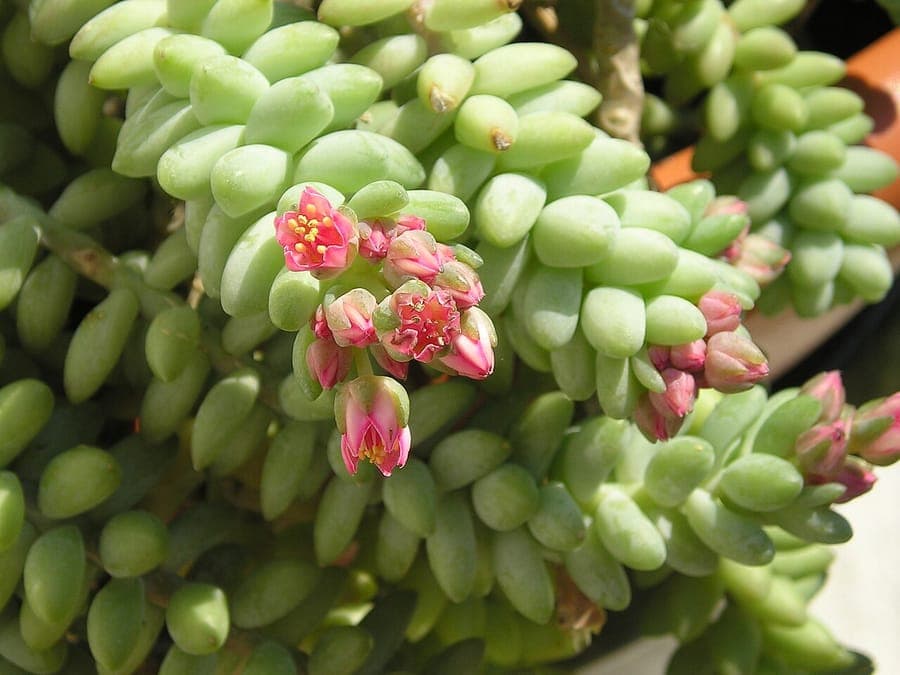
The leaves of Sedum morganianum are its defining feature: densely packed in perfect rows along thin, trailing stems, naturally pale green to blue-green. Each leaf is roughly 0.5-1 cm long and symmetrically arranged, creating the appearance of a refined beaded necklace.
Under optimal light, leaf tips may blush pink, particularly at the stem bases. The plant grows vigorously, producing thick, weeping stems that cascade elegantly from containers. The foliage is translucent and succulent, showing light play beautifully.
In spring and summer, delicate pink flowers appear at stem tips. While not showy, they attract bees and add interest. Stems remain intact after blooming and continue growing.
Ideal Location
Sedum morganianum thrives in bright, indirect sunlight to dappled shade. Unlike many succulents, this species dislikes intense direct sun, which can scorch leaves or cause shriveling.
Indoors: Position in a bright north or east-facing window, or at distance from a south-facing window (3-4 meters). Filtered, diffused light (through sheer curtains) is ideal.
Outdoors: Place on a shaded patio or balcony under overhanging eaves. Extended full sun (more than 4 hours) causes leaf burn or wilting. Afternoon shade is essential.
Moderate humidity (35-50%) is favorable, unlike drought-loving succulents. This makes it suitable for bathrooms, kitchens, or humid indoor spaces.
Soil
While more water-tolerant than other sedums, Sedum morganianum still requires excellent drainage. Waterlogged soil causes rot.
- Commercial succulent/cactus mix (standard)
- DIY blend: 50% potting soil + 40% coarse sand/perlite + 10% zeolite or horticultural charcoal
- Add a 1-cm layer of clay pellets to pot base for extra drainage
Neutral to slightly alkaline soil (pH 6.5-7.5) is optimal. Repot annually in spring with fresh, draining mix before growth accelerates.
Free design
Want to see Sedum morganianum: complete guide in your garden? Make a free design now.
Watering
Sedum morganianum requires more frequent watering than most succulents, but never wetness.
Growing season (March-October): Water when the top 1-2 cm of soil feels dry. This may be every 7-10 days, depending on temperature and humidity. During hot spells (above 25C), water more often. Pour until water drains from pot holes.
Dormancy and winter (November-February): Reduce watering significantly. Water only when soil is completely dry, roughly every 2-3 weeks.
Signs of overwatering: Leaves become translucent or semi-transparent, feel mushy. Cease watering immediately and remove standing water (repot in dry soil if necessary).
Rainwater: This species benefits from rainwater due to lower salt and chlorine content.
Pruning
Sedum morganianum requires minimal pruning, but you can manage form:
- Remove dead or withered leaves at stem bases
- Cut away spent flower stalks
- Long stems may be gently pinched at the tip to stimulate branching
- Remove dead stems at soil level
Pruned segments can be used as propagation material.
Maintenance Calendar
Spring (March-May)
- Resume regular watering as temperatures rise
- Repot in fresh, draining mix
- Inspect for winter damage or fungal growth
- Position in bright light, avoiding harsh midday sun
Summer (June-August)
- Water frequently (warm climate)
- Monitor for sun-scorch (excessive sun)
- Enjoy discreet pink flowers
- Ensure good air circulation
Autumn (September-October)
- Gradually reduce watering
- Remove dead foliage
- Ensure temperatures don't drop below 10C
Winter (November-February)
- Minimal watering
- Maintain temperatures between 10-15C
- Provide bright air, avoid cold drafts
- Plant enters slow growth or dormancy
Winter Hardiness
Sedum morganianum is not winter-hardy in temperate climates and cannot survive outdoor winter.
- Year-round: Keep indoors in temperatures between 5-25C
- Frost-sensitive: Damage occurs below -2C
- Optimal winter temperature: 10-15C promotes energy conservation
If placed outdoors during summer, bring inside each evening once temperatures drop below 15C.
Companion Plants
Pair Sedum morganianum with other trailing succulents in hanging baskets:
- String of Pearls (Senecio rowleyanus): Fine, bead-like texture
- Pothos (Epipremnum): Green, non-succulent, textural contrast
- Creeping Fig (Ficus repens): Fine foliage, tropical aesthetic
- Peperomia: Compact, green, perfect companion
- Hoya: Waxy, succulent leaves, subtle blooms
Alternatively, grow alone in a large hanging basket where it fills dramatically.
Final Words
Sedum morganianum is an elegant, low-maintenance trailing succulent offering years of enjoyment. With regular but cautious watering, good light, and proper temperature care, it grows into a beautiful, moving display. Perfect for homes, patios, or as a gift for plant enthusiasts.
Find specimens at garden centers and specialty retailers. Design your perfect front yard on gardenworld.app and combine this elegant trailer with complementary plants for stunning visual impact.
Want to see Sedum morganianum: complete guide in your garden? Make a free design now.
Upload a photo, pick a style, and get a photorealistic design with plant list in under a minute.
No credit card required


Similar plants
Sedum moranense: complete guide
Sedum moranense
Mexican red stonecrop: vibrant succulent with velvety foliage and rosy-pink flowers. Perfect for dry gardens, patios, and container collections.
Sedum pachyphyllum: complete guide
Sedum pachyphyllum
Thick-leafed stonecrop from Mexico: robust succulent with dense rosettes and golden-yellow summer flowers. Perfect for dry gardens and alpine rockeries.