Yvan leduc / CC BY-SA 3.0, via Wikimedia Commons
Wax plant (Hoya carnosa): complete guide
Hoya carnosa
Want to see Wax plant (Hoya carnosa): complete guide in your garden?
Full design in HD: €7.99
Look after your Wax plant with the GardenWorld app
Identify plants with your camera and get a care calendar with reminders for this plant.


Overview
The wax plant (Hoya carnosa) has graced windowsills for generations. Grandparents trained it around a window frame or a wire hoop, and today it is firmly back in fashion, often in variegated or twisted forms. It owes its name to its flowers: clusters of starry blooms that look as if they were moulded from wax or porcelain, which is why it is also known as porcelain flower.
Hoya carnosa belongs to the dogbane family (Apocynaceae) and is native to East Asia, including southern China, Taiwan and southern Japan. There it grows as a climber or epiphyte on tree trunks and rocks, clinging to bark with aerial roots. It receives plenty of light but is sheltered by the canopy above.
It is one of the easiest flowering houseplants, provided you leave it alone. The thick, fleshy leaves store water, so it shrugs off a forgotten watering. Overwatering and moving it around are the biggest mistakes. It is also non-toxic to cats and dogs, making it a good choice for pet owners.
Appearance and flowering
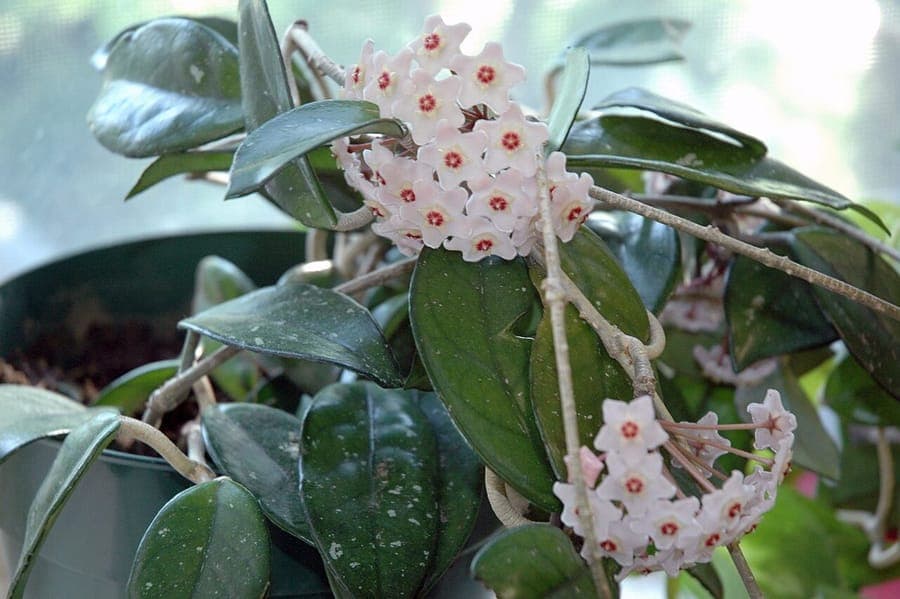
The wax plant forms trailing, twining stems that can reach 2 to 4 metres indoors. The leaves are opposite, oval and 5 to 10 cm long, thick, leathery and glossy green, often flecked with small silvery spots. Young stems sometimes grow on leafless at first, as long exploratory tendrils, and only produce leaves later. So do not cut them off.
The flowers appear from May to September in rounded umbels of 10 to 30 blooms. Each flower is about 1.5 cm across, five-pointed, pale pink to white, with a dark red star-shaped corona in the centre. They have a velvety sheen and give off a sweet scent in the evening and at night, a little like honey or vanilla. The flowers sometimes drip sticky nectar, so do not keep anything precious beneath the plant.
One important detail: the flowers form on short, woody stalks called spurs or peduncles. These remain on the plant after flowering and bloom again the following year. Cut them off and you remove next year's flowers.
Well-known cultivars include 'Krimson Queen' with creamy white leaf margins, 'Krimson Princess' with a yellow and pink centre to each leaf, and 'Compacta', the twisted form with curled, tightly packed leaves often sold as Hindu rope plant.
Ideal location
The wax plant loves light. A spot in an east- or west-facing window is ideal, or half a metre to a metre from a south-facing window. A little morning or evening sun does it good and encourages flowering. Harsh midday sun behind glass can scorch the leaves in summer and turn them yellow. In a spot that is too dark it will grow, but it will not flower.
Once it has buds, leave the plant where it is. Moving or turning it at this stage often causes the buds to drop. Train the stems around a hoop, trellis or a few wires, or let them trail from a pot or hanging basket. It climbs by twining, so give young stems an occasional nudge in the right direction.
From late May to mid-September the wax plant can go outside to a sheltered, bright spot out of scorching sun, such as under a porch roof or on a balcony with morning sun. Bring it back in as soon as nights drop below 12 °C.
Compost and repotting
Hoya carnosa needs an airy, free-draining mix. Ordinary houseplant compost combined with a third orchid bark and a good handful of perlite mimics its epiphytic lifestyle well. Wet, compacted compost will rot the roots.
Repot rarely. The wax plant flowers best when slightly pot-bound. Only repot when roots are really pushing out of the pot, usually every three or four years, in spring and into a pot just one size larger. A terracotta pot helps the compost dry out faster. Always make sure there is a drainage hole.
Watering and feeding
Water when the compost is almost completely dry. In summer that is roughly once a week to once every ten days; in winter sometimes only every three to four weeks. Water thoroughly until it runs out of the bottom, then let the pot drain well. Soft, slightly wrinkled leaves are a sign of thirst; yellow, limp leaves and a sour smell point to too much water.
The wax plant copes perfectly well with ordinary indoor air. It appreciates slightly higher humidity in summer, but misting is not necessary.
From April to August, feed once a month with a liquid fertiliser for flowering houseplants, ideally one with more potassium than nitrogen. Too much nitrogen gives lots of leaves and long stems but few flowers. Stop feeding from September.
Free preview
Want to see Wax plant (Hoya carnosa): complete guide in your garden? Make a free preview of your design.
Pruning and training
Pruning is rarely needed. Overlong or bare stems can be shortened in spring to just above a pair of leaves, but never cut off the flowering spurs. Let spent flower clusters drop naturally; the spur stays put.
When you prune or a stem breaks, white milky sap oozes from the wound. It can mildly irritate the skin, so wash your hands or wear gloves.
Cuttings root easily. Take a piece with two or three pairs of leaves, let the cut end dry for a few hours and place it in water or a moist mix of cutting compost and perlite. At 20 to 25 °C, roots form within four to six weeks.
Watch out for mealybugs and scale insects, which like to hide in the leaf axils and on the spurs. Wipe them off with a cotton bud dipped in surgical spirit, or spray with a mild soap solution.
Maintenance calendar
March-April: Growth starts again. Gradually increase watering and begin feeding. Only repot if really necessary.
May-June: The first flower clusters appear. Stop moving the plant. From late May it can go outside to a sheltered spot.
July-August: Full flowering. Water regularly and feed monthly. Check for scale and mealybugs.
September-October: Stop feeding. Bring the plant in before nights fall below 12 °C.
November-February: Rest period. Keep the plant cool and bright, at around 12 to 15 °C, and water sparingly. This cool rest encourages next year's flowers.
On gardenworld.app you will find a planting calendar that helps you do the right jobs at the right time, for houseplants as well as for the garden.
Temperature and hardiness
Hoya carnosa is not hardy. During the growing season it is happiest between 18 and 25 °C. In winter it tolerates a cool spell of around 10 to 15 °C, and it is precisely that cooler, drier rest that helps it set buds in spring. Below 10 °C it starts to suffer damage, and frost is fatal.
An unheated but frost-free bedroom, a bright stairwell or a cool conservatory is often a better winter spot than a warm living room. Keep it away from cold draughts and the direct heat of a radiator.
Toxicity to pets
The ASPCA, the American animal welfare organisation, lists the wax plant as non-toxic to cats and dogs, and it is not considered poisonous to people either. That makes it one of the few flowering trailing plants you can keep with confidence in a home with pets.
There are two caveats. The white sap can mildly irritate the skin or mouth of both people and animals. And a pet that eats a lot of plant material may still vomit or get diarrhoea, simply because its stomach is not built for it. Ideally hang the plant high up or out of reach of cats that love to pull at trailing stems. Always store fertilisers and pesticides where pets cannot get at them.
Companion plants
Pair the wax plant with others that also enjoy good light and like to dry out a little between waterings. The Christmas cactus (Schlumbergera truncata) shares its liking for a cool winter rest and looks lovely alongside it as a trailing plant. The spider plant (Chlorophytum comosum) and the Chinese money plant (Pilea peperomioides) fit in well too, and like the wax plant they are non-toxic to pets.
For a windowsill of succulents, combine it with burro's tail (Sedum morganianum) or the jade plant (Crassula ovata). Bear in mind that the jade plant is toxic to cats and dogs, so only grow it in a pet-free home or well out of reach.
The wax plant can play a role outdoors in summer too. On gardenworld.app you can create a garden design for your patio that includes a sheltered corner for houseplants spending the summer outside.
Final thoughts
The wax plant is a rewarding, long-lived houseplant that, with very little care, gives you years of glossy leaves and fragrant porcelain flowers. The secret lies in three things: plenty of light, sparing water and patience. Leave the flowering spurs alone, do not move the plant when it is in bud, and give it a cool winter rest. Then it will flower again every year, safely alongside your cats and dogs.
Frequently asked questions about Wax plant
Is Wax plant winter hardy?
Hoya carnosa is not hardy. During the growing season it is happiest between 18 and 25 °C.
When and how do you prune Wax plant?
Pruning is rarely needed. Overlong or bare stems can be shortened in spring to just above a pair of leaves, but never cut off the flowering spurs.
How much water does Wax plant need?
Water when the compost is almost completely dry. In summer that is roughly once a week to once every ten days; in winter sometimes only every three to four weeks.
Where does Wax plant grow best?
The wax plant loves light. A spot in an east- or west-facing window is ideal, or half a metre to a metre from a south-facing window.

See it in your garden
See Wax plant in your garden
One photo of your garden and a few questions. You see the result in about a minute.
Try it with a photoIdentify this plant in your own garden. Identify a plant
Similar plants
Thanksgiving cactus: complete guide
Schlumbergera truncata
Schlumbergera truncata produces vibrant autumn flowers perfect for indoor cultivation. Learn watering, blooming triggers, and care for this popular houseplant.
Chlorophytum comosum: complete guide
Chlorophytum comosum
Discover everything about Chlorophytum comosum (spider plant). Learn care requirements, propagation, location and maintenance for thriving indoor plants.
Chinese Money Plant: complete guide
Pilea peperomioides
Chinese Money Plant (Pilea peperomioides) is a trendy houseplant from China featuring distinctive round, mint-green leaves. This Instagram-famous plant has become a favorite for modern homes with its elegant appearance and easy-care nature.
