
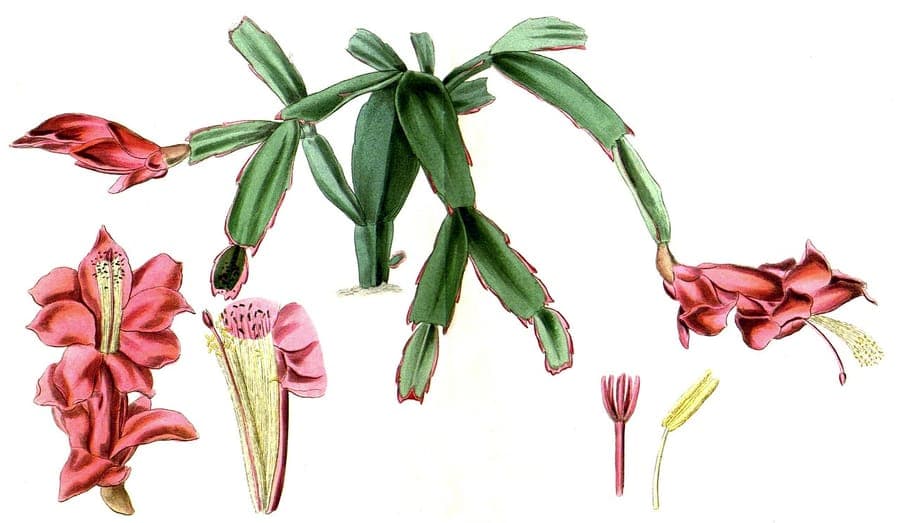
Hooker, William Jackson, Sir Blackwood, William, publisher; Cadell, Thomas, publisher; Swan, Joseph, engraver / Public domain, via Wikimedia Commons
Thanksgiving cactus: complete guide
Schlumbergera truncata
Want to see Thanksgiving cactus: complete guide in your garden?
1 minute, no credit card
Overview
Schlumbergera truncata, commonly known as Thanksgiving cactus or claw cactus, is an epiphytic cactus from the Cactaceae family. This species naturally occurs in the tropical rainforests of southeastern Brazil, growing as an epiphyte in tree branches rather than desert soil. It represents a unique cactus group adapted to tropical forest conditions.
First formally described in 1953, Thanksgiving cactus is classified as an accepted cacti species. Its natural habitat spans the wet, shaded forest regions of Brazil.
Appearance & bloom
Thanksgiving cactus forms a cascading or trailing growth habit composed of flattened, segmented stems. The green stems are relatively smooth with shallow teeth along the margins. Plants reach 30-45 centimeters length in cultivation, particularly attractive in hanging containers.
Flowers typically appear from October through November, earning the common name. They are vibrant purple-red to pink, symmetrically formed and highly ornamental. The flowers remain open for several days and are very showy. Many color cultivars exist, ranging from deep red to white.
The plant also produces decorative fruits following flowering.
Ideal location
Thanksgiving cactus grows best in indirect light, avoiding intense direct sun. Position the plant in a bright but shaded location that mimics its natural forest habitat. Indoors, a north-facing or east-facing window proves ideal.
The plant thrives on shelves or windowsills without direct afternoon sun. Hanging basket displays prove particularly effective. Room temperatures between 15-21 degrees Celsius are optimal.
Avoid drastic temperature fluctuations and cold drafts.
Soil
Thanksgiving cactus requires well-draining, humus-rich potting soil, not standard desert cactus mix. Use equal parts peat moss, orchid bark and coarse sand. Soil pH should range from 6.0 to 6.5.
The plant prefers hanging containers or wide pots with drainage holes. Add compost for moisture retention while maintaining good drainage. Avoid heavy clay or compacted soils.
Repot every 2-3 years after flowering using fresh soil mix.
Free design
Want to see Thanksgiving cactus: complete guide in your garden? Make a free design now.
Watering
Thanksgiving cactus requires more water than typical desert cacti. Keep soil moist but not waterlogged during the growing season from May through September. Water approximately twice weekly.
After September, reduce watering to stimulate flower bud formation. From October through December, maintain slightly drier soil. After blooming completes, increase water again.
Avoid complete waterlogging, which promotes root rot and plant death.
Pruning
Pinching off stem segments encourages branching and fuller growth. This is best done in June after the previous blooming period.
Remove weak or excessively long stems to maintain shape. The plant does not require heavy pruning. Pinched-off segments can be propagated as cuttings.
Maintenance calendar
January-April: Minimal care, reduced water, cool conditions. May-June: Increase watering, warm temperatures 18-21 degrees. July-September: Regular watering and feeding, bright shade. October-November: Lower temperature to 12-15 degrees, reduce water, promotes flowering. December: Observe and enjoy blooming period.
Winter hardiness
Thanksgiving cactus is not cold-hardy and will freeze and die outdoors. It must be grown indoors in all regions except very warm subtropical areas.
The plant prefers cool autumn and winter temperatures (12-15 degrees Celsius) to trigger reliable flowering.
Companion plants
Combine Thanksgiving cactus with other epiphytic cacti:
- Selenicereus spp (night-blooming cereus): Similar care requirements
- Rhipsalis spp (mistletoe cactus): Equivalent humus needs
- Hoya spp (porcelain flower): Similar watering requirements
- Epipremnum pinnatum (satin pothos): Similar light preferences
- Peperomia spp (peperomia): Comparable humidity and care
Group in hanging displays for dramatic effect.
Closing
Schlumbergera truncata provides reliable autumn blooms and relatively simple care, making it a popular houseplant worldwide. The vibrant flowers and cascading habit suit hanging baskets and plant stands perfectly.
With proper watering, autumn temperature reduction and patient care, this plant will produce years of spectacular blooming. Discover Thanksgiving cactus for your home or conservatory today. Learn more about houseplants and indoor gardening at gardenworld.app.
Want to see Thanksgiving cactus: complete guide in your garden? Make a free design now.
Upload a photo, pick a style, and get a photorealistic design with plant list in under a minute.
No credit card required


Similar plants
Plains prickly pear: complete guide
Opuntia polyacantha
All about plains prickly pear cactus: hardiness, soil, placement and care. One of the most cold-tolerant cacti for temperate gardens.
Saguaro: complete guide
Carnegiea gigantea
Everything about growing saguaro cactus: container care, watering, overwintering, and companion plants for this iconic desert giant.
Cylindropuntia imbricata: complete guide
Cylindropuntia imbricata
The Tree Cholla offers distinctive segmented stems and vibrant red flowers. A unique ornamental succulent perfect for sunny, dry gardens and large containers.