
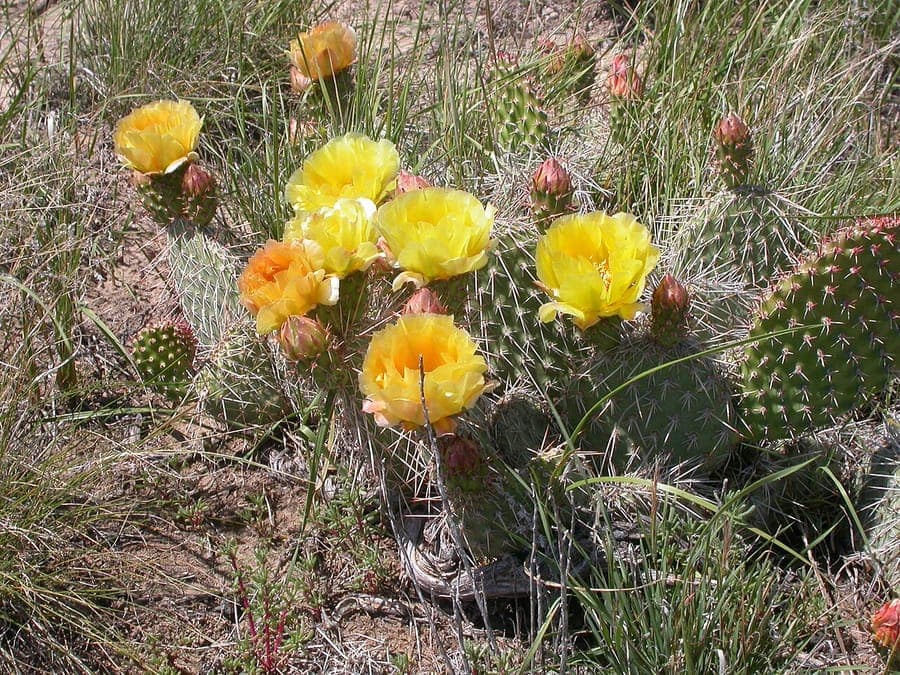
Matt Lavin from Bozeman, Montana, USA / CC BY-SA 2.0, via Wikimedia Commons
Plains prickly pear: complete guide
Opuntia polyacantha
Want to see Plains prickly pear: complete guide in your garden?
1 minute, no credit card
Overview
Opuntia polyacantha, commonly known as plains prickly pear or cliff prickly-pear, is one of the most cold-hardy cactus species in the world. A member of the family Cactaceae, it is native across a vast swath of central North America - from the Canadian provinces of Alberta and Saskatchewan southward through Montana, Wyoming, Colorado, Nebraska, Kansas and Texas into northern Mexico. The species name 'polyacantha' derives from Greek meaning 'many-spined', an apt description of the numerous long, sharp spines that cover each flat stem pad.
First formally described by Adrian Hardy Haworth in 1819, this plant is a defining element of dry prairies, rock outcroppings, sandy dunes and open pine-grassland communities across its native range. It spreads by stolons, sending out new pads that root and form new plants, creating dense low mats that stabilise soils and provide cover and food for wildlife.
For gardeners in temperate Europe, plains prickly pear is a revelation: a genuine cactus that survives temperatures of -30 degrees Celsius without any winter protection, provided the soil is well drained. In rock gardens, gravel beds and dry borders, it delivers year-round structure, spectacular summer flowers and ornamental fruit. Visit gardenworld.app to explore how structural plants like Opuntia polyacantha can be incorporated into professional front garden designs.
Garden-worthy selections include forms with especially large yellow flowers and cultivars selected for particularly vivid red-purple fruit. The straight species, however, remains the most reliable and cold-hardy choice for European gardens.
Appearance & bloom cycle
Plains prickly pear is a low, wide-spreading shrubby cactus, typically 15 to 40 cm tall but capable of spreading several metres in width over time. The flat, elliptic to rounded stem pads (cladodes) measure 5 to 15 cm long and 4 to 10 cm wide. They are grey-green in colour and densely armed with clusters of long white to grey spines, 2 to 7 cm in length, surrounded by shorter bristle-like glochids - tiny, barbed structures invisible to the naked eye that embed themselves deeply in skin on contact.
Flowers appear from May through July, depending on location and climate. They are large and conspicuous: 5 to 8 cm across, with numerous butter-yellow to orange-yellow petals arranged in a bowl shape. Flowers are day-blooming, opening wide in warm, sunny weather. Each individual flower lasts one to two days, but a mature plant carries dozens of buds that open successively over two to four weeks.
After flowering, conspicuous fruit develops: globular to pear-shaped, initially green, ripening to purplish-red or deep red by August and September. The fruit is edible - sweet-tart in flavour - and is eagerly consumed by birds, foxes and other wildlife, contributing to the plant's natural dispersal.
In winter, the pads shrink and wrinkle dramatically as the plant loses water to reduce freezing risk inside its tissues. This is entirely normal; they plump up again when temperatures rise in spring.
Ideal location
Plains prickly pear requires full sun. A minimum of six to eight hours of direct sunlight daily is necessary for good growth and generous flowering. In partial shade the plant grows slowly, barely flowers and produces soft, weak pads prone to disease. Choose the hottest, most exposed position available: a south-facing slope, a gravel or pebble bed, a raised border beside a sunny wall.
The plant is perfectly suited to positions that experience summer drought, drying winds and intense reflected heat. It thrives against south-facing house walls, on dry banks and in gravel gardens. In the garden it works beautifully as a structural anchor plant among low-growing drought-tolerant companions, providing year-round presence that most herbaceous perennials cannot match.
Spacing for new plantings should be 60 to 90 cm to allow for the considerable spread the plant will achieve over several years. In a gravel garden or rock garden, plant directly into the grit or between rocks, allowing roots to penetrate the stone substrate as they do in nature.
As a companion plant, its yellow flowers and red fruit look striking alongside lavender (Lavandula angustifolia), feather grass (Stipa tenuissima), blue fescue (Festuca glauca) and pale evening primrose (Oenothera pallida), creating a xeriscape or steppe-style planting.
Soil requirements
Plains prickly pear demands excellent drainage above all else. It tolerates alkaline conditions well - optimal pH is 7.0 to 8.8 - and actually performs better on poor, lean soils than on rich ones. Excessive fertility produces lush but soft growth that is more susceptible to frost damage and fungal disease.
Sandy, stony and gravelly soils require no amendment. Heavy clay soils must be dramatically improved before planting: excavate to a depth of 20-30 cm and replace with a mix of three parts coarse sharp sand, one part garden soil and one part fine grit. This creates the fast-draining substrate that mimics the rocky prairies of the plant's native range.
Avoid all organic-rich materials - compost, peat, leaf mould, fresh manure - anywhere near the plant. These retain moisture around the stem base and can cause rotting even in dry summers. A mulch of decorative stone chippings or coarse gravel around the plant looks attractive, keeps the crown dry and suppresses weeds.
In containers, use a dedicated cactus mix or blend equal parts coarse sand and standard potting compost. Ensure the pot has a large drainage hole and stands on pot feet to allow free drainage.
Free design
Want to see Plains prickly pear: complete guide in your garden? Make a free design now.
Watering
Once established, plains prickly pear requires virtually no supplemental watering in a European climate. Rainfall alone is sufficient in the UK, the Netherlands, Belgium and most of France. During the establishment period in the first growing season after planting, a monthly deep watering in summer helps the plant develop its root system.
The greatest danger to Opuntia is not drought but excess moisture, especially in combination with cold. In autumn and winter, the soil around the plant must be kept as dry as possible. Waterlogging during the cold months is by far the most common cause of plant failure. Consider positioning plants under a roof overhang or adding a simple transparent shelter to reduce winter rainfall reaching the root zone.
In very hot summers, with temperatures above 35 degrees Celsius for more than two weeks, a single deep watering once a month helps. Water only at the base of the plant; never wet the pads.
In containers, move them to a sheltered, dry position in autumn to prevent excess rain from accumulating. The plant benefits from a completely dry winter in a frost-free shed or unheated glasshouse in zones 6 and colder.
Pruning
Plains prickly pear needs minimal pruning, but controlled management keeps the plant tidy and the garden safe. Always wear thick leather gloves and use tongs or pliers to handle the pads - the glochids are invisible but embed readily in skin and are difficult to remove.
To control spread, individual pads can be twisted off or cut at the joint between two pads with a sharp knife. Detached pads can be composted (carefully) or replanted elsewhere. Remove any dead or discoloured pads promptly, as they can harbour fungal disease.
In spring, assess the overall form and remove old, shrivelled or damaged pads. After severe winters, a few outer pads may blacken and die back - remove these cleanly down to healthy green tissue. The plant recovers slowly from hard pruning, so work gradually and conservatively.
To prevent unwanted spread into adjacent planting areas, remove the outermost pads completely, including any visible rooting, in late summer before pads have had time to establish.
Maintenance calendar
March: Check for frost damage; remove grey, shrivelled pads. Verify drainage around the stem base is clear.
April: Plant begins to plump up as temperatures rise. Best planting time for new introductions. Soil temperature should be above 10 degrees Celsius.
May: First buds visible; clear any accumulated leaf litter from around the plant. No watering needed.
June: Peak flowering; enjoy the conspicuous yellow blooms. No watering, no feeding required.
July: Continued flowering; fruit begins to form. Check for any signs of rot at the stem base.
August: Fruit ripens to vivid red-purple; birds visit regularly. The plant is at its most ornamental.
September: Growing season ends; plant begins withdrawing water from pads. Remove fallen leaves from around the base.
October-November: No watering. Ensure drainage is optimal for the wet winter months. Consider a protective transparent shelter if the site is particularly wet.
December-February: Dormancy; pads shrink and wrinkle - entirely normal. No water, no feeding.
Winter hardiness
Opuntia polyacantha is among the hardiest cacti that can be grown in temperate gardens. It survives temperatures down to -30 degrees Celsius without protection, making it reliable in USDA hardiness zones 3 to 9. Across the UK, Benelux, northern Germany and northern France (zones 7-8), it overwinters without any difficulty whatsoever.
This extraordinary cold hardiness comes from its ability to dehydrate its tissues in autumn, concentrating sugars in the cells to a level that acts as a natural antifreeze. The pads shrivel visibly as this process occurs, sometimes becoming almost flat. In spring, as temperatures rise, they rehydrate and return to their normal plump appearance within days.
The critical requirement for reliable overwintering is not insulation from cold but protection from excessive moisture at the crown. A dry crown in winter is far more important than a warm one. A simple lean-to cover of clear acrylic or a slate tile propped over the plant in the wettest months is more effective than any amount of fleece or straw.
Successfully overwintered specimens thrive throughout the Netherlands and Belgium, including in the colder inland zones. Discover garden examples and planting advice for hardy cacti at gardenworld.app, where you can see how these plants perform in real northern European conditions.
Companion plants
Plains prickly pear associates naturally with other drought-adapted plants sharing similar growing requirements:
- Sedum telephium (orpine): broad, fleshy leaves and rosy autumn flowers provide beautiful textural contrast with the spiny cactus pads.
- Festuca glauca (blue fescue): neat silver-blue mounds provide elegant contrast against the grey-green pads.
- Lavandula angustifolia (lavender): same affinity for alkaline, sharply draining soil; purple-blue flowers complement the yellow cactus blooms.
- Oenothera pallida (pale evening primrose): a graceful night-blooming perennial that creates a superb steppe-style combination.
- Phlox subulata (moss phlox): a low mat-forming perennial that thrives in the same dry, sunny conditions, providing spring colour.
- Stipa tenuissima (feather grass): graceful, wind-moved plumes that animate the otherwise static cactus border.
- Sempervivum (houseleek): low rosettes that fill gaps between the cactus pads and share the same preference for dry, sunny positions.
Avoid moisture-demanding plants such as hostas, ferns and astilbes, which require conditions incompatible with Opuntia's needs.
Closing
Opuntia polyacantha is one of the most versatile and impressive hardy cacti available to European gardeners. Its combination of spectacular summer flowering, ornamental fruit, exceptional drought tolerance and extreme cold hardiness makes it a unique and valuable contribution to rock gardens, gravel gardens and dry borders. Once you have grown this robust plant successfully through a European winter, you will understand why it has gained a devoted following among specialist gardeners.
Design your own low-maintenance, drought-tolerant front garden at gardenworld.app, and discover how to use structural plants like plains prickly pear to create a garden that looks beautiful year-round while demanding very little water or care.
Want to see Plains prickly pear: complete guide in your garden? Make a free design now.
Upload a photo, pick a style, and get a photorealistic design with plant list in under a minute.
10,000+ gardens designed already
No credit card required


Similar plants
Saguaro: complete guide
Carnegiea gigantea
Everything about growing saguaro cactus: container care, watering, overwintering, and companion plants for this iconic desert giant.
Cylindropuntia imbricata: complete guide
Cylindropuntia imbricata
The Tree Cholla offers distinctive segmented stems and vibrant red flowers. A unique ornamental succulent perfect for sunny, dry gardens and large containers.
Opuntia undulata: complete guide
Opuntia undulata
Barbary fig grows as a fascinating cactus with edible fruits. Learn all about cultivating this exotic plant in your front garden.