
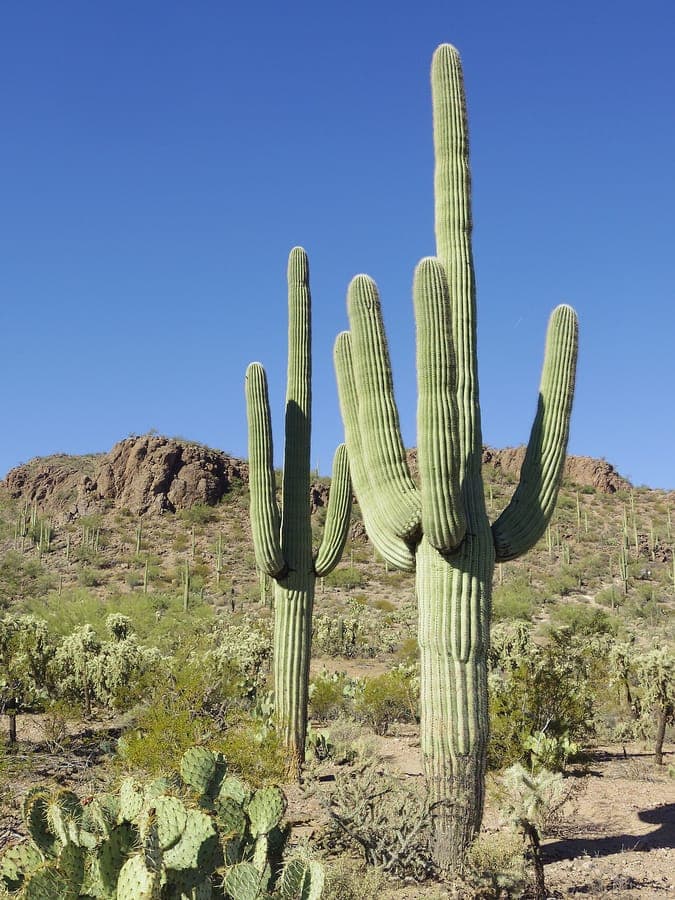
WClarke / CC BY-SA 3.0, via Wikimedia Commons
Saguaro: complete guide
Carnegiea gigantea
Want to see Saguaro: complete guide in your garden?
1 minute, no credit card
Overview
The saguaro (Carnegiea gigantea) is arguably the most iconic cactus in the world, and certainly the most recognizable symbol of the North American desert. Native to the Sonoran Desert of southern Arizona, a small area of southeastern California, and northwestern Mexico (Sonora and Baja California Norte), it stands as the sole representative of the genus Carnegiea - named after industrialist Andrew Carnegie. Few plants embody slow, patient grandeur quite like this one.
In the wild, mature specimens reach 12 to 18 metres in height and may weigh several tonnes, their pleated stems swelling accordion-like after rain to store hundreds of litres of water. Growth is extraordinarily slow: a ten-year-old seedling barely reaches 4 cm. The characteristic lateral arms - the feature that gives the saguaro its unmistakeable silhouette - typically don't emerge until the plant is 50 to 75 years old. A 15-metre specimen may be well over 150 years old.
For gardeners in northern and central Europe, the saguaro is not an outdoor perennial but a container plant requiring a cool, bright winter shelter. Despite this limitation, it draws admiration like few other plants: even a modest 60 cm specimen in an elegant terracotta pot commands a terrace or conservatory with its prehistoric, columnar presence. At gardenworld.app you can explore how desert plants like the saguaro can feature in drought-resilient garden and terrace designs.
The species was formally described by Englemann, then reclassified by Britton and Rose in 1908. Synonyms include the older name Cereus giganteus, still occasionally used in horticultural catalogues. Two forms are recognised: the standard columnar type and the rare crested form Carnegiea gigantea f. cristata, which develops a dramatic fan-shaped crown and is highly sought after by collectors.
Appearance & bloom cycle
The saguaro's stem is deeply ribbed - mature plants typically have 12 to 24 ribs - and studded with clusters of grey-yellow spines. Each areole produces one to several stout central spines of 3 to 7 cm and a ring of shorter radial spines. The waxy outer skin reflects intense sunlight, helping the plant regulate temperature even when ambient air reaches 45 °C.
Flowering occurs in May and June at the top of the main stem and, on older specimens, at the tips of arms. The creamy-white flowers, measuring 8 to 12 cm across, open exclusively at night and close the following afternoon. They produce a mild, sweet fragrance and are pollinated by lesser long-nosed bats (Leptonycteris), white-winged doves, and bees. A single plant can carry dozens of flowers in a season. The red, oval fruits that follow - 6 to 9 cm long - have been harvested for food and fermented drinks by the Tohono O'odham people for thousands of years.
Container-grown specimens in Europe rarely flower, as they are typically too young and the climate too different from their desert home. The structural, monumental form is the main attraction, and even a young saguaro of 40 to 60 cm height is a compelling focal point.
Ideal location
In nature, saguaros grow on dry, rocky slopes and plains from sea level to about 1,500 metres. They prefer south-facing aspects, often clustered near boulders or ridge lines that provide both radiant heat and wind protection.
As a container plant, the saguaro demands maximum sunlight: a south-facing terrace, rooftop, or large south-facing window. Aim for at least 8 hours of direct sun from May through September. Avoid positions shaded by buildings or overhangs - insufficient light causes the stem to elongate and lose its compact, cylindrical form, a process called etiolation that cannot be reversed.
Bring the plant indoors before the first frost, ideally when overnight temperatures fall consistently below 5 °C. A cool, frost-free, well-lit space - an unheated conservatory, bright garage, or glass porch - is ideal for winter. The minimum safe temperature is around 2 °C; brief exposure to -6 °C is tolerated only if the root ball is completely dry.
Soil requirements
The saguaro's greatest enemy is excess moisture around the roots. In its native habitat it grows on calcareous, mineral-rich, fast-draining soils with a pH of 7.0 to 9.0. Waterlogged conditions cause rapid root rot and are almost always fatal.
For container cultivation, mix equal parts coarse horticultural grit (2–4 mm particle size), perlite, and proprietary cactus compost. Adding a handful of pumice or lava grit further improves drainage. Always use a pot with a generously sized drainage hole and place a layer of gravel at the base. Repot every three to four years in spring when roots begin circling inside the pot, moving to a vessel only slightly larger - an oversized pot retains too much moisture and raises rot risk.
Mains water is preferable to rainwater for saguaro, as its higher mineral content and near-neutral pH (7–8) more closely resembles desert water chemistry. If using rainwater long term, add a small pinch of garden lime to maintain pH above 6.8.
Free design
Want to see Saguaro: complete guide in your garden? Make a free design now.
Watering
The saguaro is supremely adapted to extended drought. Its pleated stem can expand dramatically after rainfall, storing enough water to sustain the plant through months of dry weather. A mature wild specimen can hold 750 to 1,000 litres.
For container plants, water thoroughly from May to September every two to three weeks: drench the root ball until excess water flows freely from the drainage hole, then allow the compost to dry out completely before watering again. During the peak growing period of July and August, weekly watering may be appropriate during prolonged heat above 30 °C.
From October, reduce drastically: once a month is sufficient to prevent root desiccation. From November to March, keep almost dry - water only if the ribs show visible inward contraction, indicating water stress. Always use water at room temperature; cold water can shock roots and promote rot. Resume the growing-season regime gradually from mid-March as light levels increase.
Pruning
The saguaro requires no routine pruning. Its form develops according to its own slow programme, and no intervention accelerates or improves that process. Never remove healthy tissue - wounds are slow to callous and highly susceptible to bacterial and fungal infection.
If a section of stem shows sunken, discoloured, or soft tissue indicating rot or infection, act promptly: cut back to clearly healthy tissue with a sterilised, sharp knife, allow the cut surface to dry and callous in a dry, airy place, and dust with sulphur powder to discourage further infection. Brown corky scars are normal and indicate healed tissue.
Handle with thick leather gloves at all times. Remove loose or dead spines carefully with long-nosed pliers if necessary for aesthetic reasons. Never spray pesticides directly onto open wounds.
Maintenance calendar
January – February: Deep dormancy. No water unless ribs are severely contracted. Check monthly for rot patches, scale insects, and mealybug. Ensure good air circulation in winter quarters.
March: Begin reintroducing moisture cautiously as light levels increase. A small amount of water every three weeks. Move closer to the window or under a grow light if available.
April: Move outside once night frosts are reliably over. Begin monthly low-nitrogen, high-potassium cactus fertiliser.
May – June: Full sun. Water every two weeks. Watch for spider mite and scale.
July – August: Peak growing season. Water weekly during heat waves, every two weeks in cool summers. Fertilise monthly.
September: Reduce watering. Final fertiliser application no later than the first week of September.
October: Bring inside before first frost. Begin transition to dormancy.
November – December: Near-dry dormancy. Cool bright conditions.
Winter hardiness
Carnegiea gigantea is not cold-hardy in northern Europe. It occupies USDA zones 9b to 11 in its natural range - Mediterranean to subtropical conditions. Brief exposure to -6 °C is tolerated only when the root zone is completely dry, but extended cold or wet conditions cause irreversible damage and death.
In the UK, Netherlands, Belgium, and northern France, bring the plant inside before sustained temperatures drop below 5 °C at night. A cool but frost-free space with maximum available daylight is ideal. The colder and darker the winter quarters, the drier the root zone must be kept. In a barely heated storage room at 2 to 5 °C, no water at all may be needed from November through February. In a bright conservatory at 10 to 15 °C, monthly watering is appropriate. Poor air circulation and high humidity during winter are the leading causes of rot in overwintered specimens - ventilate regularly.
Companion plants
The saguaro's bold vertical profile pairs beautifully with plants that share its preference for heat, sun, and sharp drainage. For a coherent desert-inspired container grouping or raised bed:
- Opuntia engelmannii (prickly pear): same climate requirements, brilliant yellow flowers in May–June
- Agave americana (century plant): blue-grey rosettes of architectural weight; excellent textural contrast
- Ferocactus cylindraceus (barrel cactus): lower and rounded, glowing yellow or orange spines
- Yucca rostrata (beaked yucca): slender trunk topped with a globe of silver-blue leaves; superb vertical companion
- Echeveria subsessilis and related species: rosette-forming, low accent plants for the base of container groupings
- Dasylirion wheeleri (desert spoon): long grey-green leaves provide entirely different texture beside the columnar saguaro
In garden centre collections across Europe you can often find young saguaro specimens alongside these companions. Allow at least 60 to 80 cm between large container specimens to avoid root competition. For more design ideas using drought-tolerant plants, visit gardenworld.app.
Conclusion
The saguaro is one of the most remarkable plants any collector or adventurous gardener can cultivate. It asks for patience - years pass before visible change - a proper overwintering strategy, and the right fast-draining compost. In return, it provides a living sculpture of extraordinary presence, a plant with as much personality as a century-old oak, compressed into a form that fits a terrace pot. Even a young specimen of 40 to 60 cm is a conversation piece that never fails to draw questions.
For container gardeners and terrace enthusiasts who want to push the boundaries of what can grow in a northern European garden, the saguaro is a worthy challenge and a lifelong companion plant.
Want to see Saguaro: complete guide in your garden? Make a free design now.
Upload a photo, pick a style, and get a photorealistic design with plant list in under a minute.
10,000+ gardens designed already
No credit card required


Similar plants
Plains prickly pear: complete guide
Opuntia polyacantha
All about plains prickly pear cactus: hardiness, soil, placement and care. One of the most cold-tolerant cacti for temperate gardens.
Cylindropuntia imbricata: complete guide
Cylindropuntia imbricata
The Tree Cholla offers distinctive segmented stems and vibrant red flowers. A unique ornamental succulent perfect for sunny, dry gardens and large containers.
Opuntia undulata: complete guide
Opuntia undulata
Barbary fig grows as a fascinating cactus with edible fruits. Learn all about cultivating this exotic plant in your front garden.