Eric Hunt / CC BY-SA 4.0, via Wikimedia Commons
Arkansas bluestar: complete guide
Amsonia hubrichtii
Want to see Arkansas bluestar: complete guide in your garden?
Full design in HD: €7.99
Look after your Arkansas bluestar with the GardenWorld app
Identify plants with your camera and get a care calendar with reminders for this plant.


Overview
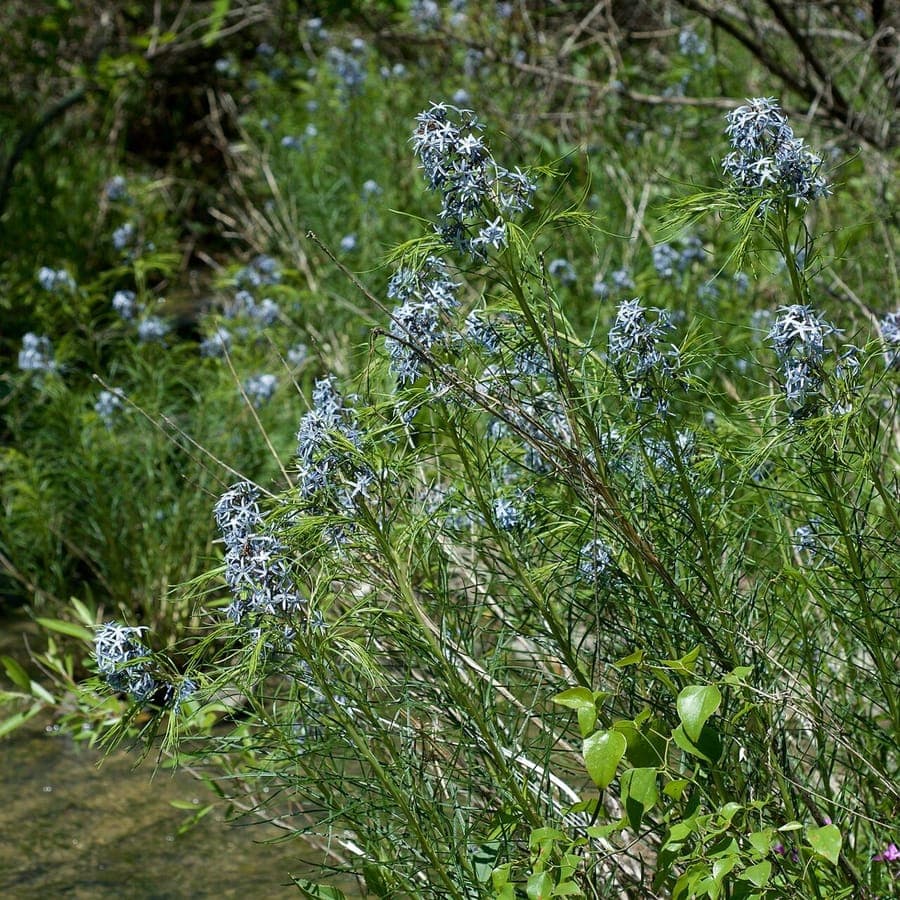
Arkansas bluestar (Amsonia hubrichtii), also sold as threadleaf bluestar or Hubricht's bluestar, is a perennial that surprises you twice a year. In May and June it carries clusters of small, pale blue starry flowers above a cloud of thread-fine leaves. Through summer it remains a soft green mound that sways in the breeze, rather like a fine-leaved ornamental grass. The real high point, though, comes in October and November, when the entire plant turns golden to orange-yellow and seems to glow in the low autumn light.
The species is native to the Ouachita Mountains of Arkansas and Oklahoma in the United States. There it grows on rocky banks of streams and rivers, where it must cope with occasional flooding as well as long, dry summers. It was named after the collector Leslie Hubricht, who found it in 1942. Amsonia belongs to the dogbane family (Apocynaceae), which you can see in its star-shaped flowers. In 2011 the Perennial Plant Association in the United States named it Perennial Plant of the Year.
A mature plant grows 60 to 90 cm tall and 90 to 120 cm wide. It is slow to get going in its first years, but it is long-lived and becomes fuller each season. On gardenworld.app you can have a garden design made in which Arkansas bluestar joins ornamental grasses and other prairie plants in a border that holds your interest from spring to winter.
Appearance and bloom cycle
In April numerous upright stems push through the soil, densely clothed in narrow, needle-like leaves 5 to 10 cm long. Together they form an airy, dome-shaped clump reminiscent of fennel or a fine grass. The foliage is bright green and stays healthy all season.
Flowering runs from mid-May to late June. At the tip of each stem a loose cluster of small flowers appears, each about 1.5 cm across with five narrow, pointed petals. The colour is a soft steel blue to sky blue. Bees, bumblebees and early butterflies visit the flowers. After flowering, slender upright seed pods develop.
In autumn the leaves turn pale yellow first and then a deep golden yellow. In a sunny border this display can last for weeks. With the first hard frost the foliage browns, but the clump still gives structure to the winter garden.
When you cut Arkansas bluestar, a milky sap seeps from the stems. It can irritate sensitive skin, so wear gloves. As with many members of the dogbane family, we advise against eating any part of the plant, as it may cause stomach upset. Deer and rabbits generally leave it alone.
Ideal location
For the best autumn colour and a compact shape, choose a position in full sun. Amsonia hubrichtii also grows in light shade, but the stems become longer, the clump flops open and the autumn colour is less intense. It tolerates wind and heat well.
Because the clump spreads wide, it needs room. Allow 90 to 100 cm between plants. It looks superb as a specimen, as a low informal hedge along a path or in groups of three to five in a large prairie border. Try it beside a pond or on a bank too, much as it grows in the wild.
Soil requirements
Arkansas bluestar is not fussy. It grows in sand, loam and clay as long as the ground is not waterlogged for long periods. Ordinary garden soil with a pH from slightly acidic to neutral is ideal. Rich, heavily fed soil is unnecessary and only makes the stems floppy.
At planting time loosen the soil generously to a depth of 30 to 40 cm, and on heavy clay work in some compost or coarse grit. A mulch of compost or fine gravel keeps weeds down in the first years while the clump is still small. After that it barely needs feeding.
Free preview
Want to see Arkansas bluestar: complete guide in your garden? Make a free preview of your design.
Watering
In the first year after planting water regularly, roughly 5 to 10 litres a week in dry weather, so the plant can build a deep root system. From the second or third year onwards it is very drought tolerant and rarely needs watering.
Only during long heatwaves on sandy soil should you give an occasional thorough soak at the base. Too much water in heavy soil does more harm than a dry spell. Extra water is never needed in winter.
Pruning
There are two key moments for pruning. After flowering, in late June or early July, you can trim the whole clump back by about a third with shears. That keeps it compact and dome-shaped and prevents the stems from splaying under the weight of their foliage. In light shade this trim is almost essential; in full sun you can skip it.
The second moment is late February or early March, when you cut all stems back to about 10 cm above the ground. Feel free to leave the clump standing through winter, as it gives structure and shelter for insects. Wear gloves for both jobs because of the milky sap. Dividing is possible in early spring, but the plant has a tough, woody rootstock and recovers slowly, so it is best left undisturbed.
Maintenance calendar
February-March: Cut all old stems back to about 10 cm. Add a thin layer of compost if you like.
April: Shoots emerge. Weed around young plants and top up the mulch.
May-June: Pale blue starry flowers. Water young plants during dry spells.
July: Trim the clump by a third for a compact shape, especially in light shade.
August-September: A green, airy mound with little to do. September is a good time to plant new specimens.
October-November: Golden autumn colour. Enjoy it and leave the foliage in place.
December-January: Dormancy. The clump stays as winter structure. Use the plant calendar on gardenworld.app to remind you when to cut back the stems.
Winter hardiness
Amsonia hubrichtii is fully hardy and tolerates temperatures down to about -25 °C; some sources give even lower figures. Anywhere in Britain and Ireland it needs no winter protection. The top growth dies back and the plant regrows from its rootstock in April.
The only real risk is wet, poorly drained soil combined with hard frost. Keep young plants in pots sheltered against a wall over winter or plunge them into the ground until they can be planted out.
Companion plants
Arkansas bluestar is a star plant for a prairie border, its fine foliage contrasting nicely with coarser leaves and rounded flower shapes. Purple coneflower (Echinacea purpurea) and Balkan clary (Salvia nemorosa) flower in summer after the amsonia, filling the border with pink and violet.
Ornamental grasses such as switchgrass (Panicum virgatum) and prairie dropseed (Sporobolus heterolepis) suit its autumn colour perfectly: the gold of the amsonia next to the red and tawny tones of the grasses makes a warm autumn scene. New England aster (Symphyotrichum novae-angliae) flowers purple beside the yellow foliage in September and October. Blue false indigo (Baptisia australis) is another classic partner with the same needs.
Final thoughts
Arkansas bluestar (Amsonia hubrichtii) is a plant for anyone who loves a garden that changes through the year: pale blue stars in spring, a soft green cloud in summer and a golden glow in autumn. It asks for full sun, ordinary well-drained soil and a little patience in its early years.
Give it enough space and leave it to grow undisturbed. After a few years you will have one of the toughest and most atmospheric perennials in your border.
Frequently asked questions about Arkansas bluestar
Is Arkansas bluestar winter hardy?
Amsonia hubrichtii is fully hardy and tolerates temperatures down to about -25 °C; some sources give even lower figures. Anywhere in Britain and Ireland it needs no winter protection.
When and how do you prune Arkansas bluestar?
There are two key moments for pruning. After flowering, in late June or early July, you can trim the whole clump back by about a third with shears.
How much water does Arkansas bluestar need?
In the first year after planting water regularly, roughly 5 to 10 litres a week in dry weather, so the plant can build a deep root system. From the second or third year onwards it is very drought tolerant and rarely needs watering.
Where does Arkansas bluestar grow best?
For the best autumn colour and a compact shape, choose a position in full sun. Amsonia hubrichtii also grows in light shade, but the stems become longer, the clump flops open and the autumn colour is less intense.
What soil does Arkansas bluestar need?
Arkansas bluestar is not fussy. It grows in sand, loam and clay as long as the ground is not waterlogged for long periods.

See it in your garden
See Arkansas bluestar in your garden
One photo of your garden and a few questions. You see the result in about a minute.
Try it with a photoIdentify this plant in your own garden. Identify a plant
Similar plants
Switchgrass: complete guide
Panicum virgatum
Discover Panicum virgatum, an American ornamental grass with delicate foliage and stunning autumn color change. Perfect for modern gardens and prairie designs.
Prairie Dropseed: complete guide
Sporobolus heterolepis
Everything about Sporobolus heterolepis, the elegant prairie dropseed from North America. Location, soil, care and garden design inspiration.
Purple coneflower: complete guide
Echinacea purpurea
Everything about Purple Coneflower (Echinacea purpurea): planting, care, pruning and combinations. Expert tips for a thriving prairie-style garden.
