
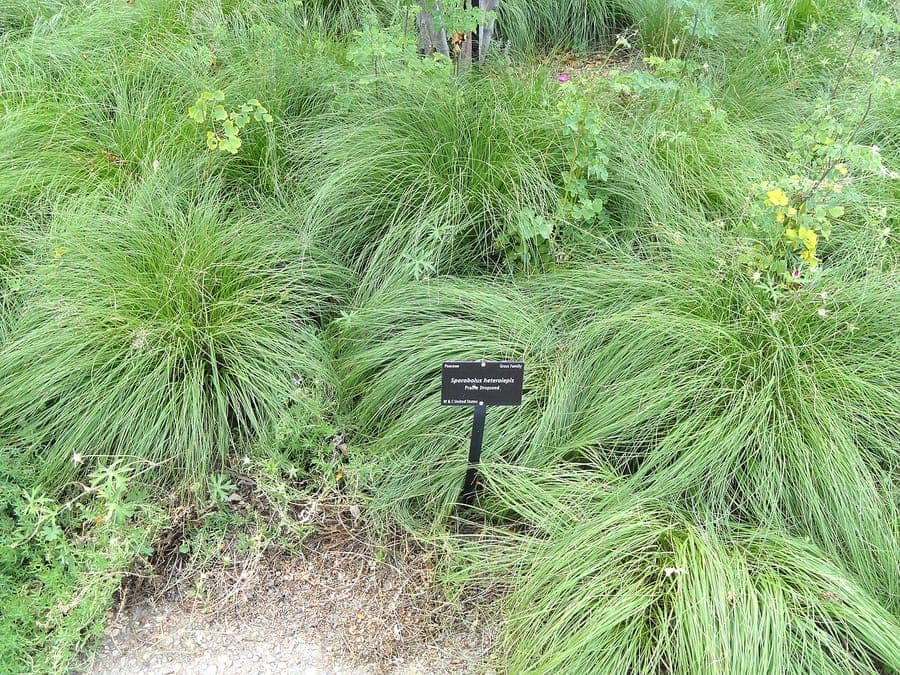
Daderot / Public domain, via Wikimedia Commons
Prairie Dropseed: complete guide
Sporobolus heterolepis
Want to see Prairie Dropseed: complete guide in your garden?
1 minute, no credit card
Overview
Sporobolus heterolepis, commonly known as prairie dropseed or northern dropseed, is a fine-textured, arching bunchgrass native to the vast prairies of North America, ranging from southern Canada through much of the central and eastern United States. Described scientifically in 1848 by botanist A. Gray, this member of the Poaceae family has gained considerable popularity in European gardens over the past two decades, valued for its refined elegance, distinct seasonal transitions, and remarkable ease of care.
The plant forms tidy, rounded clumps typically 40 to 80 cm tall and wide. In spring, narrow, arching dark-green leaves emerge from the base. By midsummer, slender flowering stems rise above the foliage, bearing delicate, open panicles with small, yellowish florets. What truly distinguishes this species is its subtle, sweet fragrance - often described as buttery popcorn or coriander - which drifts pleasantly on warm summer evenings. In autumn, the foliage transitions from its summer green through shades of gold and copper to a rich warm bronze, offering some of the finest autumn colour among ornamental grasses. Through winter, the dried stems and seed heads persist as elegant, frost-dusted structures.
For gardeners seeking a versatile, low-maintenance grass that performs beautifully across all four seasons, prairie dropseed is an outstanding choice. Visit gardenworld.app for design inspiration on incorporating this species into your front garden.
Appearance and bloom cycle
The leaves of Sporobolus heterolepis are narrow, 2 to 3 mm wide, arching gracefully from a central crown. They can reach 45 to 55 cm in length, with a bright green colour that deepens through the season. The texture is notably fine - finer than most ornamental grasses - which creates a delightful, airy quality in the planting.
Flowering occurs from August through October. Stems rise to 70 to 90 cm, well above the foliage mound, and bear loose, open panicles 15 to 25 cm in length. The individual spikelets are small and greenish-yellow, barely conspicuous individually but collectively creating a hazy, smoke-like effect in the late summer border. The characteristic fragrance is most noticeable on warm, still evenings, and on sunny days when the plumes catch the light.
After flowering, the seed heads persist through winter, providing food for seed-eating birds and structure in the dormant garden. The autumn foliage display - shifting from gold through copper to warm orange-brown - is spectacular, and lasts well into November in mild years. This combination of year-round interest makes prairie dropseed one of the most complete ornamental grasses available for temperate gardens.
Ideal location
Prairie dropseed thrives in full sun to very light shade. In its natural habitat on open prairies, it receives direct sunlight for most of the day. In the garden, a minimum of 6 hours of direct sun per day produces the best clumps - compact, upright, and richly fragrant at flowering time.
This species is an excellent choice for dry, exposed positions that challenge many other plants. Its deep root system, which penetrates well into the subsoil, allows it to access moisture even during extended dry spells. It performs particularly well in urban gardens where reflected heat from paving and walls would stress less-adapted species.
Prairie dropseed is suitable for borders, naturalistic plantings, prairie-inspired schemes, rock gardens, dry stream beds, and as an accent plant in containers. Its compact, rounded habit makes it easy to use in a variety of design contexts without the spreading or self-seeding issues that affect some other ornamental grass species.
Soil
Sporobolus heterolepis is adapted to well-drained, lean to moderately fertile soils with a pH of 6.0 to 7.2. On its native prairies, it grows in sandy or rocky soils with excellent drainage and low organic matter content. Replicating these conditions in cultivation produces the most vigorous and attractive plants.
In heavier clay soils, it is worth preparing the planting area by mixing in coarse sand or fine gravel to a depth of 30 cm or more. This improves drainage significantly and reduces the risk of root problems in wet winters. Avoid planting in low-lying areas where water might pool after heavy rainfall.
Rich, overly fertile soils produce lush but floppy growth that looks less attractive and may be less stable in the wind. No regular fertilising is needed: an annual top-dressing of a small amount of well-rotted compost in early spring is entirely sufficient, and many established plants need nothing at all beyond what rainfall and the natural breakdown of mulch can provide.
Watering
Once established, prairie dropseed is highly drought tolerant. During the first growing season after planting, regular watering is important to help the plant develop a deep, extensive root system. Water two to three times a week during dry spells in the first year, ensuring moisture penetrates to a depth of at least 20 cm.
From the second year onwards, the plant can typically manage on natural rainfall except during prolonged droughts of four weeks or more. In these exceptional circumstances, a single thorough watering per week - enough to wet the soil to a significant depth - is usually sufficient. Avoid light, frequent surface watering, which promotes shallow root development.
Reduce watering in autumn and stop entirely through winter. The plant enters a natural dormancy period and excess moisture during cold months increases the risk of crown and root problems, particularly on heavy or poorly drained soils. Good drainage is the key to year-round success.
Free design
Want to see Prairie Dropseed: complete guide in your garden? Make a free design now.
Pruning
Prairie dropseed requires minimal pruning. The recommended approach is to leave the stems and seed heads standing through the winter months. They provide visual interest in the dormant garden, supply seeds for small birds, and offer a degree of insulation to the crown of the plant during frosts.
In late winter or early spring - typically February to early March - cut the whole clump back to 10 to 15 cm above ground level. Use sharp scissors or pruning shears for a clean cut. After cutting, gently remove any dead material from around the base of the clump without disturbing the soil or the emerging new shoots, which may already be visible as small green points at the base.
Do not cut back young plants in their first year after planting. Allow them to complete a full growing season before beginning the annual cutting regime. From the second year, annual spring cutting keeps the clumps fresh and vigorous, stimulating new growth and maintaining the attractive rounded form.
Maintenance calendar
January to February: leave the dried stems and seed heads in place. They provide winter structure and food for birds. The plant is fully dormant.
March: cut the clumps back to 10 to 15 cm. Remove dead material from the base. Add a light top-dressing of compost if desired, but keep it away from the crown.
April to May: new shoots emerge. Slugs may be an issue on young plants - check regularly and take action if needed. No fertiliser required.
June to July: rapid growth phase. Water as needed during dry spells, especially in the first year. No pruning needed.
August to October: the flowering period. Enjoy the delicate plumes and their sweet fragrance. Watch for the gradual change in autumn foliage colour. No action required.
November to December: the plant becomes dormant. Leave all stems in place. No watering, feeding, or pruning needed until the following spring.
Winter hardiness
Sporobolus heterolepis is exceptionally cold-hardy. In its native range it survives temperatures as low as -30 degrees Celsius, across USDA hardiness zones 3 to 5. This makes it fully hardy throughout the United Kingdom and most of Europe, including areas that experience significant winter frost.
No winter protection is needed. In fact, the standing stems provide a small but meaningful degree of insulation to the plant's crown during hard frosts. A thick layer of mulch over the roots is unnecessary for most gardens and may even be counterproductive by trapping excess moisture.
The main winter risk for this species is not cold but wet: prolonged standing water around the roots during cold weather can cause crown rot. Ensuring good drainage is the most important step in preparing for successful winter survival. On well-drained soils, the plant will survive even extended periods of hard frost without any damage.
Companion plants
The fine texture and rounded clump form of prairie dropseed make it an excellent companion for a wide range of perennials and other ornamental plants. Consider the following combinations:
- Echinacea purpurea: the bold, upright coneflowers provide strong contrast with the delicate foliage and plumes of prairie dropseed, and both share a preference for sunny, well-drained conditions.
- Rudbeckia fulgida: its bright yellow flowers in late summer and early autumn complement the bronze autumn foliage of the grass perfectly.
- Salvia nemorosa: the vertical blue flower spikes of meadow sage create a beautiful counterpoint to the arching, rounded form of the grass clumps.
- Agastache foeniculum: prairie-style planting with bee and butterfly appeal, complementing the naturalistic style of this grass.
- Penstemon digitalis: tall and slender, adding height and vertical interest to plantings where prairie dropseed provides the middle layer.
- Aster novae-angliae: New England aster blooms precisely when the grass is at its best autumn colour, creating a stunning seasonal finale.
These combinations produce plantings with interest across all seasons, from spring emergence through summer flowering to autumn colour and winter structure. For more planting combinations and garden design ideas, visit gardenworld.app.
Closing
Sporobolus heterolepis, prairie dropseed, is one of the most rewarding ornamental grasses for temperate gardens. Its four-season appeal - fresh green growth in spring, fragrant flowering plumes in summer, spectacular copper-gold autumn colour, and elegant winter structure - is matched by a toughness and adaptability that makes it easy to grow for gardeners at all levels of experience.
Whether used as a solitary specimen, massed in a prairie-inspired border, or woven through a naturalistic mixed planting, this grass earns its place in any garden that values beauty, seasonal change, and ecological value. It attracts beneficial insects during the growing season and feeds small birds in winter. It asks for little beyond sun and good drainage, and rewards patient gardeners with years of effortless, four-season beauty.
Want to see Prairie Dropseed: complete guide in your garden? Make a free design now.
Upload a photo, pick a style, and get a photorealistic design with plant list in under a minute.
10,000+ gardens designed already
No credit card required


Similar plants
Seashore Dropseed: complete guide
Sporobolus virginicus
Everything about Sporobolus virginicus, the tough seashore dropseed for salty, dry locations. Location, soil, care and coastal garden design ideas.
Intermediate Wheatgrass: complete guide
Thinopyrum intermedium
Everything about Thinopyrum intermedium, the robust intermediate wheatgrass from Europe and Central Asia. Location, soil, care and garden applications.
Smooth meadow grass: complete guide
Poa pratensis
Smooth meadow grass is the most common grass in northern Europe. Learn how to cultivate and maintain this versatile, hardy grass in gardens and lawns.