
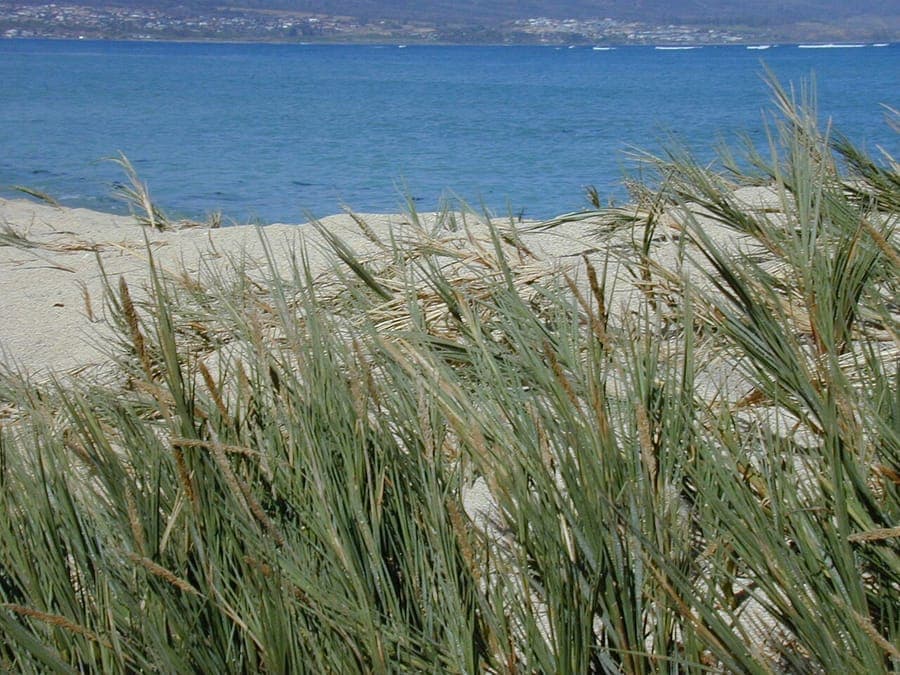
Forest & Kim Starr / CC BY 3.0, via Wikimedia Commons
Seashore Dropseed: complete guide
Sporobolus virginicus
Want to see Seashore Dropseed: complete guide in your garden?
1 minute, no credit card
Overview
Sporobolus virginicus, widely known as seashore dropseed, beach dropseed, water couch, or marine couch, is a perennial rhizomatous grass belonging to the family Poaceae. Native to tropical and subtropical coastal regions worldwide - from the Atlantic coast of the United States and the Caribbean through Africa, South Asia, Australia, and the islands of the Pacific - it is one of the most geographically widespread grasses on earth. In its type locality of Virginia (from which the species name is derived), it colonises salt marshes, sandy foreshores, and brackish transition zones with a dense network of spreading underground rhizomes.
The plant forms low, dense mats typically 20 to 50 cm tall, spreading indefinitely by rhizomes that travel considerable distances through the soil. Its stiff, greyish-green leaves are narrow and sharply pointed, with a waxy coating adapted to reflect intense sunlight and resist salt spray. Sporobolus virginicus is an exceptional groundcover for difficult sites: salty soils, alkaline substrates, full sun, and prolonged drought are conditions in which this plant not only survives but actively thrives.
For coastal garden design ideas and inspiration on using salt-tolerant plants effectively, visit gardenworld.app.
Appearance and bloom cycle
The leaves of Sporobolus virginicus are narrow, 1 to 4 mm wide, stiff, and sharply pointed. They are greyish-green to blue-green in colour, with a waxy surface layer that reduces water loss and protects against salt damage. The leaf sheaths clasp the stem tightly, and the leaves spread outward from the base at low angles, creating the characteristic flat, mat-forming growth habit.
Flowering occurs from late summer through early autumn, typically August to October. Flowering stems rise 30 to 60 cm above the foliage mat and bear narrow, spike-like panicles 3 to 12 cm in length. The individual florets are small and inconspicuous - the ornamental appeal of this plant lies more in the year-round structure of its dense mat than in its flowering display. After flowering, the heads dry to brown, persistent structures that remain through winter.
In autumn, the foliage may take on reddish or bronzy tones before the plant enters its semi-dormant phase in colder climates. The dense, rippling mats of seashore dropseed provide year-round texture and structure in coastal gardens, moving fluidly with sea breezes and offering a naturalistic quality that suits relaxed, wildlife-friendly planting styles.
Ideal location
Sporobolus virginicus requires full sun. Adapted to the intense sunlight of tropical and subtropical coastal environments, it performs best with at least 6 hours of direct sun per day in garden cultivation. In shadier positions, the mats become thinner and less vigorous, losing the dense, attractive quality that makes this species useful.
This species is outstanding for locations that challenge most other plants: salt-affected soils near the coast, brackish areas, dry rock faces and slopes, and hard surfaces with reflected heat and low moisture. It is widely used for coastal bank stabilisation and erosion control on sandy slopes, and it is also well suited to contemporary, low-maintenance garden designs where a tough, permanent groundcover is required for large, difficult areas.
For private gardens, seashore dropseed is interesting for driveways, between paving stones, along walls and hedges that retain heat and salt, and on properties bordering the coast. Its spreading rhizomes gradually colonise the surrounding soil, eventually forming a tight, seamless mat that suppresses weeds effectively.
Soil
Sporobolus virginicus has exceptionally broad soil tolerances. It is well-known within the Poaceae family as one of the most salt-tolerant species available, and it also tolerates dry, alkaline, sandy, and even mildly disturbed soils without difficulty. In its natural habitat it grows on substrates ranging from beach sand and dune systems to brackish mudflats and rocky shores.
The ideal cultivation soil is well-drained, lean to moderately fertile, with a pH of 6.0 to 8.0. On lean sandy soils it performs excellently. On richer, more humus-rich soils the growth may be more lush, but the compact mat structure is maintained as long as sufficient sunlight is available.
In clay-heavy or poorly drained gardens, incorporating a drainage layer of coarse sand or gravel is essential before planting. Standing water is not problematic during the growing season, but persistent moisture during cold winters can damage the rhizomes on heavy substrates. Fertilising is rarely necessary: this species actually prefers lean conditions and excessive fertility can produce floppy, less attractive growth.
Watering
Once established, Sporobolus virginicus is one of the most drought-tolerant grasses available for garden use. In its native coastal habitat, it regularly endures periods of extreme drought, and the high salt concentration in the soil further limits available moisture - conditions that most plants would not survive.
In the first year after planting, regular watering is important to give the rhizomes time to become established. Water two to three times a week during dry spells, ensuring moisture penetrates to at least 15 cm depth. From the second year, the plant generally manages on natural rainfall except during exceptionally prolonged droughts.
In coastal sites or on soils with a brackish water table, virtually no supplementary irrigation is needed: the plant adjusts its water uptake to suit the available supply. Avoid excessive and frequent watering on established plants, as this can accelerate the spread of rhizomes into areas where the gardener would prefer not to have the plant. On confined sites or in containers, careful management of water prevents unwanted spread.
Free design
Want to see Seashore Dropseed: complete guide in your garden? Make a free design now.
Pruning
Seashore dropseed requires very little active pruning. The low height and density of the mat mean that the plant rarely needs cutting back. In many applications - erosion control, bank stabilisation, large groundcover areas - pruning is actually undesirable, as cutting the mat interrupts its protective function and may expose bare soil temporarily.
In borders or along paths where a clean edge is desired, annual trimming of the perimeter is recommended to keep the mat from spreading into unwanted areas. Use sharp scissors, a garden knife, or a rotary trimmer, and cut back to the desired line in early spring - February to April - before new growth begins in earnest.
Where rhizome spread is considered invasive, the underground runners can be cut with a spade along the desired boundary. This is more effective than surface trimming alone. In containers, the plant is entirely manageable. Be aware that the rhizomes may extend 30 to 50 cm beyond the visible edge of the foliage mat.
Maintenance calendar
January to February: the mat remains intact. Edge trimming can be carried out if spread has been excessive. The plant is in a semi-dormant phase but retains its foliage in mild winters.
March to April: the beginning of the growing season. Check the edges of the mat. No fertiliser needed. Remove any frost-damaged leaf tips if desired.
May to June: rapid growth and rhizome spread. Check that the mat is not advancing into other planting areas or pathways. Establish boundaries with a spade if needed.
July to August: the plant is at its most vigorous. Water once a week during extreme drought. Flowering begins in August.
September to October: flowering and seed set. The mat may take on reddish or bronze tints. No pruning needed.
November to December: the plant remains green in mild winters, partially dying back in hard frosts. No watering, fertilising, or pruning needed until spring.
Winter hardiness
Sporobolus virginicus is a species of tropical and subtropical regions, and its cold hardiness is accordingly more limited than that of its temperate relatives. It survives without difficulty through mild winters in USDA hardiness zones 8 to 10 - which corresponds to the coastal strip of much of Western Europe, including the British Isles and the Atlantic coast of mainland Europe.
In areas with prolonged frost below minus 5 degrees Celsius, the above-ground foliage may die back entirely, but the underground rhizomes typically survive and produce new growth in spring. A protective mulch of dry straw or leaf compost over the root zone in late autumn reduces the risk of rhizome damage during hard winters.
For coastal gardens in the Netherlands, the UK, and similar maritime climates with mild, moist winters, this species is generally reliable. Its natural range includes temperate coastal regions on multiple continents, demonstrating its adaptability to the specific combination of salt, wind, and mild but moist winters that characterise Atlantic seaboard climates. For more information on coastal-hardy plants suited to temperate gardens, visit gardenworld.app.
Companion plants
Seashore dropseed combines best with other plants sharing its preference for full sun, salt tolerance, drought resistance, and lean substrates. Recommended companions include:
- Ammophila arenaria (marram grass): the classic coastal pioneer for shifting dunes and open sand, combining with seashore dropseed for maximum erosion control and coastal authenticity.
- Limonium vulgare (common sea lavender): purple-blue flower clusters above the dense mat, typical of salt marshes and tidal zones, providing colour contrast.
- Glaucium flavum (yellow horned poppy): vivid yellow flowers on dry, stony coastal edges, contrasting with the grey-green foliage of the dropseed.
- Armeria maritima (thrift or sea pink): compact pink flower heads on wiry stems, perfectly suited to salty, dry coastal soils.
- Carpobrotus edulis (Hottentot fig): a mat-forming succulent companion for sheltered coastal banks in warmer regions.
- Festuca glauca (blue fescue): similar textural qualities but with a cool blue-grey tone that creates a beautiful colour contrast within the mat planting.
These combinations are not only visually pleasing but also ecologically valuable, providing foraging habitat for coastal butterflies, bees, and other invertebrates.
Closing
Sporobolus virginicus, seashore dropseed, is a plant of extremes: extremely salt-tolerant, extremely drought-resistant, and extremely adaptable to difficult soils and challenging climatic conditions. These same qualities make it invaluable to gardeners in coastal areas, on dry slopes, and in locations that defeat most ornamental plants.
Its understated elegance - the dense, rippling mats of grey-green foliage that sway and shimmer in a sea breeze - fits well into contemporary minimal garden styles, naturalistic coastal landscapes, and erosion-control plantings alike. The plant asks for little: a sunny position, a free-draining substrate, and minimal irrigation. In return, it delivers year after year of stable, attractive groundcover that prevents erosion, suppresses weeds, and provides habitat for coastal invertebrates.
Want to see Seashore Dropseed: complete guide in your garden? Make a free design now.
Upload a photo, pick a style, and get a photorealistic design with plant list in under a minute.
10,000+ gardens designed already
No credit card required


Similar plants
Prairie Dropseed: complete guide
Sporobolus heterolepis
Everything about Sporobolus heterolepis, the elegant prairie dropseed from North America. Location, soil, care and garden design inspiration.
Intermediate Wheatgrass: complete guide
Thinopyrum intermedium
Everything about Thinopyrum intermedium, the robust intermediate wheatgrass from Europe and Central Asia. Location, soil, care and garden applications.