
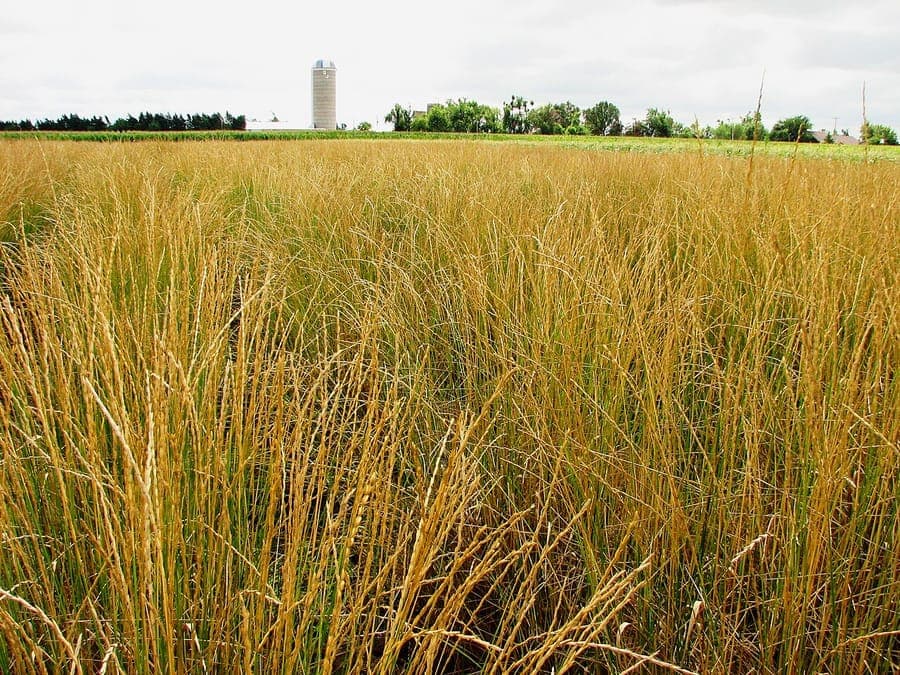
Dehaan / CC BY-SA 3.0 us, via Wikimedia Commons
Intermediate Wheatgrass: complete guide
Thinopyrum intermedium
Want to see Intermediate Wheatgrass: complete guide in your garden?
1 minute, no credit card
Overview
Thinopyrum intermedium, scientifically described in 1985 by Barkworth and D.R. Dewey, is a rhizomatous grass belonging to the family Poaceae. Formerly known as Agropyron intermedium or Elytrigia intermedia, it is native to the steppes and dry slopes of Europe and Central Asia, with a natural range extending from Spain and France through Germany, Poland, and the Balkans to Kazakhstan, Ukraine, and Pakistan. The species has also been widely introduced in North America, where it has naturalised across many states in the West and Midwest.
The plant produces upright stems 60 to 120 cm tall, with narrow, stiff, blue-grey to grey-green leaves. It spreads underground via rhizomes and can cover considerable areas given time. Its deep root system makes it exceptionally drought-tolerant and effective at stabilising soil against erosion. In its native habitat it grows on calcareous, dry soils with low fertility, and it performs best in similar conditions in cultivation.
For gardeners seeking a tough, low-maintenance grass for large, dry, or sloping sites, intermediate wheatgrass is an outstanding choice. For design inspiration on incorporating ornamental grasses into your front garden, visit gardenworld.app.
Appearance and bloom cycle
The leaves of Thinopyrum intermedium are narrow, 3 to 8 mm wide, with a blue-grey to grey-green colour from a waxy surface layer. They are stiff and slightly arching, with a characteristic ribbed texture on the upper surface. Plant height ranges from 60 to 120 cm depending on soil moisture and growing conditions.
Flowering occurs from June to August. The flowering stem rises stiffly upright and carries a spike-like inflorescence 10 to 20 cm long. The spikes are two-ranked with laterally flattened spikelets. The flower is not particularly showy in colour but gives the planting a strong vertical structure. After flowering, the seed grains ripen to brown kernels that are highly attractive to seed-eating birds such as finches and buntings.
In autumn the foliage gradually turns from grey-green to yellowish-brown. The dried stems and seed heads remain standing through winter, providing decorative structure and winter food for birds. Only in early spring, before new growth begins, should the old stems be cut back. The plant flowers reliably each year and gradually forms wider clumps unless the rhizomes are managed annually.
Ideal location
Thinopyrum intermedium thrives in full sun to very light shade. Native to open, dry steppe landscapes, it needs little shade for optimal development. A location with at least 5 to 6 hours of direct sunlight per day is ideal.
This species is particularly valuable on dry, sloping sites where erosion is a problem. The extensive rhizome network anchors the soil effectively and handles both drought and moderate rainfall. On unmanaged sites, road and rail embankments, and calcareous slopes it is a proven method of preventing soil erosion.
For garden use, it is suited to prairie-style borders, dry landscape gardens, large groundcover areas, and as a structural element in naturalistic plantings. Because it spreads by rhizomes, it is best used where some room to expand is available, or annual boundary control with a spade is applied.
Soil
The ideal soil for Thinopyrum intermedium is well-drained, moderately to poorly fertile, and neutral to mildly alkaline (pH 5.6 to 8.4). Native to calcareous, dry steppe soils, the plant does not mind lean, slightly stony conditions and actually performs better in them than in richer ground.
On sandy and light loamy soils it does excellently without any modification. On heavier clay soils it is worth mixing coarse sand or gravel into the planting hole to improve drainage and avoid standing water in winter. Rich, nitrogen-heavy soils produce lush but floppy growth that stands less attractively. Regular fertilising is almost never needed: this species prefers lean conditions. A small application of well-rotted compost in early spring is entirely sufficient for plants on very poor soils.
Watering
Once established, Thinopyrum intermedium needs very little to no supplementary watering. Native to the dry steppes of Central Asia, it has evolved to cope with extended drought periods. Its deep rhizome system allows it to access moisture from deeper soil layers even in dry summers.
In the first year after planting, watering twice a week is recommended to help the rhizomes establish well. Ensure water penetrates to at least 20 cm depth. Surface sprinkling is ineffective and encourages shallow rooting. From the second growing year, supplementary watering is only needed during prolonged droughts of four to five weeks or more. Water thoroughly once a week in those circumstances. In autumn and winter, additional watering is unnecessary and potentially harmful: cold combined with wet soil is more damaging than cold alone.
Free design
Want to see Intermediate Wheatgrass: complete guide in your garden? Make a free design now.
Pruning
Intermediate wheatgrass requires minimal pruning. The stems and seed heads can remain standing through autumn and winter - they are decorative and feed overwintering seed-eating birds. Only in early spring - February or early March - should the clumps be cut back to 10 to 15 cm above ground level. Use a sharp pair of scissors or hedge shears for a clean cut. Remove cut material from the base and avoid digging around the plant to protect the rhizomes. Young plants in their first year should not be cut back; allow them to complete a full growing season first.
When rhizome spread is excessive, the underground runners can be cut with a spade at the desired boundary. This is more effective than surface pruning. In narrower borders, annual boundary management is recommended; in larger landscape settings, the spreading habit is often an advantage.
Maintenance calendar
January to February: the dried stems and seed heads stand as decorative winter structure. Seed-eating birds visit the clumps. The plant is fully dormant.
March: cut clumps back to 10 to 15 cm. Remove dead material from the base. Check whether rhizome spread has been excessive.
April to May: new shoots appear. No fertiliser needed unless the soil is very poor. Check for slugs on young plants.
June to August: the flowering period. The upright seed spikes are decorative. Water only during severe drought. No pruning needed.
September to October: seed heads ripen. Seeds attract birds. Foliage turns yellowish-brown. Growth slows significantly.
November to December: the plant is dormant. Stems remain standing. No watering, fertilising, or pruning needed until spring.
Winter hardiness
Thinopyrum intermedium is very cold-hardy. In its natural range it survives the hard winters of Central Asia and Eastern Europe, down to minus 20 degrees Celsius or colder, corresponding to USDA hardiness zones 4 to 6. It overwinters without any protection throughout the UK, most of continental Europe, and the temperate zone generally.
No winter protection is needed. The standing stems provide the plant's crown with a small degree of insulation during hard frost. A mulch layer is unnecessary and can be counterproductive if it traps excess moisture at the base. On well-drained soils, winter hardiness is essentially never an issue.
Wet winters pose a greater risk than cold ones: prolonged standing water around the roots during frost can damage the rhizomes. Good drainage is therefore the key protective measure. On free-draining soils, this grass withstands even extended periods of hard frost without damage.
Companion plants
Thinopyrum intermedium combines excellently with other drought-tolerant, sun-loving plants. Recommended combinations include:
- Salvia nemorosa (meadow sage): upright blue flower spikes beside the stiff seed heads of the wheatgrass create a classic steppe combination with strong horizontal-vertical dynamics.
- Echinacea purpurea (purple coneflower): bold, rounded flowers that contrast beautifully with the linear texture of the grass.
- Achillea filipendulina (fernleaf yarrow): flat yellow flower heads above the grass add a light, summery feel to the planting.
- Sedum telephium (orpine): succulent leaves and rosy-red late-autumn flowers as contrast with the dry, stiff stems.
- Verbascum thapsus (great mullein): tall, felted flower spikes adding vertical dynamism in naturalistic borders alongside the wheatgrass.
- Festuca glauca (blue fescue): similar texture but finer and bluer in colour for a harmonious transitional effect.
These combinations suit prairie-style borders, dry landscape gardens, and naturalistic plantings. They are also attractive to butterflies, bees, and seed-eating birds. For more garden design ideas, visit gardenworld.app.
Closing
Thinopyrum intermedium, intermediate wheatgrass, is a robust and versatile grass that has thrived on the steppes of Europe and Central Asia for millennia. Its exceptional drought resistance, soil-binding rhizomes, and attractive vertical structure make it a valuable plant for gardens challenged by drought, erosion, or large difficult-to-plant areas.
In an era of climate change with warmer, drier summers, a plant like intermediate wheatgrass only grows more relevant. It asks little, delivers a seasonal rhythm from green to golden, and provides a winter structure that also feeds birds. Place it correctly - a sunny, dry location with a well-draining substrate - and it will reward you year after year with effortless, sustained beauty.
Want to see Intermediate Wheatgrass: complete guide in your garden? Make a free design now.
Upload a photo, pick a style, and get a photorealistic design with plant list in under a minute.
10,000+ gardens designed already
No credit card required


Similar plants
Prairie Dropseed: complete guide
Sporobolus heterolepis
Everything about Sporobolus heterolepis, the elegant prairie dropseed from North America. Location, soil, care and garden design inspiration.
Seashore Dropseed: complete guide
Sporobolus virginicus
Everything about Sporobolus virginicus, the tough seashore dropseed for salty, dry locations. Location, soil, care and coastal garden design ideas.
Crested Wheatgrass: complete guide
Agropyron cristatum
Discover Agropyron cristatum, a resilient Eurasian grass. Learn cultivation and use in drought gardens for sustainable, low-maintenance landscapes.