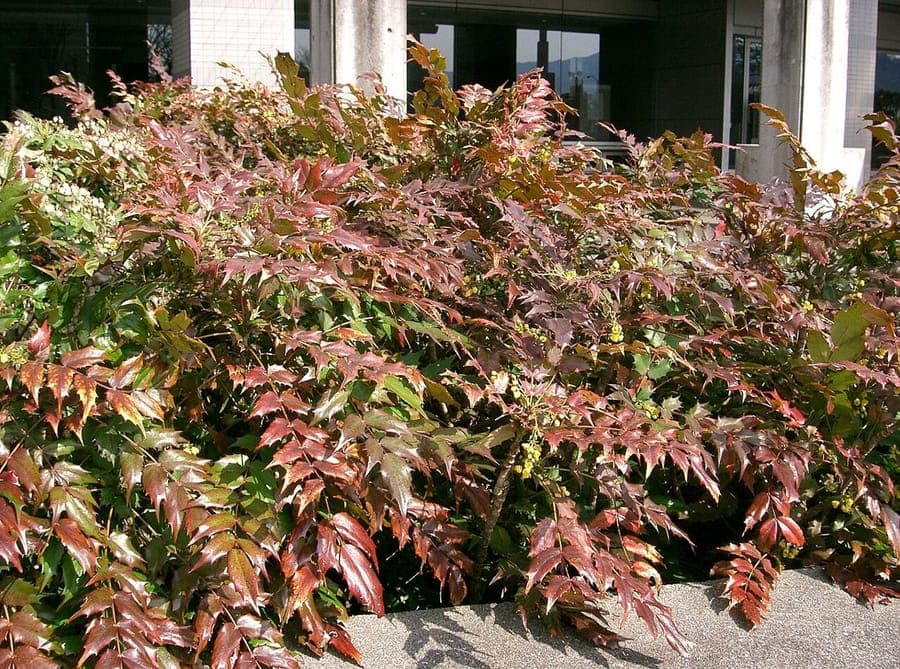
KENPEI / CC BY-SA 3.0, via Wikimedia Commons
Japanese mahonia: complete guide
Mahonia japonica
Want to see Japanese mahonia: complete guide in your garden?
Full design in HD: €7.99
Look after your Japanese mahonia with the GardenWorld app
Identify plants with your camera and get a care calendar with reminders for this plant.


Overview
Japanese mahonia (Mahonia japonica) is an evergreen shrub that flowers when the garden is at its barest. From November into March, long sprays of lemon-yellow flowers hang above the dark foliage, releasing a sweet scent reminiscent of lily of the valley. On a mild winter's day you smell the shrub before you see it.
Despite its name, the species does not originally come from Japan but from Taiwan and parts of China. It has, however, been grown in Japanese gardens for centuries, and from there it reached Europe in the nineteenth century. It is one of the parents of the well-known hybrid Mahonia × media, which includes cultivars such as 'Charity' and 'Winter Sun'. Botanists now often place mahonias in the genus Berberis, but in the nursery trade Mahonia remains the usual name.
The shrub grows slowly into a broad, slightly open shape 1.5 to 2 m tall and 2 to 3 m wide. It is ideal for shady positions, under trees or on the north side of a house. On gardenworld.app you can have a garden design made in which Japanese mahonia joins other winter-flowering plants to create a corner that stands out in the darkest months.
Appearance and bloom cycle
The leaves are large and pinnate, up to 40 cm long, with seven to nineteen stiff, glossy leaflets edged with a few sharp spiny teeth. In shade they stay dark green. In a sunnier spot they often turn bronze, red or purple in autumn and winter, adding an extra splash of colour at that time of year.
The flower sprays appear at the tips of the stems and are 10 to 25 cm long. They spread outwards at first and later arch slightly, unlike the upright spikes of Mahonia × media. The flowers are pale lemon yellow and more fragrant than those of most other mahonias. On mild days queen bumblebees and early bees visit them, and their winter nectar is a welcome source of food.
In spring the flowers are followed by oval, blue-black berries with a bluish bloom, which blackbirds and thrushes love. Like all mahonias the plant contains berberine, mainly in the roots and bark. The berries are not seriously poisonous, but eaten raw in quantity they can cause stomach upsets in people and pets.
Ideal location
Mahonia japonica is a true shade plant. Partial to full shade suits it best, for example under tall trees, along a north-facing wall or among other shrubs. In full sun on a dry site the leaves may scorch, although in a cooler climate it will take a few hours of sun.
Choose a spot sheltered from cold, drying winds, which damage leaves and flowers in winter. Because it flowers in winter, plant it where you will see and smell it then: beside the front door, along a path you use every day or within view of a window.
Mind the spines. Do not plant Japanese mahonia right next to a narrow path or a play area. Allow about 1.5 to 2 m between it and other shrubs. For an informal hedge or group, space plants 1 m apart.
Soil requirements
Japanese mahonia grows best in humus-rich, moisture-retentive soil that drains well. It tolerates both slightly acidic and slightly alkaline conditions. Ordinary garden soil with compost or leaf mould is fine, and under deciduous trees the fallen leaves provide humus naturally.
On heavy clay, work compost and coarse grit into the planting hole, as the plant dislikes roots sitting wet through winter. On poor, sandy soil add plenty of compost. Dig a hole twice as wide as the root ball and plant at the same level as in the pot. A mulch of leaf mould or bark keeps the soil cool and moist.
Free preview
Want to see Japanese mahonia: complete guide in your garden? Make a free preview of your design.
Watering
Young plants need regular watering in their first year. In dry weather give 10 litres once or twice a week so the soil around the root ball stays moist. Once established, Japanese mahonia is fairly resilient and usually manages on rainfall.
Under trees, competition for water is fierce. Give extra water there during long, dry summers, otherwise the shrub will form fewer flower buds. Evergreen leaves can also dry out during a dry, frosty winter, so water on a frost-free day. In a large container, check every two or three days in summer.
Pruning
Pruning is usually unnecessary. If you do want to shape the shrub, do it straight after flowering in March or April. That way you lose no flowers, as next winter's buds form in summer at the tips of the stems.
After several years the stems often become long and bare, with leaves only at the top. Cut one or two of the longest stems back to just above a whorl of leaves, 30 to 50 cm above the ground. They will reshoot from there and the shrub becomes fuller. Spread this renewal over a few years, and wear sturdy gloves.
Maintenance calendar
January to March: Full flower. Enjoy the scent and leave the blooms for early insects.
March to April: Light pruning or renewal after flowering. Add a layer of compost or some organic shrub feed.
May to June: Berries ripen; leave them for the birds. A good time to plant.
July to August: Water during dry spells, especially under trees and in containers. Flower buds are forming now.
September to October: Top up the mulch. Buds become visible.
November to December: Flowering begins. Protect young plants and containers from hard frost and cold winds.
The plant calendar on gardenworld.app sets out these tasks month by month, along with what the rest of your garden needs.
Winter hardiness
Mahonia japonica is reliably hardy and tolerates temperatures down to about -15 to -20 °C. Across Britain and Ireland it survives in open ground without protection. Hard frost and cold easterly winds can damage the flowers and some of the foliage, but the plant usually recovers quickly in spring.
Young plants and those in containers are more vulnerable. During prolonged frost, spread a layer of leaves around the base and wrap the pot in hessian or bubble wrap.
A word on spread: related species such as Mahonia aquifolium have escaped from gardens in parts of Europe, and in the south-eastern United States the related Mahonia bealei has naturalised. Japanese mahonia is not on invasive species lists in western Europe, but birds do spread the seeds, so pull up seedlings if you live near woodland.
Companion plants
Japanese mahonia forms a lovely picture with other winter-flowering plants. Chinese witch hazel (Hamamelis mollis) flowers at the same time, with spidery yellow flowers and a similar fragrance. Skimmia (Skimmia japonica) adds red buds or berries and stays compact enough to sit in front of it.
At its feet, Lenten roses (Helleborus orientalis), snowdrops (Galanthus nivalis) and winter aconites colour the ground in February. For contrast in leaf shape, Japanese aralia (Fatsia japonica) is a strong choice. Ferns and pachysandra complete the shady corner in summer.
Final thoughts
Japanese mahonia is a dependable shrub for shade that brings scent and colour to the garden in winter. Humus-rich soil, shelter from cold winds and a prune after flowering when needed are all Mahonia japonica asks. Plant it where you walk past in January, and you will appreciate it anew every winter.
Frequently asked questions about Japanese mahonia
Is Japanese mahonia winter hardy?
Mahonia japonica is reliably hardy and tolerates temperatures down to about -15 to -20 °C. Across Britain and Ireland it survives in open ground without protection.
When and how do you prune Japanese mahonia?
Pruning is usually unnecessary. If you do want to shape the shrub, do it straight after flowering in March or April.
How much water does Japanese mahonia need?
Young plants need regular watering in their first year. In dry weather give 10 litres once or twice a week so the soil around the root ball stays moist.
Where does Japanese mahonia grow best?
Mahonia japonica is a true shade plant. Partial to full shade suits it best, for example under tall trees, along a north-facing wall or among other shrubs.
What soil does Japanese mahonia need?
Japanese mahonia grows best in humus-rich, moisture-retentive soil that drains well. It tolerates both slightly acidic and slightly alkaline conditions.

See it in your garden
See Japanese mahonia in your garden
One photo of your garden and a few questions. You see the result in about a minute.
Try it with a photoIdentify this plant in your own garden. Identify a plant
Similar plants
Chinese Witch Hazel: complete guide
Hamamelis mollis
Chinese witch hazel blooms in January-February with fragrant yellow flowers even in deep winter. Master care, site selection, and pruning to enjoy 30+ years of winter color.
Lenten-rose: complete guide
Helleborus orientalis
Learn how to grow and care for Helleborus orientalis. This early-blooming perennial thrives in shady spots and flowers from February to April, adding colour when little else is blooming.
Skimmia japonica: complete guide
Skimmia japonica
Evergreen shrub with red berries and fragrant leaves that remain visible long. Winter hardy to -10C, perfect for shade.
