Pahazzard / CC BY-SA 3.0, via Wikimedia Commons
Goldflame honeysuckle: complete guide
Lonicera × heckrottii
Want to see Goldflame honeysuckle: complete guide in your garden?
Full design in HD: €7.99
Look after your Goldflame honeysuckle with the GardenWorld app
Identify plants with your camera and get a care calendar with reminders for this plant.


Overview
Lonicera × heckrottii is one of the most popular climbing honeysuckles in European gardens, usually sold as goldflame honeysuckle or 'Gold Flame'. It is a garden hybrid between the North American trumpet honeysuckle (Lonicera sempervirens) and Lonicera × americana, itself a cross between the European perfoliate honeysuckle and the Etruscan honeysuckle. As far as is known there is only one clone, and 'Gold Flame' is really a trade name for that same plant.
What makes it so popular is its long flowering season. Whereas the wild woodbine flowers mainly in June and July, this hybrid keeps going in flushes from June into September and sometimes October. The flowers are strikingly two-toned, carmine pink outside and yellow within, and they are most fragrant in the evening. The plant reaches 3 to 4 metres in height and 1 to 2 metres across, which makes it less rampant than many honeysuckles. It is ideal for a smaller garden, an arch, an obelisk or a stretch of fence. If you would like to see how a climber like this fits into your garden, you can have a garden design made at gardenworld.app that takes your aspect and available space into account.
Appearance and bloom cycle
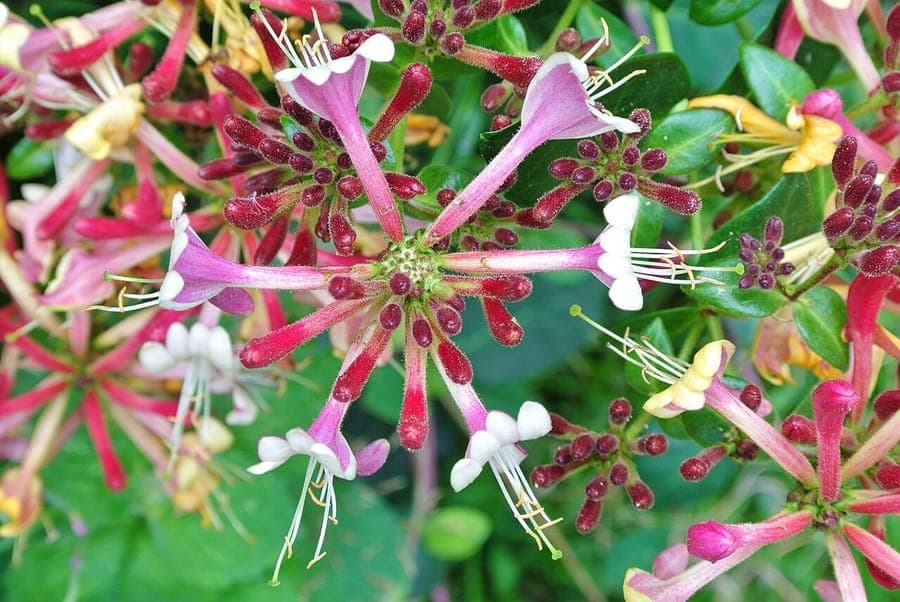
The flowers appear in whorls at the tips of the shoots, often with several whorls stacked above one another. The buds are deep carmine red and finely hairy. An open flower is a two-lipped tube 4 to 5 cm long, pink to purplish pink outside and creamy white to golden yellow inside, the yellow deepening as the flower ages. Long stamens and a style protrude from the mouth. So one stem carries red buds, pink tubes and yellow throats at the same time, a play of colour that gave the plant its trade name.
The leaves are oval, 4 to 6 cm long, dark bluish green above and greyish green beneath. Below the flower clusters, the uppermost pairs of leaves are often fused, so the stem appears to pass through the leaf, a feature inherited from its parents. In mild winters some foliage hangs on, as the plant is semi-evergreen. It produces only a few berries, which are red.
Ideal location
Lonicera × heckrottii flowers most freely in sun or light partial shade. Like most honeysuckles, it prefers its stems in the light and its roots in the cool. An east- or west-facing position is ideal. On a hot, dry south wall it suffers more from aphids and mildew; in too much shade it flowers less.
Support. This is the big difference from clematis: honeysuckle is a twining climber. It does not climb with leaf stalks or aerial roots, but winds its whole stems around a support. It therefore prefers vertical elements to twist around:
- vertical wires or tension cables 20 to 30 cm apart, with a 5 cm gap to the wall;
- a timber or metal trellis with upright battens;
- an obelisk, rose arch or pergola with uprights that are not too thick;
- a strong rope or climbing net along a post.
On a bare, smooth wall it cannot climb. After planting, guide the shoots to the support and wind them around it a few times yourself. Tie them in loosely, because tight string will cut into the stems later. Let a few stems run diagonally or horizontally as well: this produces more side shoots and so more flowers at eye level.
Soil requirements
Honeysuckle is not fussy. Any humus-rich, moisture-retentive but well-drained garden soil will do, from slightly acid to slightly alkaline. On sand, work compost into the planting hole to hold moisture; on heavy clay, add some coarse grit to avoid wet feet in winter.
Dig a hole about 40 cm deep and wide and plant 30 to 40 cm away from a wall. A mulch of leaf mould or wood chips around the base keeps the roots cool and moist. Spring and early autumn are the best planting times.
Watering
In the first year, give a full can of water once a week during dry spells. Established plants are fairly drought tolerant, but a honeysuckle that is too dry is more prone to aphids and mildew and flowers for a shorter time. Give extra water in hot summers, especially against a wall.
Feed in March with compost or an organic fertiliser. Too much nitrogen produces soft, aphid-prone growth; a balanced feed with some potassium is better for flowering. Lonicera × heckrottii also does well in a large container of at least 40 litres, provided you water regularly and give a liquid feed every three weeks.
Free preview
Want to see Goldflame honeysuckle: complete guide in your garden? Make a free preview of your design.
Pruning
The familiar pruning groups 1, 2 and 3 belong to clematis, not to honeysuckle. Climbing honeysuckles are divided differently: those that flower mainly on the previous year's wood, and those that flower on new shoots. Lonicera × heckrottii belongs to the second type: it forms its flowers at the tips of shoots grown in the same season. The RHS places it among climbers that are pruned lightly after flowering.
Light summer pruning: after the first flush, in July, cut the flowered shoots back by a good length to a few pairs of leaves. This encourages new shoots and a further flush of flowers.
Spring tidy-up: in March, remove dead wood, shorten over-long stems and thin out a few old, bare stems. Then guide the young shoots back over the support.
Renovation: an old, overgrown plant can be cut back to 60 cm above ground in one go in February or March. It reshoots well, but will flower less that year.
Left unpruned, honeysuckle forms a dense tangle with flowers only at the top and a bare, woody base.
Maintenance calendar
March: tidy-up pruning, remove dead wood, add compost or fertiliser, check the support.
April to May: wind young shoots around the support and tie in loosely. Check shoot tips for aphids and hose them off if needed.
June to July: first flush of flowers. Water during dry spells.
July: shorten flowered shoots to encourage another flush.
August to September: repeat flowering; keep watering in dry weeks.
October to November: planting season; some leaves drop.
December to February: dormancy. An overgrown plant can be renovated in late February.
A planting calendar with these tasks for each plant, tailored to your garden, is available at gardenworld.app.
Winter hardiness
Lonicera × heckrottii is reliably hardy in Britain, Ireland and the Low Countries, tolerating frost down to about -20 °C. In severe winters it loses all its leaves and the youngest shoot tips can be frosted; simply cut these off in March. Move container plants against the house in winter or insulate the pot.
Pests and diseases: aphids are the main issue, especially on young tips in spring, and a dry, hot position makes matters worse. Powdery mildew can appear in dry late summers; enough water and an airy spot help.
Toxicity: honeysuckle berries are considered mildly toxic. Eating them can cause stomach upsets such as vomiting and diarrhoea in children and pets such as dogs and cats. Lonicera × heckrottii sets only a few berries, but keep them out of reach anyway. Touching the flowers and leaves causes no problems.
Companion plants
A classic combination is honeysuckle with a climbing rose on the same arch or pergola. The pink and yellow flowers go beautifully with a pink or creamy white rose, and the scents complement each other. A pruning group 3 clematis such as purple or wine-red Clematis viticella can also share a support with honeysuckle, as long as the honeysuckle does not smother it.
For a true scented corner, combine it with common jasmine (Jasminum officinale) and the wild woodbine (Lonicera periclymenum), which flowers a little earlier. At the base, lavender, catmint or sage (Salvia nemorosa) work well: like the honeysuckle they attract bees and butterflies and give a lovely contrast in purple and blue.
Final thoughts
Lonicera × heckrottii is a rewarding climber for anyone who wants a long flowering season and evening scent without taking on a giant. Remember that it is a twining climber: give it vertical wires, battens or an arch to wind around. And do not prune it like a clematis, but lightly: shorten flowered shoots after the first flush and tidy it up in March. From June into autumn you will then have colourful, fragrant flower clusters by your patio or front door.
Frequently asked questions about Goldflame honeysuckle
Is Goldflame honeysuckle winter hardy?
Lonicera × heckrottii is reliably hardy in Britain, Ireland and the Low Countries, tolerating frost down to about -20 °C. In severe winters it loses all its leaves and the youngest shoot tips can be frosted; simply cut these off in March.
When and how do you prune Goldflame honeysuckle?
The familiar pruning groups 1, 2 and 3 belong to clematis, not to honeysuckle. Climbing honeysuckles are divided differently: those that flower mainly on the previous year's wood, and those that flower on new shoots.
How much water does Goldflame honeysuckle need?
In the first year, give a full can of water once a week during dry spells. Established plants are fairly drought tolerant, but a honeysuckle that is too dry is more prone to aphids and mildew and flowers for a shorter time.
Where does Goldflame honeysuckle grow best?
Lonicera × heckrottii flowers most freely in sun or light partial shade. Like most honeysuckles, it prefers its stems in the light and its roots in the cool.
What soil does Goldflame honeysuckle need?
Honeysuckle is not fussy. Any humus-rich, moisture-retentive but well-drained garden soil will do, from slightly acid to slightly alkaline.

See it in your garden
See Goldflame honeysuckle in your garden
One photo of your garden and a few questions. You see the result in about a minute.
Try it with a photoIdentify this plant in your own garden. Identify a plant
Similar plants
Woodbine: complete guide
Lonicera periclymenum
Grow Lonicera periclymenum successfully: blooms June–September, thrives in partial shade, ideal for climbing fences and trees, attracts pollinators.
Common jasmine: complete guide
Jasminum officinale
Everything you need to grow and care for Common jasmine: light, watering, pruning, and the best companion plants for your garden.
Purple clematis: complete guide
Clematis viticella
How to grow Clematis viticella successfully: ideal conditions, pruning, watering, companion plants and design tips for your garden.
