
Wikimedia Commons / CC BY-SA 3.0, via Wikimedia Commons
Woodbine: complete guide
Lonicera periclymenum
Want to see Woodbine: complete guide in your garden?
1 minute, no credit card
Overview
Lonicera periclymenum, commonly known as woodbine, is a classic British native climber that brings elegance and scent to gardens across temperate zones. It naturally occurs in woodlands and hedgerows from Ireland to Greece, climbing over shrubs and low trees using its twining stems. With a steady growth rate of 50–80 cm per year, it typically reaches 4–6 m in height within a few seasons. Once established, it can live for decades, making it a long-term asset in any garden.
On gardenworld.app, you can design a planting scheme that incorporates woodbine along fences, arbours, or old tree trunks, ensuring it has room to climb without overcrowding.
Appearance & bloom cycle
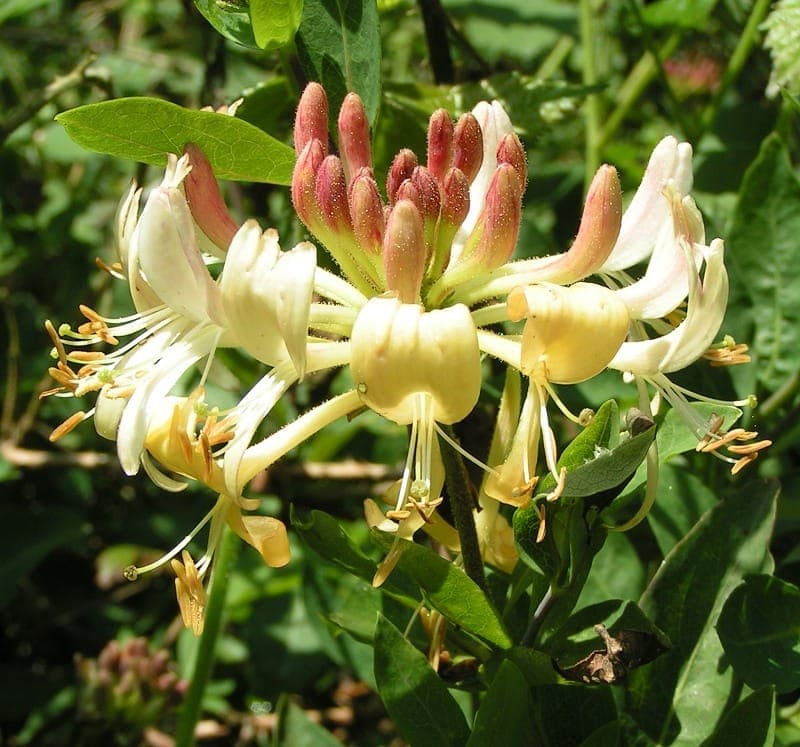
Woodbine blooms from June through September, producing tubular flowers that start white and mature to creamy-yellow. The scent is rich and sweet, particularly strong in the evening, which helps attract moths, bees, and hoverflies. After flowering, it may produce clusters of bright red-orange berries-slightly toxic to humans but a valuable food source for birds like blackbirds and thrushes.
The leaves are oval to lance-shaped, dark green above and paler underneath, arranged in opposite pairs. In milder winters, they may remain semi-evergreen, but typically fall in late autumn. The stems are wiry and twine around supports, allowing the plant to climb vertically with minimal intervention.
Ideal location
Woodbine thrives in partial shade (light level 5/10), especially when the roots are shaded and the top growth receives dappled sunlight. It performs poorly in deep shade or scorching full sun. An east- or north-facing wall, fence, or pergola offers ideal conditions. Provide a sturdy support-wooden trellis, metal mesh, or a tree trunk-so the stems can twine upward.
Avoid planting in exposed, windy spots, as this can damage young shoots. Use gardenworld.app to assess light patterns in your garden and choose the perfect spot for woodbine.
Soil requirements
This honeysuckle prefers moist, well-drained soil with a pH between 5.0 and 5.5. Acidic to slightly acidic conditions suit it best. Heavy clay soils should be improved with compost and grit to enhance drainage. Avoid chalky or highly alkaline soils, as these may cause leaf yellowing.
When planting, mix in plenty of organic matter like leaf mould or composted bark. A mulch of pine needles or bark chips in spring helps retain moisture and keeps the root zone cool.
Watering
Water thoroughly once a week during the first growing season, especially in dry spells. Apply 5–10 litres per plant to encourage deep root development. Once established, woodbine is moderately drought-tolerant but performs best with consistent moisture. Water during prolonged dry periods in summer to prevent bud drop.
Use rainwater when possible, as tap water can raise soil pH over time, especially in containers.
Free design
Want to see Woodbine: complete guide in your garden? Make a free design now.
Pruning
Pruning is minimal. Only remove dead, damaged, or congested stems in late winter or early spring (February–March). Avoid hard pruning, as flowers form on previous year's growth. Over-pruning can drastically reduce blooming.
If the plant becomes too large, you can cut it back by up to 30% after flowering ends in autumn. This should only be done every few years and never on old, woody stems that no longer produce shoots.
Maintenance calendar
- Jan: inspect for dieback, light pruning if needed
- Feb: apply organic mulch, prepare for spring growth
- Mar: check for new shoots, secure climbing stems
- Apr: water during dry spells, add slow-release fertiliser
- May: monitor for aphids, keep soil moist
- Jun: flowering begins, scent fills the air in evenings
- Jul: peak bloom, watch for powdery mildew in humid weather
- Aug: continue watering in droughts, enjoy pollinators
- Sep: last flowers fade, no pruning this month
- Oct: clear fallen leaves, mulch base lightly
- Nov: plant enters dormancy, minimal care required
- Dec: protect young plants from frost heave with mulch
Winter hardiness
Woodbine is fully hardy in USDA zones 5–9. It withstands temperatures down to -20°C and requires no winter protection in most UK and northern European gardens. Young plants benefit from a 5–10 cm layer of mulch around the base to insulate roots during the first winter.
Though it may lose leaves in cold weather, it reliably re-sprouts in spring. Don't mistake winter dieback for plant death-wait until late spring to assess.
Companion plants
Pair woodbine with other woodland species like foxglove (Digitalis purpurea), bluebell (Hyacinthoides non-scripta), and ivy (Hedera helix). At the base, plant lungwort (Pulmonaria officinalis) or hostas to create layered texture. Avoid invasive ground covers that compete for moisture.
For structure, grow it near a rustic arch or alongside clematis for extended bloom time. The combination supports biodiversity and adds seasonal interest.
Closing
Woodbine is a low-effort, high-reward climber that brings fragrance, beauty, and wildlife value to any garden. It's widely available at garden centres across the UK, where you can find healthy potted specimens in spring. Check stems for pests and roots for rot before buying. Whether you're restoring a cottage garden or creating a wild corner, woodbine fits naturally. And with gardenworld.app, you can visualise how it integrates into your space-perfect for planning long-term growth and support structures.
Want to see Woodbine: complete guide in your garden? Make a free design now.
Upload a photo, pick a style, and get a photorealistic design with plant list in under a minute.
No credit card required


Similar plants
Yellow honeysuckle (Lonicera tragophylla): complete guide
Lonicera tragophylla
Meet yellow honeysuckle (Lonicera tragophylla): a Chinese climber with large golden flowers that thrives in partial shade.
Lonicera korolkowii: complete guide
Lonicera korolkowii Stapf
Discover blueleaf honeysuckle, a vigorous shrub with beautiful flowers. Guide on growing, shaping and why this Asian climbing plant is perfect for gardens.
Lonicera oblongifolia: complete guide
Lonicera oblongifolia Hook.
Discover swamp fly honeysuckle, a North American woodland plant. Guide on growing, caring and why this native species is valuable for gardens.