
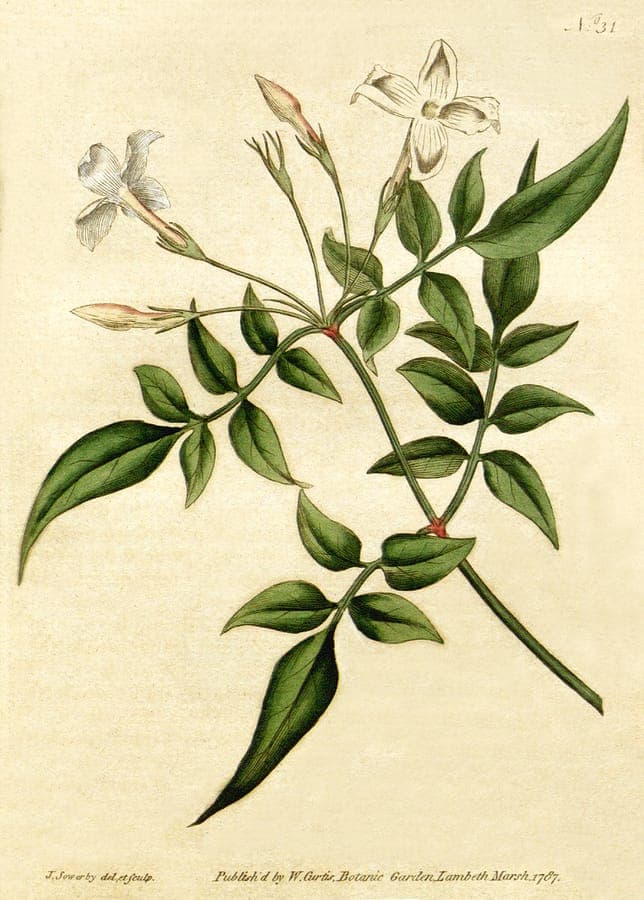
Botanical Magazine / Public domain, via Wikimedia Commons
Common jasmine: complete guide
Jasminum officinale
Want to see Common jasmine: complete guide in your garden?
1 minute, no credit card
Overview
Jasminum officinale, better known as Common jasmine, is a beloved ornamental climber that brings unmatched fragrance to gardens across temperate zones. Native to regions like Afghanistan, the Himalayas, and parts of China, this vigorous vine thrives in USDA zones 7 to 10, making it suitable for many UK and North American gardens. It's especially valued for its evening perfume - sweet, rich, and intoxicating.
On gardenworld.app you can design a garden layout that maximizes the impact of Common jasmine, placing it near seating areas or pathways where its scent can be fully enjoyed. This plant grows as a vine but can be trained as a bushy shrub with regular pruning. Left unchecked, it can reach 4 meters in height, making it ideal for pergolas, fences, or walls.
Appearance & bloom cycle
Common jasmine features glossy, dark green pinnate leaves made up of 5 to 9 lance-shaped leaflets. From May through September, it produces clusters of pure white, star-shaped flowers, each around 2–3 cm wide. The bloom peaks in June and July, when the air fills with its heady aroma - strongest at dusk and on warm evenings.
Flowers are followed occasionally by small black berries, though these are rare in cultivation and not edible. Growth rate is moderate to fast, with 60–80 cm of new growth possible per season under ideal conditions. The stems are semi-woody and benefit from support like trellises or wires.
Ideal location
Plant in full sun to light shade (light level 7/10). A south- or southwest-facing wall, fence, or arbor works best. The plant needs at least 6–7 hours of direct sunlight daily for strong flowering. While the top growth loves sun, the roots prefer to stay cool and shaded - a perfect reason to underplant with low-growing companions.
Avoid exposed, windy spots, especially in colder regions. Urban gardens with heat-retaining brick or stone walls provide excellent microclimates. On gardenworld.app you can simulate sunlight patterns to find the ideal spot for your jasmine before planting.
Soil requirements
Jasminum officinale prefers well-drained, loamy soil rich in organic matter. The ideal pH range is 6.5 to 7.0 - slightly acidic to neutral. Heavy clay soils should be amended with grit or compost to improve drainage. Sandy soils benefit from added compost to retain moisture and nutrients.
Apply a 5–7 cm layer of organic mulch in spring to conserve moisture and suppress weeds. Keep mulch a few inches away from the main stem to prevent rot.
Watering
Water regularly during the growing season (April to October), especially in dry spells. Young plants need more consistent moisture - aim for once a week, increasing during heatwaves. Mature vines are somewhat drought-tolerant but bloom better with consistent watering.
Reduce watering in winter when the plant is dormant. Only water during prolonged dry periods with no frost, as saturated soil in cold months can lead to root rot.
Free design
Want to see Common jasmine: complete guide in your garden? Make a free design now.
Pruning
Pruning is essential for abundant flowering and neat growth. Prune right after the main bloom, in August or early September. Remove dead, damaged, or congested stems. Cut back flowering shoots by one-third to encourage branching and next year's blooms.
Avoid hard pruning in spring, as you'll remove the current season's flower buds. If growing as a shrub, cut out one-third of the oldest stems annually to renew the plant.
Maintenance calendar
- Jan: Minimal care. Check for winter damage.
- Feb: Prepare tools. Light tidy-up if needed.
- Mar: Apply balanced organic fertilizer or compost.
- Apr: Begin regular watering. Watch for aphids.
- May: Flowers appear. Start bi-weekly liquid feed.
- Jun: Peak bloom. Keep soil moist but not soggy.
- Jul: Fragrance at its peak. Continue feeding and watering.
- Aug: Prune after flowering. Remove spent blooms.
- Sep: Final prune. Top up mulch.
- Oct: Reduce watering. Leave fallen leaves as natural mulch.
- Nov: Protect young plants with fleece or straw in colder zones.
- Dec: Dormant period. No feeding. Water only if soil is dry.
Winter hardiness
Common jasmine is hardy in USDA zones 7–10. In zone 7 (down to -15°C), it may suffer dieback in harsh winters but often regrows from the base. Young plants are more vulnerable - protect the root zone with mulch and consider wrapping stems in fleece during extended cold.
In exposed gardens or colder microclimates, grow in a container and move to a sheltered spot in winter. Mature plants are more resilient but still benefit from a sheltered location.
Companion plants
Pair Common jasmine with late-flowering clematis like 'Etoile Violette' or climbing roses such as 'Zephirine Drouhin' for extended visual and aromatic interest. Underplant with thyme, catmint, or lavender to keep roots cool and deter pests.
Avoid invasive groundcovers or plants with aggressive root systems that compete for water and nutrients. Stick to well-behaved perennials that complement jasmine's open growth habit.
Closing
Common jasmine is a garden standout - not for its flashy looks, but for its unforgettable scent and reliable performance. With proper support, sunlight, and an annual prune, it rewards gardeners with months of fragrance. You'll find healthy stock at garden centres across the UK, including independents and larger chains.
Let gardenworld.app help you plan where to place this climber for maximum sensory impact. Whether trained over an arch or along a fence, Jasminum officinale earns its place as a fragrant cornerstone in any well-designed garden.
Want to see Common jasmine: complete guide in your garden? Make a free design now.
Upload a photo, pick a style, and get a photorealistic design with plant list in under a minute.
No credit card required


Similar plants
Rough menodora: complete guide
Menodora scabra
Full guide to Menodora scabra: a drought-tolerant desert subshrub with bright yellow flowers, ideal for rock gardens and xeriscapes.
Fraxinus dipetala: complete guide
Fraxinus dipetala
California ash or two-petal ash from southwestern USA. Beautiful spring flowers, drought-tolerant. Experimental choice for warm Mediterranean front gardens.
Syringa komarowii: complete guide
Syringa komarowii
Syringa komarowii is a striking lilac from central China with elegant flower spikes and lovely foliage. Discover the complete care guide here.