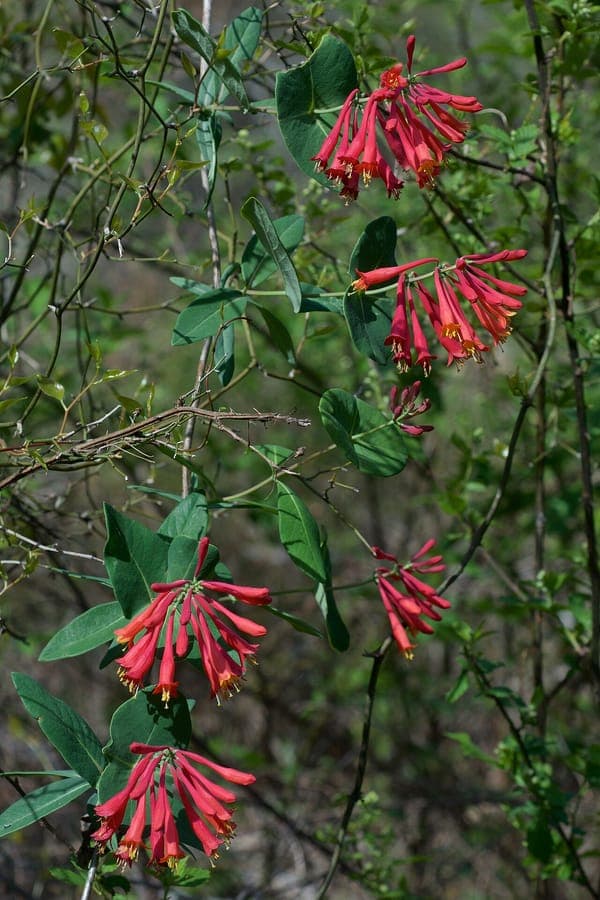
Eric Hunt / CC BY-SA 4.0, via Wikimedia Commons
Coral honeysuckle: complete guide to this vibrant evergreen climber
Lonicera sempervirens
Want to see Coral honeysuckle: complete guide to this vibrant evergreen climber in your garden?
Full design in HD: €7.99
Look after your Coral honeysuckle with the GardenWorld app
Identify plants with your camera and get a care calendar with reminders for this plant.


Overview
Coral honeysuckle (Lonicera sempervirens), also called scarlet honeysuckle, is a stunning evergreen vine from the eastern United States. This frost-hardy climber produces spectacular, bright red, tubular flowers that attract hummingbirds and songbirds. With its vigorous growth habit and glossy foliage, it makes an ideal covering for trellises, pergolas, and garden walls. This is a true garden workhorse offering years of minimal-care enjoyment.
Appearance and bloom cycle
Coral honeysuckle grows as a strong, twining vine reaching 3-5 meters tall. Stems are reddish-brown to green, firm and durable. Opposite, elliptical to oblong leaves measure 3-6 cm long, bright green, glossy, and crucially, evergreen – the plant retains foliage throughout winter.
The flowers steal the show: tubular, about 4-5 cm long, intense red to orange-red, scentless but irresistible to hummingbirds. Blooming begins in May and continues until September, with peak display in May-June. Small red berries follow, valuable for birds.
Ideal location
Coral honeysuckle thrives in full sun to light shade. Position it where it receives at least 5-6 hours of direct sunlight. Against south- or southwest-facing walls, it grows explosively. North-facing aspects work too, though flowering is lighter. The plant tolerates wind well and even succeeds in windswept coastal gardens.
Always provide sturdy support: trellis, mesh, pergola, or rope. Without support, it becomes a dense ground cover.
Soil requirements
Coral honeysuckle is remarkably unfussy about soil. Nearly any normal garden soil suffices. Heavy clay, sandy soil, poor soil – it grows everywhere. Slight preference for neutral to slightly acidic (pH 6-7.5), but tolerance is vast. Drainage doesn't need to be perfect; this plant tolerates wet feet better than most climbers.
At planting, add compost for structure; thereafter, supplemental feeding is rarely necessary.
Watering
Once established, coral honeysuckle needs minimal water. In the first year, water regularly until roots take hold. After establishment, rainfall suffices. Only during severe drought (more than 3 weeks without rain) add supplemental water.
In containers, more frequent watering is needed – approximately weekly in summer. In wet winters, omit supplemental water; rain provides ample moisture.
Free preview
Want to see Coral honeysuckle: complete guide to this vibrant evergreen climber in your garden? Make a free preview of your design.
Pruning
Pruning keeps the plant neat and promotes flowering. In early spring (February-March), remove old, dead, or poorly branched stems. Remove stems that outgrow the support structure. Mild pruning after flowering (July) may encourage next year's bloom.
This plant flowers on young wood, making hard pruning safe. Moderate pruning (removing 10-20% of growth) suffices; excessive cutting is unnecessary.
Maintenance calendar
Spring (March-May): Prune as needed. Check support structure security. Light feeding (general-purpose bloom fertiliser, half strength) may boost flowering. Young plants need regular watering until established (6-8 weeks).
Summer (June-September): Enjoy red flowers and visiting hummingbirds. Water only in extreme drought. Remove dead stems. Monitor for pests (especially spider mites during hot summers).
Autumn (October-November): Reduce watering. Plant prepares for winter. Colour remains vibrant. Check support structure for winter stability.
Winter (December-February): Plant is frost-hardy and evergreen. No supplemental watering (rain suffices). Check support after storms. Pruning can occur in late February.
Frost hardiness
Coral honeysuckle is very frost-hardy, tolerating temperatures to at least -20°C. In temperate zones, the plant suffers no winter damage; even in severe winters, it remains green and healthy. No protection or mulching is needed. This is a perfect plant for gardeners seeking reliable, evergreen coverage.
Companion plants
Coral honeysuckle forms stunning combinations with:
- Clematis (white varieties): Beautiful colour contrast and differing bloom times.
- Hedera helix (Ivy): Another evergreen with subtler foliage.
- Hydrangea petiolaris: Frost-hardy climber with white flowers.
- Rosa (Climbing roses): For dual flowering and fragrant seasons.
Together they create richly clothed trellises with extended seasonal interest.
Final thoughts
Coral honeysuckle is a tireless workhorse. Don't plant in shaded corners – good light prevents disease. Birds and insects will thank you for the flowers and berries. Summer cuttings root easily for propagation.
Wondering how to integrate this vibrant climber into your garden design? Visit gardenworld.app – upload a garden photo and receive personalised plant recommendations. Explore more climbing plants on gardenworld.app's plant blog.
Frequently asked questions about Coral honeysuckle
Is Coral honeysuckle winter hardy?
Coral honeysuckle is very frost-hardy, tolerating temperatures to at least -20°C. In temperate zones, the plant suffers no winter damage; even in severe winters, it remains green and healthy.
When and how do you prune Coral honeysuckle?
Pruning keeps the plant neat and promotes flowering. In early spring (February-March), remove old, dead, or poorly branched stems.
How much water does Coral honeysuckle need?
Once established, coral honeysuckle needs minimal water. In the first year, water regularly until roots take hold.
Where does Coral honeysuckle grow best?
Coral honeysuckle thrives in full sun to light shade. Position it where it receives at least 5-6 hours of direct sunlight.
What soil does Coral honeysuckle need?
Coral honeysuckle is remarkably unfussy about soil. Nearly any normal garden soil suffices.

See it in your garden
See Coral honeysuckle in your garden
One photo of your garden and a few questions. You see the result in about a minute.
Try it with a photoIdentify this plant in your own garden. Identify a plant
Similar plants
Glossy abelia: complete guide
Abelia × grandiflora
Everything about glossy abelia (Abelia × grandiflora): position, soil, pruning and hardiness of a shrub that flowers from July to October with scented white bells.
Seven-son flower (Heptacodium miconioides): complete guide
Heptacodium miconioides
Seven-son flower (Heptacodium miconioides): fragrant white flowers in September, red calyces in October and peeling bark. Site, soil, pruning and hardiness.
Macedonian scabious (Knautia macedonica): growing guide
Knautia macedonica
Grow Macedonian scabious (Knautia macedonica): sunny position, lean soil, deadheading for a long season and self-seeding. Wine-red pincushions for pollinators.
