Wikimedia Commons / CC BY-SA 3.0, via Wikimedia Commons
Macedonian scabious (Knautia macedonica): growing guide
Knautia macedonica
Want to see Macedonian scabious (Knautia macedonica): growing guide in your garden?
Full design in HD: €7.99
Look after your Macedonian scabious with the GardenWorld app
Identify plants with your camera and get a care calendar with reminders for this plant.


Overview
Macedonian scabious (Knautia macedonica) has become a mainstay of modern planting schemes. For months on end, small, deep wine-red pincushions dance on thin, branching stems above neighbouring plants. That dark colour is unusual among perennials and makes the species a favourite with garden designers: it adds depth to a border and ties together pinks, purples and silvers.
The species comes from the Balkans, including North Macedonia, Serbia, Bulgaria and Greece, where it grows in dry grassland, woodland margins and open scrub. It is related to field scabious (Knautia arvensis), a common wildflower of verges and meadows, and is now placed in the honeysuckle family (Caprifoliaceae).
The plant forms a loose clump 60 to 80 cm tall and about 45 cm wide. More compact selections include 'Mars Midget' (around 40 cm) and the mixed 'Melton Pastels', with pink, lilac and red flowers. As far as is known, Knautia macedonica is not toxic to people or pets. It is, however, a fairly short-lived perennial: an individual plant often lasts three to five years, but it usually stays in the garden by self-seeding. You can have a garden design made at gardenworld.app that places this scabious among grasses and other summer-flowering perennials.
Appearance and bloom cycle
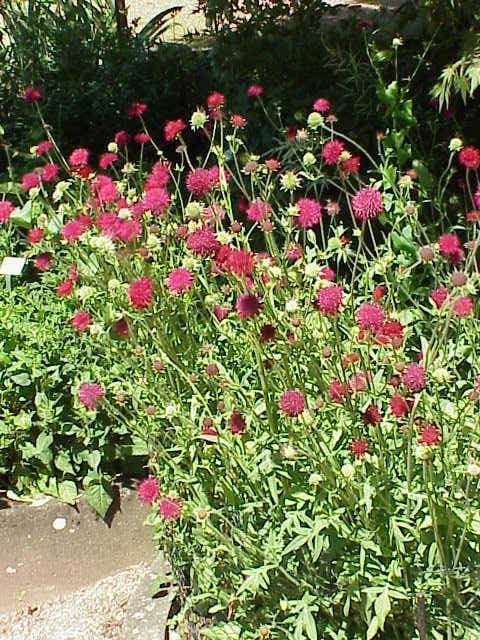
The flower heads are 2 to 3 cm across and have the classic pincushion shape: a dome of many small florets from which pale stamens protrude like pinheads. The colour is a deep crimson to burgundy. After flowering, rounded green seed heads remain, which are decorative in their own right. The photo shows a free-flowering clump with dozens of red to pink heads and a few green seed heads on slender stems beside a garden path.
The basal leaves form a rosette of lance-shaped to deeply lobed leaves, dark green and slightly hairy. The stems carry smaller, pinnately divided leaves. Because the stems are thin and freely branched, the flowers seem to float in an airy cloud above the clump.
Flowering starts in June or July and continues into September and sometimes October, especially if you deadhead regularly. Bees, bumblebees and butterflies visit the flowers constantly, making this an excellent plant for a pollinator-friendly garden. It also works well as a cut flower.
Ideal location
Give Knautia macedonica a spot in full sun. It will still flower in partial shade, but the stems become longer and floppier. It suits a sunny border, a prairie or gravel garden and naturalistic plantings with ornamental grasses.
Because the stems are thin and tend to sprawl, the plant looks best among neighbours that lend it some support. Space plants 40 to 50 cm apart in groups of three or more, or let them seed loosely among grasses for a natural look. Avoid a sheltered, damp corner, where powdery mildew is more likely.
Soil requirements
Well-drained, lean to moderately fertile soil is ideal. Sandy, loamy and chalky soils all suit it. On heavy, wet clay it rarely lasts long, mainly because the roots rot in winter. On clay, work coarse grit or gravel into the planting area.
Feeding is unnecessary and even counterproductive: on rich soil the plant grows too lush, falls open and flowers less. A thin layer of compost in spring is plenty.
Free preview
Want to see Macedonian scabious (Knautia macedonica): growing guide in your garden? Make a free preview of your design.
Watering
Once established, Macedonian scabious copes very well with drought thanks to its taproot. Water young plants regularly during their first season, roughly once a week in dry weather. After that, extra water is needed only during prolonged midsummer drought, ideally as a thorough soak at the base.
Avoid waterlogged soil in winter and do not water over the leaves, as moisture on the foliage encourages powdery mildew.
Powdery mildew is the only real problem with this plant. It mostly appears in late summer, when the soil is dry and the nights are damp, as a white, powdery coating on the leaves. It is usually harmless: cut back the affected stems and the plant will produce fresh growth. An open, sunny position with some space between plants helps most. Aphids occasionally gather on the flower stems in early summer, but bees and other insects usually keep them in check.
Pruning
Deadhead regularly to prolong flowering. On larger plants you can cut faded stems back by about a third in July, which triggers a fresh wave of flowers. If you want the plant to self-seed, leave some of the seed heads from late August onwards.
For a more compact plant, cut the stems back by a third to a half in late May. Flowering will be slightly later, but the plant will be sturdier and less likely to flop. In autumn or early spring, cut old stems back to the basal rosette.
Because the plant has a taproot, division is not very successful. Propagate from seed or basal cuttings instead: in April, take young shoots from the base and root them in moist cutting compost.
Maintenance calendar
March-April: Cut back old stems. Take basal cuttings from young shoots. Sow seed in a cold frame if you wish.
May: Shorten the stems for a more compact plant if desired.
June-July: Flowering begins. Deadhead regularly.
August: Peak flowering. Cut back faded stems for a fresh flush. Water during long dry spells.
September-October: Final flowers. Leave seed heads for self-seeding and for birds.
November-February: Dormant period. Leave the basal rosette undisturbed.
Winter hardiness
Knautia macedonica is fully hardy and tolerates temperatures down to about -25 °C. In the UK and the Low Countries it survives winter without protection, provided the soil drains well. As with many plants from dry grassland, wet winter soil is a bigger threat than hard frost.
Because the species is naturally short-lived, a plant may disappear after a few years even when nothing has gone wrong. Let some seed ripen each year or take the occasional cutting, so you always have young plants coming on. Seedlings of mixed strains can vary in colour, from deep red to pink. The species is not considered invasive anywhere in Europe, but it can self-seed generously in loose, open soil; simply weed out surplus seedlings in spring.
The plant calendar at gardenworld.app shows month by month when to cut back, sow and propagate your perennials.
Companion plants
The dark red of Knautia macedonica looks superb alongside silver, blue and pink. Salvia nemorosa provides violet-blue spikes in early summer. Verbena bonariensis floats its lilac flower clusters in the same airy way and is a classic partner in prairie-style planting. Purple coneflower (Echinacea purpurea) adds larger pink daisies at the same time of year.
Ornamental grasses such as tufted hair grass (Deschampsia cespitosa) create a soft, swaying backdrop against which the red buttons glow. For a spiky contrast, add flat sea holly (Eryngium planum) with its steel-blue flower heads.
Final thoughts
Macedonian scabious is an essential perennial for anyone who wants a sunny, naturalistic border with a touch of deep red. Full sun, lean, well-drained soil and regular deadheading are all that Knautia macedonica needs. Let it self-seed a little, and you will enjoy a cloud of wine-red pincushions that draws bees and butterflies from June into autumn for years to come.
Pruning
Frequently asked questions about Macedonian scabious
Is Macedonian scabious winter hardy?
Knautia macedonica is fully hardy and tolerates temperatures down to about -25 °C. In the UK and the Low Countries it survives winter without protection, provided the soil drains well.
When and how do you prune Macedonian scabious?
Deadhead regularly to prolong flowering. On larger plants you can cut faded stems back by about a third in July, which triggers a fresh wave of flowers.
How much water does Macedonian scabious need?
Once established, Macedonian scabious copes very well with drought thanks to its taproot. Water young plants regularly during their first season, roughly once a week in dry weather.
Where does Macedonian scabious grow best?
Give Knautia macedonica a spot in full sun. It will still flower in partial shade, but the stems become longer and floppier.
What soil does Macedonian scabious need?
Well-drained, lean to moderately fertile soil is ideal. Sandy, loamy and chalky soils all suit it.

See it in your garden
See Macedonian scabious in your garden
One photo of your garden and a few questions. You see the result in about a minute.
Try it with a photoIdentify this plant in your own garden. Identify a plant
Similar plants
Woodland sage: complete guide
Salvia nemorosa
Everything about Woodland Sage (Salvia nemorosa): planting, care, pruning and combinations. Expert tips for months of blue-violet flower spikes.
Argentine vervain: complete guide
Verbena bonariensis
Discover how to grow Verbena bonariensis: ideal conditions, pruning tips, hardiness and plant partners. Perfect for wildlife gardens in USDA zones 7-11.
Purple coneflower: complete guide
Echinacea purpurea
Everything about Purple Coneflower (Echinacea purpurea): planting, care, pruning and combinations. Expert tips for a thriving prairie-style garden.
