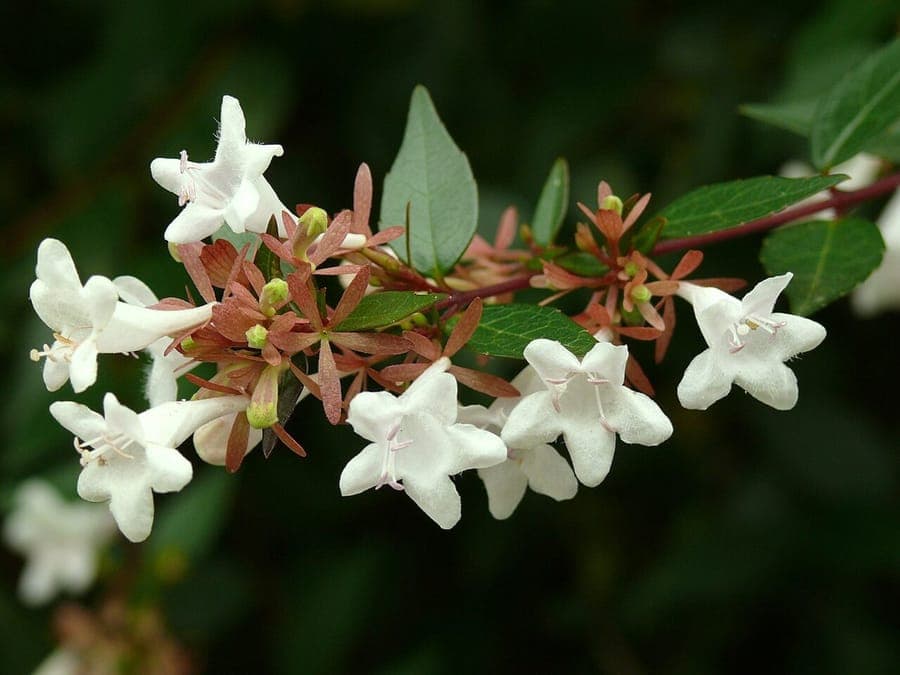
Mariko GODA / Public domain, via Wikimedia Commons
Glossy abelia: complete guide
Abelia × grandiflora
Want to see Glossy abelia: complete guide in your garden?
Full design in HD: €7.99
Look after your Glossy abelia with the GardenWorld app
Identify plants with your camera and get a care calendar with reminders for this plant.


Overview
Glossy abelia (Abelia × grandiflora) is one of those shrubs you have probably walked past a hundred times without knowing its name. It deserves better, because it does something very few shrubs manage: it flowers without a break from midsummer well into autumn. When most shrubs have long finished, abelia is still covered in small, lightly scented bells that keep bees and butterflies busy until October.
The plant is a cross between two Chinese species, Abelia chinensis and Abelia uniflora. The hybrid arose in the 1880s at a nursery on the shores of Lake Maggiore in northern Italy and quickly found its way into gardens across Europe and North America. It belongs to the honeysuckle family (Caprifoliaceae).
In northern European gardens Abelia × grandiflora usually reaches 1.5 to 2 metres in height and spread. In mild coastal areas and sheltered spots it can grow larger, up to around 2.5 metres. The shrub is semi-evergreen: in a mild winter it keeps most of its leaves, while in a hard winter it drops many of them. On gardenworld.app you can have a garden design made that shows where a late performer like this fits best, for instance as a bridge between a summer border and the autumn colour of larger trees.
Well-known cultivars include 'Kaleidoscope' (variegated yellow and green leaves that turn orange-red in autumn), 'Francis Mason' (golden variegation), 'Edward Goucher' (lilac-pink flowers, slightly more compact, strictly a related hybrid) and 'Sherwoodii' (low and dense, ideal for small gardens).
Appearance and bloom cycle
The stems first grow upright and then arch gracefully, giving the shrub a loose, fountain-like outline. Young shoots are reddish brown. The leaves are opposite, oval to pointed, 2 to 5 cm long and distinctly glossy. In spring they often emerge with a bronze flush, and in autumn they take on a purple-red tint.
Flowers appear from July at the tips of the current year's growth, in small clusters of two to four. Each one is a funnel-shaped bell about 2 cm long, white with a blush of pink, with a soft, sweet scent you notice most on warm evenings. Flowering continues into October and, in a mild autumn, right up to the first frost.
What gives abelia extra value are its sepals. When the petals fall, two to five pink to coppery sepals stay on the plant like tiny stars. The shrub looks as if it is still flowering for weeks, in a warm rusty tone. The photo at the top shows exactly that: white bells alongside the reddish-brown stars left by spent flowers.
Ideal location
Abelia × grandiflora grows and flowers best in full sun or light shade. The more sun it gets, the more generous the flowering and the better the wood ripens before winter. A south- or west-facing position, sheltered from cold easterly winds, is ideal. Against a wall the shrub gets just that little bit of extra warmth that makes a difference in a cold spell.
In deep shade it becomes thin and flowers poorly. In an exposed spot the leaves can scorch in winter. Abelia works well in a mixed border, as a single specimen in a smaller garden, as an informal hedge or in a large pot on a sunny patio. For a hedge, plant 60 to 80 cm apart; as a specimen, allow at least 1.5 metres.
Soil requirements
Abelia is not a fussy plant. It grows in most ordinary garden soils as long as they do not stay waterlogged. A humus-rich, free-draining soil that does not dry out completely in summer is ideal. Improve heavy clay at planting time with compost and some coarse grit; on poor sandy soil, mix a generous spadeful of well-rotted compost into the planting hole.
Soil pH is not critical. Slightly acid to neutral soil (pH 5.5 to 7.5) suits it best, but it usually copes well on mildly chalky ground too. Plant in spring or early autumn so the roots can settle before hard frost arrives. A layer of leaf mould or bark chips around the base keeps the soil cool and moist and protects the roots in winter.
Free preview
Want to see Glossy abelia: complete guide in your garden? Make a free preview of your design.
Watering
In the first year after planting, abelia needs regular watering: during dry spells give it a full can of 8 to 10 litres once or twice a week, ideally in the morning or evening. Once established, the shrub is fairly drought tolerant, although after several weeks without rain you will see flowering slow down and the leaves start to droop. At that point give one thorough soaking rather than a little every day.
A container-grown abelia dries out much faster. In summer check the compost every two or three days and water as soon as the top few centimetres feel dry. Make sure the pot has a good drainage hole, as wet roots in winter are a problem. Stop feeding potted plants in mid-August so the new wood can harden.
Pruning
Abelia flowers on the current season's growth, so you can prune in spring without losing any blooms. The best time is late March or early April, once the worst of the frost has passed. Start by removing dead and frost-damaged wood back to healthy, green tissue. On older shrubs, also take out one or two of the oldest, woodiest stems at ground level each year. This keeps the plant young and free-flowering and preserves its natural arching shape.
Avoid shearing it into a ball, or you lose the graceful habit. After a severe winter, abelia may be cut back by frost almost to ground level. Do not panic. Prune everything back to live wood, or even to 20 cm above the ground. In most cases the plant shoots strongly from the base and still flowers the same year, if a little later than usual.
Maintenance calendar
January to February: Dormant period. In hard frost, protect young or container plants with a fleece jacket. Check pots for waterlogging.
March to April: Pruning time. Remove frost-damaged tips and a few older stems. Scatter compost or organic shrub feed around the base. A good moment to plant new abelias.
May to June: The shrub puts on strong growth. Water young plants in dry weather and keep the base free of weeds.
July to October: The long flowering season. Water during hot, dry weeks. Stop feeding from mid-August.
November to December: The sepals turn rusty red and the foliage takes on a purple tint. Mulch around the base and move pots to a sheltered spot. The plant calendar on gardenworld.app lists these jobs month by month, matched to the plants in your own garden.
Winter hardiness
Abelia × grandiflora is moderately hardy and tolerates short spells down to about -15 °C. Across most of the Low Countries, southern England and northern France it comes through winter without protection, especially in a sheltered position. In a prolonged cold spell some or all of the top growth may be killed, but the roots usually survive and the plant regrows in spring.
In mild winters most leaves stay on the shrub; in long frosts they drop. That is normal and not a sign that the plant has died. Variegated cultivars such as 'Kaleidoscope' tend to be slightly more tender than the green-leaved form. Container plants are the most vulnerable, because the root ball freezes through far faster in a pot. In winter, stand them against a house wall and wrap the pot in hessian or bubble wrap.
Abelia is not known to be toxic to people, dogs or cats, which makes it a relaxed choice for family gardens.
Companion plants
Because abelia really comes into its own late in the season, pair it with plants that flower earlier or at the same time and with grasses that stay attractive in autumn. English lavender (Lavandula angustifolia) and catmint (Nepeta × faassenii) add a blue base in summer. Russian sage (Perovskia atriplicifolia) flowers at the same time, and its silvery stems contrast nicely with abelia's glossy leaves.
Panicle hydrangea (Hydrangea paniculata) is a good partner of similar height: both flower in late summer and fade to pink and rust in autumn. Ornamental grasses such as Calamagrostis × acutiflora 'Karl Foerster' and low autumn asters complete the picture. In a smaller garden, a compact cultivar like 'Sherwoodii' underplanted with Geranium 'Rozanne' gives months of continuous flower.
Final thoughts
Abelia × grandiflora is a rewarding, easy shrub for anyone who wants a long flowering season without much work. Give it a sunny, sheltered spot, soil that does not stay wet and a light prune in spring, and it will flower from July until well into autumn. Bees and butterflies find it late into the year, and the reddish-brown sepals add colour when the rest of the garden is already winding down for winter.
Frequently asked questions about Glossy abelia
Is Glossy abelia winter hardy?
Abelia × grandiflora is moderately hardy and tolerates short spells down to about -15 °C. Across most of the Low Countries, southern England and northern France it comes through winter without protection, especially in a sheltered position.
When and how do you prune Glossy abelia?
Abelia flowers on the current season's growth, so you can prune in spring without losing any blooms. The best time is late March or early April, once the worst of the frost has passed.
How much water does Glossy abelia need?
In the first year after planting, abelia needs regular watering: during dry spells give it a full can of 8 to 10 litres once or twice a week, ideally in the morning or evening.
Where does Glossy abelia grow best?
Abelia × grandiflora grows and flowers best in full sun or light shade. The more sun it gets, the more generous the flowering and the better the wood ripens before winter.
What soil does Glossy abelia need?
Abelia is not a fussy plant. It grows in most ordinary garden soils as long as they do not stay waterlogged.

See it in your garden
See Glossy abelia in your garden
One photo of your garden and a few questions. You see the result in about a minute.
Try it with a photoIdentify this plant in your own garden. Identify a plant
Similar plants
English Lavender: complete guide
Lavandula angustifolia
Everything about English Lavender (Lavandula angustifolia): planting, pruning, care and overwintering. Practical tips for lush purple blooms.
Perovskia atriplicifolia: complete guide
Perovskia atriplicifolia
Russian sage is a semi-shrub with purple-blue flowers and grey-green foliage that blooms from July to October. Perfect for dry gardens and landscape design.
Panicle hydrangea: complete guide
Hydrangea paniculata
Master the panicle hydrangea (Hydrangea paniculata): cultivation tips, summer blooming, pruning techniques, soil requirements and hardiness. A versatile shrub for modern gardens.
