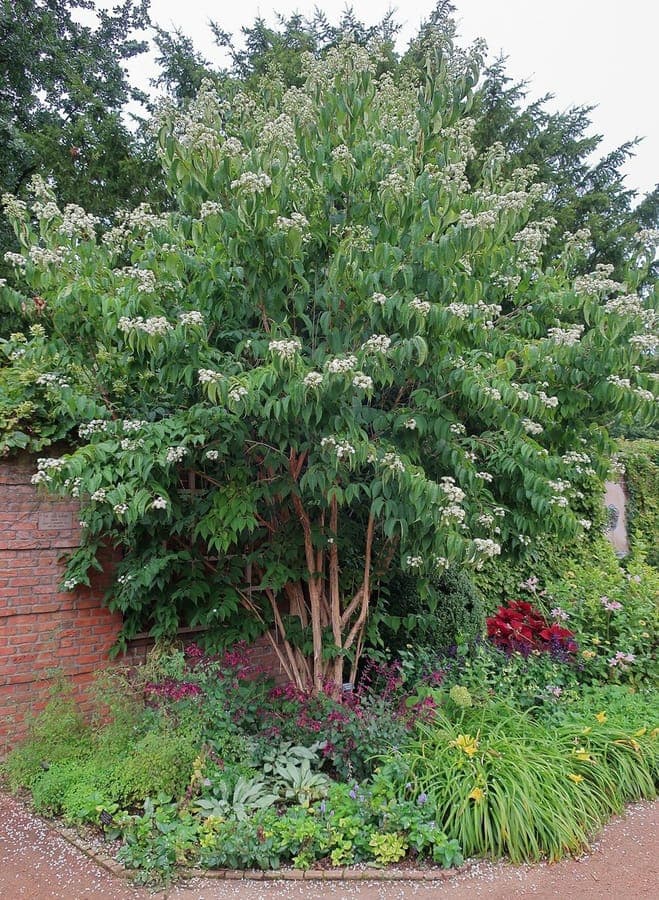
cultivar413 from Fallbrook, California / CC BY 2.0, via Wikimedia Commons
Seven-son flower (Heptacodium miconioides): complete guide
Heptacodium miconioides
Want to see Seven-son flower (Heptacodium miconioides): complete guide in your garden?
Full design in HD: €7.99
Look after your Seven-son flower with the GardenWorld app
Identify plants with your camera and get a care calendar with reminders for this plant.


Overview
Seven-son flower (Heptacodium miconioides) is a large shrub or small multi-stemmed tree that flowers when most shrubs have long finished. From late August into October it is smothered in clusters of small white flowers with a sweet, jasmine-like scent. Afterwards the calyces turn cherry red and pink, so the plant effectively flowers a second time. In winter its peeling, cream to pale brown bark takes centre stage. Few shrubs give so much in the second half of the year.
It belongs to the honeysuckle family (Caprifoliaceae) and comes from eastern China, from the provinces of Hubei, Zhejiang and Anhui, where it has become rare in the wild. The plant hunter Ernest Wilson found it in Hubei in 1907, but it only became widely known in gardens after a Sino-American expedition brought seed to the Arnold Arboretum in Boston in 1980. Since then it has slowly spread through European gardens. The common name refers to the flower arrangement: around a central flower sit six others, seven "sons" in all. Some recent sources list it as Heptacodium jasminoides.
In gardens it usually reaches 3 to 5 m in height and 2.5 to 4 m across, sometimes more with age. It grows quickly, with an upright, vase-shaped habit and several stems. If you want to know whether and where it would fit on your plot, you can have a garden design made on gardenworld.app that gives it a place as a focal point.
Appearance and bloom cycle
The leaves are opposite, ovate to oblong, 8 to 15 cm long and dark green. Their most striking feature is three distinct, curving veins running from base to tip. The leaves hang slightly downwards, giving the shrub a relaxed, loose look. Autumn colour is a modest yellow, and leaf fall comes fairly late.
Flowering begins in late August and continues to the end of September, into October in warm years. The flowers are small and creamy white, carried in dense clusters at the tips of the current season's shoots. They smell sweet and attract huge numbers of butterflies, bees and bumblebees; on a sunny September day the whole shrub hums.
Once the white petals fall, the calyces remain and enlarge. They turn pink first and then cherry red to purplish red, so the plant is in colour again in October, often for several weeks. The red is most intense after a warm summer.
The bark is the winter feature: pale brown to cream, peeling away in long strips. If you remove the lower branches, the stems are shown off well, as in the photo at the top of this page, where a multi-stemmed specimen flowers against a brick wall.
Ideal location
For the best flowering, plant Heptacodium miconioides in full sun. It will grow in light partial shade but flowers less freely there, and the red calyces are less vivid. A warm spot, for example near a wall or in an open sunny position, gives the best results.
Give it room. It looks best as a specimen in a lawn, at the back of a border or as a small tree beside a terrace. Keep at least 3 m from buildings and other large shrubs. It copes well with wind, although very long young shoots can occasionally snap in a storm.
Soil requirements
This is a remarkably tolerant shrub. It grows on sand, loam and clay as long as the ground does not stay wet for long periods, and is happy on both slightly acid and chalky soil. Fertile, well-drained ground gives the fastest growth and the best flowering.
Work some compost into the soil when planting. Plant in autumn or early spring when the ground is not frozen. A mulch around the base keeps the soil moister in summer and suppresses weeds.
Free preview
Want to see Seven-son flower (Heptacodium miconioides): complete guide in your garden? Make a free preview of your design.
Watering
In the first and second years, give about 15 litres per plant once a week during dry weather. Once established, Heptacodium miconioides is fairly drought tolerant. Even so, a thorough soaking during a long dry spell in July and August, when the flower buds are forming, prevents early leaf drop and poorer flowering.
Avoid standing water. Where water collects in winter, the shrub can suffer from root rot.
Pruning
Because it flowers on the current season's growth, prune in late winter or early spring, in February or March. You can then shape it however you like. For a multi-stemmed small tree, select three to five strong stems, remove the rest and cut away the lower side branches to reveal the bark.
If you prefer a dense shrub, it also tolerates fairly hard pruning. Remove dead and crossing branches. Suckers can be cut off at ground level in summer. Do not prune during or after summer, as this removes the flower buds.
Maintenance calendar
February and March: Formative pruning. Select the stems, cut out crossing branches and, if you like, the lowest side shoots.
April: Apply a handful of organic shrub fertiliser and renew the mulch.
May and June: Main growth. Water during dry spells, especially young plants.
July: Flower buds form. Water during prolonged drought.
August and September: Full flower, with fragrant white blooms and plenty of insects.
October: The calyces turn red. A good time to enjoy the show and to plant new shrubs.
November to January: Leaf fall. The peeling bark becomes the winter feature.
Winter hardiness
Heptacodium miconioides is very hardy and tolerates frosts down to about -25 °C, so no winter protection is needed in the UK or the Low Countries. After a severe winter the tips of young shoots may be frosted, but the shrub simply regrows in spring and flowers on the new wood.
It is less suited to large containers because it grows big quickly, so plant it in open ground where possible.
There are no reports of toxicity. Heptacodium miconioides does not appear on the usual lists of poisonous garden plants for people or pets, though it is sensible to stop children and animals eating any plant material. It is not invasive in Europe.
Companion plants
As a late bloomer, Heptacodium miconioides pairs perfectly with other plants that peak in late summer and autumn. Panicle hydrangea (Hydrangea paniculata) flowers at the same time with large white plumes that fade to pink. Ornamental grasses such as Chinese silver grass (Miscanthus sinensis) bring movement and catch the autumn light.
At its feet, New England aster (Symphyotrichum novae-angliae), purple coneflower (Echinacea purpurea) and black-eyed Susan (Rudbeckia fulgida) are excellent partners: they flower at the same time and draw in even more butterflies. In the photo, salvias, daylilies and lungwort serve as underplanting. For early spring, plant bulbs such as daffodils and tulips beneath the shrub; they flower before its leaves appear.
Final thoughts
Heptacodium miconioides is an excellent choice if you want your garden to stay lively after midsummer. With fragrant white flowers, red calyces in autumn and attractive bark in winter, it never becomes dull. It is healthy, hardy and undemanding.
Want to know when to prune or plant? The plant calendar on gardenworld.app sets out the tasks month by month for this shrub and the other plants in your garden. Plant a seven-son flower in a sunny spot this autumn and enjoy a garden that keeps flowering and buzzing well into October next year.
Frequently asked questions about Seven-son flower
Is Seven-son flower winter hardy?
Heptacodium miconioides is very hardy and tolerates frosts down to about -25 °C, so no winter protection is needed in the UK or the Low Countries. After a severe winter the tips of young shoots may be frosted, but the shrub simply regrows in spring and flowers on the new wood.
When and how do you prune Seven-son flower?
Because it flowers on the current season's growth, prune in late winter or early spring, in February or March. You can then shape it however you like.
How much water does Seven-son flower need?
In the first and second years, give about 15 litres per plant once a week during dry weather. Once established, Heptacodium miconioides is fairly drought tolerant.
Where does Seven-son flower grow best?
For the best flowering, plant Heptacodium miconioides in full sun. It will grow in light partial shade but flowers less freely there, and the red calyces are less vivid.
What soil does Seven-son flower need?
This is a remarkably tolerant shrub. It grows on sand, loam and clay as long as the ground does not stay wet for long periods, and is happy on both slightly acid and chalky soil.

See it in your garden
See Seven-son flower in your garden
One photo of your garden and a few questions. You see the result in about a minute.
Try it with a photoIdentify this plant in your own garden. Identify a plant
Similar plants
Panicle hydrangea: complete guide
Hydrangea paniculata
Master the panicle hydrangea (Hydrangea paniculata): cultivation tips, summer blooming, pruning techniques, soil requirements and hardiness. A versatile shrub for modern gardens.
Chinese Silver Grass: complete guide
Miscanthus sinensis
Everything about Chinese Silver Grass (Miscanthus sinensis): planting, cutting back, cultivars and winter silhouette. Expert tips for a spectacular ornamental grass.
New England aster: complete guide
Symphyotrichum novae-angliae
Learn all about New England aster (Symphyotrichum novae-angliae), a stunning fall-blooming perennial.
