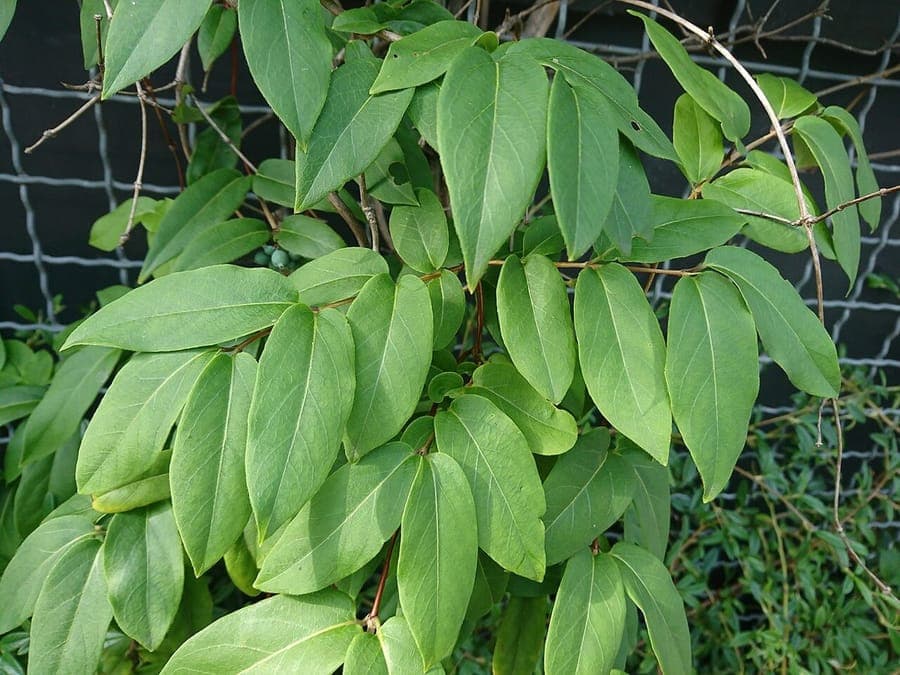
Katrin Schneider / korina.info / CC BY-SA 4.0, via Wikimedia Commons
Henry's honeysuckle (Lonicera henryi): complete guide
Lonicera henryi
Want to see Henry's honeysuckle (Lonicera henryi): complete guide in your garden?
Full design in HD: €7.99
Look after your Henry's honeysuckle with the GardenWorld app
Identify plants with your camera and get a care calendar with reminders for this plant.


Overview
Henry's honeysuckle (Lonicera henryi) is one of the most useful climbers for anyone who wants a fence, wire panel or pergola to stay green all year round. While most honeysuckles drop their leaves in autumn, this species keeps its long, glossy dark green foliage through an ordinary winter. That makes it ideal as a living screen beside a patio, to clothe a bare wall, or to turn a chain-link fence into a solid green barrier in a short time.
The species comes from western and central China, where it grows in woodland and scrub on mountain slopes. The plant collector Ernest Wilson brought it to Europe in the early twentieth century, and it is named after Augustine Henry, an Irish doctor and botanist who described many Chinese plants. Alongside the species, garden centres also offer the selection 'Copper Beauty', with copper-tinted young growth.
Lonicera henryi is a twining climber: its stems wind around a support and reach 4 to 6 m in a good spot, sometimes more. It grows quickly, putting on 1 to 2 m a year once established. If you want to see how a green screen like this would fit into your garden, you can have a garden design made on gardenworld.app that brings climbers, fences and borders together into one scheme.
Appearance and bloom cycle
The leaves are opposite, oblong to lance-shaped, 4 to 10 cm long and pointed at the tip. They are dark green and shiny above, slightly paler beneath. Leaf margins and young shoots are finely hairy. In a severe winter some leaves may brown or fall, but the plant simply reshoots in spring.
Flowering runs from June into August. Small clusters of tubular, two-lipped flowers about 2 cm long appear at the tips of the shoots. They are purplish red to reddish brown on the outside and yellow within, fading to orange-yellow as they age. The flowers are more modest than those of the native woodbine and only faintly scented, but bumblebees and other insects visit them readily.
In late summer and autumn, round blue-black to purple-black berries about 6 mm across follow. Birds love them. They are not edible for people and can cause nausea, vomiting and stomach pain if eaten, so keep an eye on young children and pets that like to nibble berries.
Ideal location
One great advantage of this honeysuckle is that it grows well in shade. It is happy in sun, partial shade and even on a north-facing wall, though it flowers less freely in shade. As with many honeysuckles, the ideal is a spot where the base is shaded and the upper shoots can climb towards the light.
Avoid a baking hot, dry south wall, where the plant is more prone to aphids and powdery mildew and the leaves may scorch. Shelter from cold easterly winds helps keep the foliage looking good in winter. Because it twines, it needs a support: mesh, tensioned wires spaced 20 to 30 cm apart, a pergola or an obelisk. It cannot cling to a smooth wall on its own. Plant 30 to 40 cm away from the wall or fence and angle the first shoots towards the support.
Soil requirements
Lonicera henryi is not fussy. It grows in most humus-rich, well-drained garden soils, from slightly acidic to chalky. Soil that does not dry out completely in summer and does not sit waterlogged in winter is ideal.
At planting time, dig a generous hole of 40 by 40 cm and mix the excavated soil with a few spadefuls of compost. Along walls and fences the soil is often dry and poor because of rain shadow and foundations, so extra compost pays off there. A mulch of leaf mould or compost around the base keeps the roots cool and moist. Feed in spring with compost or an organic fertiliser; too much nitrogen gives plenty of leaves but few flowers.
Free preview
Want to see Henry's honeysuckle (Lonicera henryi): complete guide in your garden? Make a free preview of your design.
Watering
Regular watering in the first year after planting is important, especially against a wall. During dry spells give 10 litres per plant once or twice a week. Once established, the plant copes with short dry periods, but it benefits from a thorough soak in prolonged drought and heat.
Drought makes the plant prone to aphids and mildew, so regular watering is also the best protection against these problems. Water at the base rather than over the leaves. In a large container of at least 40 litres, you will need to water almost daily in summer.
Pruning
This honeysuckle takes pruning well. The best time is after flowering, in late August or September, or in early spring in March. Shorten overlong shoots, remove dead wood and tie new growth in along the support. This keeps the plant dense and tidy.
If left alone for several years, it often forms a heavy tangle at the top with bare growth below. You can then cut it back hard in March, to about 50 cm above the ground. It will regrow vigorously, although you will lose a season of flowers. With a young plant, trim the shoots after planting so that it branches from the base.
Maintenance calendar
March: Renovation pruning if needed. Remove frost-damaged shoots. Spread compost around the base.
April–May: Tie in new shoots along the support. Check shoot tips for aphids.
June–August: Flowering time. Water in dry spells. Watch for powdery mildew in warm, dry weather.
September: Light pruning after flowering. A good month for planting.
October–November: Berries turn blue-black. Mulch the base with leaf mould.
December–February: Dormant period. Some leaves may drop in hard frost; they regrow in spring.
To keep track of pruning times and other jobs, use the plant calendar on gardenworld.app, which shows you what to do in your garden month by month.
Winter hardiness
Lonicera henryi is hardy to around -15 °C. The RHS rates the species H5, while the selection 'Copper Beauty' is considered slightly more tender. Across Britain and the Low Countries the plant overwinters outdoors without trouble, but in severe winters with long spells below -15 °C it may lose much of its foliage and the shoot tips can be killed. If that happens, cut out the dead growth in March.
A sheltered spot against a wall or in the lee of a hedge reduces damage. Protect young plants in their first winter with a layer of leaf mould around the base during hard frost. Container plants are more vulnerable; move the pot against a wall and wrap it in hessian.
Lonicera henryi is not known to be invasive in Europe, unlike Japanese honeysuckle (Lonicera japonica), which escapes from gardens in some regions. Because birds spread the berries, it is still sensible not to plant it right next to a nature reserve or woodland edge, and to pull up any seedlings you find.
Companion plants
A screen of Henry's honeysuckle combines beautifully with other climbers for extra flowers. Clematis viticella scrambles easily through the honeysuckle and flowers in summer in purple, pink or wine red. Clematis montana adds a cloud of pink or white blossom in May; give it enough room, as it is extremely vigorous.
At the foot of the fence, shade-tolerant ground covers such as lesser periwinkle (Vinca minor) and Euonymus fortunei keep the base green. Cotoneaster horizontalis, with its red autumn berries, adds structure to a low wall. To extend the season, plant an early-flowering shrub in front of the screen so there is something to enjoy from spring to autumn.
Final thoughts
Henry's honeysuckle is a dependable climber for anyone who wants a quick green screen that stays largely dense through winter. It grows in sun and shade, asks little of the soil and tolerates hard pruning. The flowers are modest, but the glossy leaves and blue-black berries more than make up for it.
Plant it against a wire fence, a panel fence or a pergola, give it a sturdy support and enough water in the first year, and within two seasons you will have a living wall that brings privacy and calm to your garden all year round.
Frequently asked questions about Henry's honeysuckle
Is Henry's honeysuckle winter hardy?
Lonicera henryi is hardy to around -15 °C. The RHS rates the species H5, while the selection 'Copper Beauty' is considered slightly more tender.
When and how do you prune Henry's honeysuckle?
This honeysuckle takes pruning well. The best time is after flowering, in late August or September, or in early spring in March.
How much water does Henry's honeysuckle need?
Regular watering in the first year after planting is important, especially against a wall. During dry spells give 10 litres per plant once or twice a week.
Where does Henry's honeysuckle grow best?
One great advantage of this honeysuckle is that it grows well in shade. It is happy in sun, partial shade and even on a north-facing wall, though it flowers less freely in shade.
What soil does Henry's honeysuckle need?
Lonicera henryi is not fussy. It grows in most humus-rich, well-drained garden soils, from slightly acidic to chalky.

See it in your garden
See Henry's honeysuckle in your garden
One photo of your garden and a few questions. You see the result in about a minute.
Try it with a photoIdentify this plant in your own garden. Identify a plant
Similar plants
Purple clematis: complete guide
Clematis viticella
How to grow Clematis viticella successfully: ideal conditions, pruning, watering, companion plants and design tips for your garden.
Himalayan clematis: complete guide
Clematis montana
Everything you need to know about Clematis montana: fast-growing climber with spring flowers, perfect for walls, fences, and arbors. Care, pruning, and planting tips.
Climbing euonymus: complete guide
Euonymus fortunei
Full care guide for Euonymus fortunei: ideal location, soil, pruning and winter care. A tough, evergreen climber for shady walls and low-maintenance gardens.
