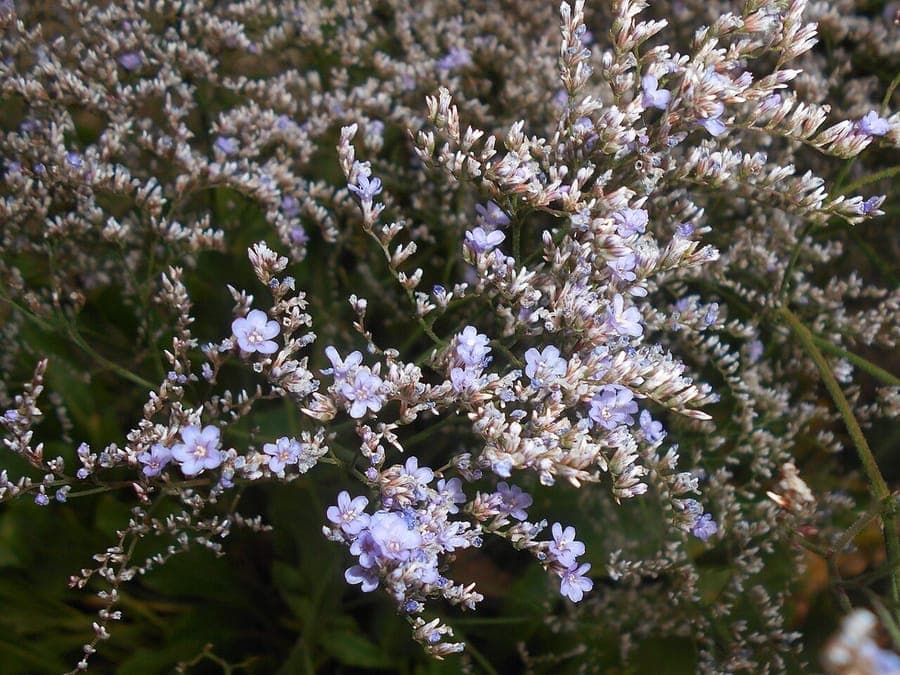
Salicyna / CC BY-SA 4.0, via Wikimedia Commons
Sea lavender (Limonium platyphyllum): complete guide
Limonium platyphyllum
Want to see Sea lavender (Limonium platyphyllum): complete guide in your garden?
Full design in HD: €7.99
Look after your Sea lavender with the GardenWorld app
Identify plants with your camera and get a care calendar with reminders for this plant.


Overview
Walk past a border planted with Limonium platyphyllum in August and you will not notice individual flowers at first. What you see is a haze. Above a flat rosette of large, leathery leaves floats a wide, endlessly branched panicle packed with tiny lavender-blue flowers, so airy that the plants behind it still show through. This perennial is sold as sea lavender, broad-leaved statice or perennial statice, and many nurseries still label it under its older name, Limonium latifolium.
Limonium platyphyllum belongs to the leadwort family (Plumbaginaceae). In the wild it grows on dry steppe grassland and sunny slopes in south-eastern Europe, from Bulgaria and Romania through Ukraine into southern Russia. That origin tells you most of what you need to know about growing it: give it sun, give it soil that drains quickly, and resist the urge to fuss over it. In return you get a long-lived plant that stays put for years and flowers more generously as it matures.
The flowering stems reach 60 to 80 cm, and on an established plant the cloud of flowers can be 60 cm or more across. The rosette itself stays low, rarely above 15 cm. Well-known selections include 'Violetta', with a deeper violet-blue colour, and 'Blue Cloud', which is a touch paler and even more open.
There is no known toxicity to people or pets, and the plant is not invasive anywhere in Europe; in gardens it self-seeds sparingly at most.
Appearance and bloom cycle
The foliage is surprisingly bold for such a delicate flowerer. The leaves are elliptic to broadly oval, 15 to 30 cm long, dark green and slightly leathery, with a faintly hairy underside. They lie flat in a broad rosette, so outside the flowering season the plant is fairly modest. That is really its only weakness: do not put it right at the front if you want a full look in spring.
From late June the flower stems shoot up and branch again and again into a fine, domed panicle carrying hundreds of florets only 4 to 5 mm across. Each floret has a whitish, papery calyx and a lavender-blue corolla. The main flowering runs from July into September. Afterwards the blue petals drop, but the calyces remain, so the panicle stays silvery grey to straw coloured for weeks.
Those papery calyces are exactly why flower arrangers love it. Cut when most of the florets are open, the sprays hold their colour for months once dried. In summer the plant is busy with bees, hoverflies and small butterflies.
Ideal location
Give it full sun. With at least six hours of direct sunlight a day the stems grow sturdy and the panicles dense. It will grow in partial shade, but it flowers less freely and the stems are more likely to flop. A south-facing slope, a gravel garden, the edge of a terrace or a sunny border shared with other drought lovers are all ideal.
Because the plant develops a deep taproot, it resents being moved once established. Choose its final spot from the start and allow 50 to 60 cm per plant. It copes well with wind and even salty sea air, which makes it a useful plant for coastal gardens. It can live in a container for a few years, but the long taproot is much happier in open ground.
Soil requirements
Limonium platyphyllum likes free-draining, rather lean soil. Sandy soil, light loam and gritty ground are ideal. On heavy clay that stays wet over winter the root rots easily. If that is what you have, raise the planting spot slightly or work plenty of coarse grit and sharp sand into the top 30 cm.
It tolerates both slightly acidic and chalky soils; a pH of roughly 6 to 8 is fine. Rich soil with lots of compost or manure does more harm than good, producing lush leaves and weak stems. A small handful of compost at planting time is plenty. Plant in spring, in April or May, so the roots have a full season to settle before their first winter.
Free preview
Want to see Sea lavender (Limonium platyphyllum): complete guide in your garden? Make a free preview of your design.
Watering
During the first year after planting, water regularly, roughly once a week in dry spells, so the taproot is encouraged to go deep. After that the plant is very drought tolerant. An established clump will come through a hot, dry summer without any help, precisely because its root reaches so far down.
In prolonged heat, water thoroughly now and then rather than little and often. Above all, avoid waterlogging in winter. In a pot, check weekly whether the compost has dried out and make sure there are generous drainage holes. Never leave the pot standing in a saucer of water.
Pruning
Pruning this plant is little more than a formality. If you want to dry the flowers, cut the stems in July or August, when about three quarters of the florets are open. Hang them upside down somewhere dry, dark and airy; after two or three weeks they are ready.
If you leave the panicles in place, they give a fine silvery mist in the autumn border. You can cut them down in November or leave them until the end of winter, then remove the old stems just above the rosette in March. The leaves need no pruning; just pull away dead ones around the rosette. Dividing is awkward because of the taproot. To increase your stock, take root cuttings in winter or sow seed in spring.
Maintenance calendar
March: Cut back old flower stems if you left them standing over winter. Remove dead leaves from around the rosette.
April-May: Best time to plant. Water young plants weekly in dry weather.
June: The flower stems grow quickly. On rich soil check whether they need support; on lean soil that is rarely necessary.
July-August: Full flower. Cut sprays for drying once most florets are open.
September: Flowering draws to a close. Leave the remaining panicles for autumn interest.
October-November: Clear old stems if you prefer. Make sure fallen tree leaves do not settle in the rosette, as they trap moisture.
December-February: Dormant period. No protection is needed, only soil that does not lie wet.
You will find a full plant calendar for your own garden, with jobs for every month, on gardenworld.app.
Winter hardiness
Limonium platyphyllum is extremely hardy. In its native steppes it endures harsh winters, and in western Europe it survives temperatures down to roughly -25 °C to -30 °C without trouble. The Royal Horticultural Society gives it its highest hardiness rating, H7.
The real danger in a mild, damp winter is wet rather than cold. A taproot sitting in cold, saturated clay can rot. On well-drained soil the plant overwinters anywhere in Britain and the Low Countries without any protection. Do not smother it with a thick mulch or a layer of leaves, as that keeps the rosette damp. A thin layer of gravel around the base actually helps by keeping the crown dry.
Companion plants
An airy plant like sea lavender looks best next to plants with a firmer outline. Flat sea holly (Eryngium planum) with its steel-blue heads is a classic partner: both enjoy the same dry, sunny spot and both dry beautifully. Russian sage (Perovskia atriplicifolia) and English lavender (Lavandula angustifolia) match it perfectly in colour and in their needs.
For contrast in shape, purple coneflower (Echinacea purpurea) and yarrow (Achillea millefolium) work well: their flat or domed flower heads stand out against the blue haze. Grasses such as blue fescue (Festuca glauca) or Calamagrostis × acutiflora add structure, and ice plant (Hylotelephium spectabile) takes over in September. Avoid pairing it with plants that want plenty of water and feeding; their needs clash with those of Limonium platyphyllum.
Final thoughts
Limonium platyphyllum is a plant for anyone who likes a natural, airy border and does not want much work. A sunny spot, soil that dries out quickly and a little patience in the first year are all it asks. After that it produces a blue cloud every summer that lasts for months, both in the garden and in a vase.
Pick its permanent home at planting time, because its taproot does not like moving house. If you want to fit drought lovers like this into a gravel garden or steppe-style border, you can have a garden design made on gardenworld.app that brings together the right partners and spacings for your plot. That modest spring rosette will then become the centrepiece of your border every August.
Frequently asked questions about Sea lavender
Is Sea lavender winter hardy?
Limonium platyphyllum is extremely hardy. In its native steppes it endures harsh winters, and in western Europe it survives temperatures down to roughly -25 °C to -30 °C without trouble.
When and how do you prune Sea lavender?
Pruning this plant is little more than a formality. If you want to dry the flowers, cut the stems in July or August, when about three quarters of the florets are open.
How much water does Sea lavender need?
During the first year after planting, water regularly, roughly once a week in dry spells, so the taproot is encouraged to go deep. After that the plant is very drought tolerant.
Where does Sea lavender grow best?
Give it full sun. With at least six hours of direct sunlight a day the stems grow sturdy and the panicles dense.
What soil does Sea lavender need?
Limonium platyphyllum likes free-draining, rather lean soil. Sandy soil, light loam and gritty ground are ideal.

See it in your garden
See Sea lavender in your garden
One photo of your garden and a few questions. You see the result in about a minute.
Try it with a photoIdentify this plant in your own garden. Identify a plant
Similar plants
Blue eryngo: complete guide
Eryngium planum
Everything you need to know about Blue eryngo (Eryngium planum): growing conditions, soil, pruning and hardiness. Perfect for dry gardens.
Perovskia atriplicifolia: complete guide
Perovskia atriplicifolia
Russian sage is a semi-shrub with purple-blue flowers and grey-green foliage that blooms from July to October. Perfect for dry gardens and landscape design.
English Lavender: complete guide
Lavandula angustifolia
Everything about English Lavender (Lavandula angustifolia): planting, pruning, care and overwintering. Practical tips for lush purple blooms.
