
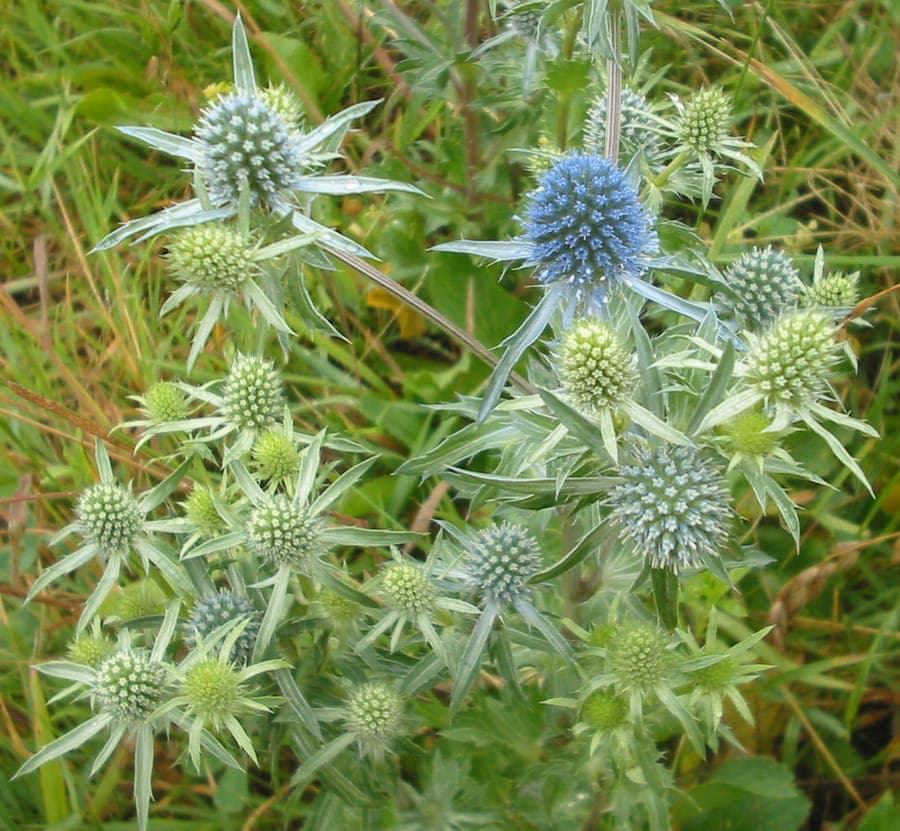
No machine-readable author provided. Bogdan assumed (based on copyright claims). / CC BY-SA 3.0, via Wikimedia Commons
Blue eryngo: complete guide
Eryngium planum
Want to see Blue eryngo: complete guide in your garden?
1 minute, no credit card
Overview
Blue eryngo (Eryngium planum) is a striking yet understated perennial that brings architectural flair to the garden. Unlike its spikier relatives, this member of the Apiaceae family holds its ground with elegance rather than aggression. Native to central and eastern Europe-from Austria through Russia to Mongolia-it thrives in open grasslands and woodland edges, adapting well to cultivated gardens across temperate zones.
In the UK and US, it's increasingly popular in drought-tolerant borders, gravel gardens, and native plant schemes. It grows between 60 and 80 cm tall, forming upright stems with deeply cut, silvery-green leaves. What really sets it apart are the steel-blue flower heads that appear midsummer, lasting well into autumn. It's not flashy, but it's unforgettable.
On gardenworld.app, you can design a planting scheme that highlights Blue eryngo's structural qualities, pairing it with complementary textures and bloom times.
Appearance & bloom cycle
Blue eryngo has a clean, architectural form. The leaves are lance-shaped, deeply lobed, and covered in a fine, silvery fuzz that reduces water loss-perfect for hot, dry summers. They grow in a basal rosette and climb up stiff, unbranched stems.
From July to late August, the plant produces round, thistle-like flower heads, 2–3 cm wide, in a distinctive steely blue. Each head is surrounded by pointed, bristly bracts that give it a modern, almost metallic look. The true flowers inside are tiny and pale blue, but it's the bracts that steal the show. These hold their colour and shape long after blooming, making them excellent for dried arrangements.
The plant doesn't spread aggressively and stays well-behaved in mixed borders. It looks best when given space to breathe, not crowded by more vigorous neighbours.
Ideal location
Full sun is non-negotiable. Blue eryngo needs at least 6 hours of direct sunlight daily. In partial shade, it becomes leggy, leans, and produces fewer flowers. South- or southwest-facing beds are ideal.
Avoid low-lying areas where water pools. This plant hates wet feet, especially in winter. Raised beds, slopes, or gravel gardens work best. If you're planting in heavy clay, amend the soil with grit or sand to improve drainage.
On gardenworld.app, you can map sunlight patterns in your garden to find the perfect spot for plants like Blue eryngo that demand dry, sunny conditions.
Soil requirements
Well-drained soil is essential. Sandy, gravelly, or rocky soils are ideal. It tolerates poor soils and doesn't need rich organic matter-too much fertility leads to floppy growth and fewer blooms.
The pH range is flexible: from slightly acidic (6.0) to slightly alkaline (7.5). Avoid adding compost or manure at planting time. A handful of horticultural grit per plant helps prevent root rot.
Free design
Want to see Blue eryngo: complete guide in your garden? Make a free design now.
Watering
Once established, Blue eryngo is drought tolerant. Water young plants weekly during their first growing season, especially in dry spells. After that, natural rainfall is usually sufficient.
Overwatering is the biggest risk. Soggy soil, particularly in winter, causes root rot. If your garden stays wet, consider growing it in a raised bed or container with a gritty mix.
Pruning
Pruning is minimal. After flowering, cut back spent stems to the base in September or October. Alternatively, leave them standing through winter for structure and to support overwintering insects.
In early spring, remove any damaged or dead foliage. Use sharp, clean secateurs to prevent disease. Don't cut into old wood-this plant doesn't regenerate from bare stems.
Maintenance calendar
- February–March: Clear away old leaves and debris. Check for slug damage.
- April–May: Plant new specimens in full sun. Water regularly if rainfall is low.
- June: Monitor for aphids. Keep soil free of weeds.
- July–August: Peak bloom period. No feeding required.
- September–October: Cut back or leave stems for winter interest.
- November–January: Leave undisturbed. No watering or feeding needed.
Winter hardiness
Blue eryngo is hardy to USDA zone 5 (–20°C to –15°C). It survives most UK and northern US winters without protection, provided the soil drains well.
In wet winters, mulch lightly with gravel instead of organic matter to keep the crown dry. Avoid thick mulches like bark chips, which trap moisture.
Companion plants
Choose companions with similar needs: sun, good drainage, and low fertility. Great pairings include:
- Sedum 'Autumn Joy' – pink flowers, late season interest
- **Echinacea purpurepaid pollinators
- Nepeta faassenii – soft blue spikes, repels deer
- Stachys lanata – fuzzy silver foliage, textural contrast
Avoid moisture-loving plants like hostas or astilbes. Blue eryngo shines when contrasted with softer forms.
Closing
Blue eryngo isn't loud, but it's deeply satisfying. Its cool-toned blooms, resilience, and low maintenance make it a quietly powerful player in the garden. It doesn't need coddling-just space, sun, and sharp drainage.
You'll find it at garden centres in summer, often labelled as Eryngium planum or Blue Eryngo. Look for healthy green foliage and firm stems. Avoid plants with yellowing leaves or mushy bases.
Pair it with the right neighbours, and it becomes a backbone plant-reliable, beautiful, and alive with bees.
Want to see Blue eryngo: complete guide in your garden? Make a free design now.
Upload a photo, pick a style, and get a photorealistic design with plant list in under a minute.
No credit card required


Similar plants
Whorled carrot: complete guide
Daucus involucratus
Daucus involucratus is a Mediterranean umbellifer with white flower heads framed by lacy bracts. Growing this gravel garden gem.
Daucus muricatus: complete guide
Daucus muricatus
Daucus muricatus, the spiny wild carrot, grows wild on Mediterranean coasts. Discover sowing, June-July bloom, and wildflower meadow use.
Daucus pumilus: complete guide
Daucus pumilus
Daucus pumilus is a dwarf wild carrot relative with white lacy umbels, thriving on dunes and coastal rock in poor, fast-draining soil.