Kurt Stüber [1] / CC BY-SA 3.0, via Wikimedia Commons
Meadowfoam: complete guide
Limnanthes douglasii
Want to see Meadowfoam: complete guide in your garden?
Full design in HD: €7.99
Look after your Meadowfoam with the GardenWorld app
Identify plants with your camera and get a care calendar with reminders for this plant.


Overview
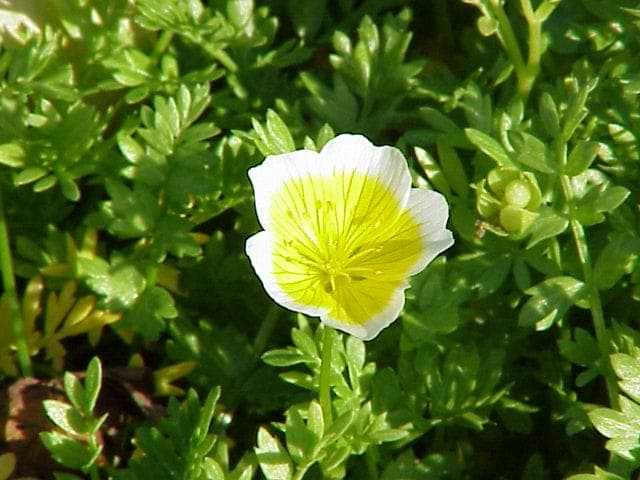
Limnanthes douglasii, better known as meadowfoam or "poached egg plant," is a charming, compact-growing plant native to California and Oregon. This plant of the Limnanthaceae family is renowned for its adorable white flowers with yellow edges that indeed resemble poached eggs. It is a wonderful filler plant for moisture-loving locations.
Appearance and Bloom
Limnanthes douglasii grows as a compact, spreading plant reaching only 20-40 cm tall. The plant features fine, light-colored foliage and produces abundant small, round flowers approximately 10-15 mm in diameter. The flowers are characteristically white with yellow borders, explaining their popular nickname "poached egg plant." Blooming runs from April to October.
Ideal Location
This plant thrives best in locations with full sun to light shade. It prefers open, sunny spots but can also grow in lightly shaded areas. The plant thrives in moisture-loving soils and along pond edges.
Soil
Limnanthes douglasii loves moist, well-draining soils and is not very fussy. The plant thrives in neutral to acidic soils (pH 6.0-7.0). It tolerates normal garden soils provided they are well-moistured.
Watering
This plant enjoys regular watering and prefers soils that are consistently moist. It is not, however, tolerant of waterlogging. Regular watering during growth and blooming ensures continuous flowering.
Free preview
Want to see Meadowfoam: complete guide in your garden? Make a free preview of your design.
Pruning
Minimal pruning is needed. You can remove spent flowers for appearance, though this is not strictly necessary. Pinch the tips to encourage bushy growth.
Maintenance Calendar
- Spring (March-May): Direct sow seed or sow in pots. Water regularly. Blooming begins.
- Summer (June-August): Plant blooms continuously if watered regularly. Remove spent flowers.
- Autumn (September-October): Plant continues blooming until first frost. Collect seed for next year.
- Winter (November-February): Plant dies in colder areas. In milder zones, it may overwinter.
Winter Hardiness
Limnanthes douglasii is not winter-hardy in many Northern European regions and is typically grown as an annual. However, it can overwinter in very mild areas.
Companion Plants
Combine Limnanthes douglasii with:
- Forget-me-nots (Myosotis)
- Violas (Viola)
- Alyssum (Lobularia maritima)
- Dianthus
These combinations create a charming, colorful groundcover.
Closing Thoughts
Limnanthes douglasii is a wonderful choice for gardeners wanting to add something unique to moisture-loving areas. Its cute flowers with their "poached egg" appearance are irresistible. This is ideal for borders and container plants. Find seed or seedlings at garden centers. For more inspiration for moisture-loving gardens, visit gardenworld.app for your next project.
More tips for moisture-loving plants can be found on gardenworld.app.
Frequently asked questions about Meadowfoam
Is Meadowfoam winter hardy?
Limnanthes douglasii is not winter-hardy in many Northern European regions and is typically grown as an annual. However, it can overwinter in very mild areas.
When and how do you prune Meadowfoam?
Minimal pruning is needed. You can remove spent flowers for appearance, though this is not strictly necessary.
How much water does Meadowfoam need?
This plant enjoys regular watering and prefers soils that are consistently moist. It is not, however, tolerant of waterlogging.
Where does Meadowfoam grow best?
This plant thrives best in locations with full sun to light shade. It prefers open, sunny spots but can also grow in lightly shaded areas.
What soil does Meadowfoam need?
Limnanthes douglasii loves moist, well-draining soils and is not very fussy. The plant thrives in neutral to acidic soils (pH 6.0-7.0).

See it in your garden
See Meadowfoam in your garden
One photo of your garden and a few questions. You see the result in about a minute.
Try it with a photoIdentify this plant in your own garden. Identify a plant
Similar plants
Glossy abelia: complete guide
Abelia × grandiflora
Everything about glossy abelia (Abelia × grandiflora): position, soil, pruning and hardiness of a shrub that flowers from July to October with scented white bells.
Trailing abutilon (Abutilon megapotamicum): care guide
Abutilon megapotamicum
Grow trailing abutilon (Abutilon megapotamicum) in a basket or against a wall: watering, feeding, pruning and overwintering for red and yellow lantern flowers.
Flowering maple (Abutilon): container shrub guide
Abutilon × hybridum
How to grow flowering maple (Abutilon × hybridum) in a pot: position, watering, feeding, March pruning and overwintering indoors for flowers from May to October.
