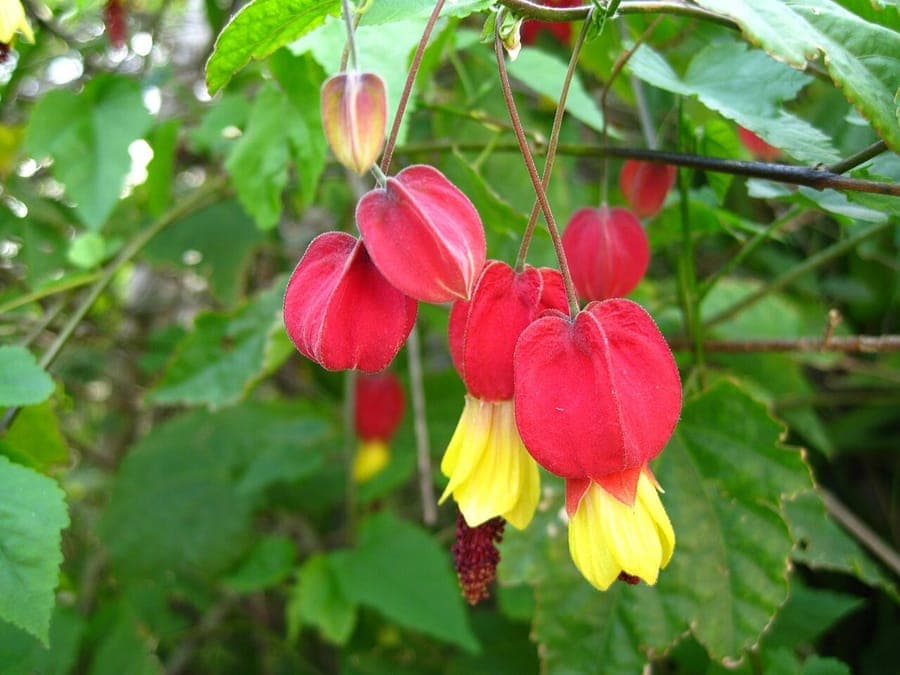
f99aq / CC BY-SA 2.0, via Wikimedia Commons
Trailing abutilon (Abutilon megapotamicum): care guide
Abutilon megapotamicum
Want to see Trailing abutilon (Abutilon megapotamicum): care guide in your garden?
Full design in HD: €7.99
Look after your Trailing abutilon with the GardenWorld app
Identify plants with your camera and get a care calendar with reminders for this plant.


Overview
Trailing abutilon (Abutilon megapotamicum) is one of the most eye-catching container plants you can grow. Its thin, arching stems carry flowers that look like tiny lanterns: an inflated, bright red calyx with a skirt of yellow petals beneath and a tuft of dark stamens hanging below. The species comes from southern Brazil and neighbouring areas; the name megapotamicum means "of the great river" and refers to the Rio Grande.
Unlike the upright flowering maple (Abutilon × hybridum), this species has slender, lax stems that arch and trail. That makes it ideal for a tall pot, a hanging basket or for training against a sheltered wall. In a container it usually reaches 60 to 120 cm; against a warm wall in a mild climate it can grow 2 to 3 metres. If you would like to work out where a sheltered wall shrub or a group of pots fits best, you can have a garden design made at gardenworld.app that gives these features a proper place.
Well-known forms include 'Variegatum', with yellow-mottled leaves, and 'Kentish Belle', a hybrid with orange-yellow petals and a red calyx. The major poison lists record abutilon as non-toxic to dogs, cats and horses, and no poisonings in people are known.
Appearance and bloom cycle
The leaves are narrowly oval to arrow-shaped, 4 to 10 cm long, with toothed edges and a pointed tip. They are fresh green and far less lobed than those of flowering maple. The stems are thin and flexible and become slightly woody at the base with age.
The flowers appear singly in the leaf axils on long, slender stalks and measure 3 to 5 cm. The most striking part is the red, slightly inflated, five-ribbed calyx, which gives each bloom a heart-shaped outline. Five yellow petals emerge from it, barely opening, and below them hangs a bundle of purplish-brown to dark red stamens and styles. The photo shows exactly that: red calyces with yellow petals among green leaves, with a few buds still to open.
Flowering is long-lasting. Outdoors in a pot it runs from May or June into autumn, and in a bright conservatory it often continues well into late autumn. Even young plants flower readily, and bumblebees visit the blooms.
Ideal location
In summer, trailing abutilon prefers a bright, sheltered position with morning sun and light shade during the hottest part of the day. It copes with full afternoon sun if the pot never dries out, but the flowers last longer in slightly filtered light. Shelter from wind matters, as the slender stems snap and the flowers bruise easily.
As a trailing plant it looks best in a tall pot on a plinth, a hanging basket under a canopy, or a trough on a low wall where the stems can spill freely. To train it on a wall, choose a south- or east-facing site and tie the stems to wires or trellis.
Only move it outdoors after mid-May, once nights stay above 8 °C, and give it a week in the shade to adjust.
Soil requirements
Use a good container compost with some structure, mixed with roughly one fifth clay granules or coarse grit. The mix should hold moisture without staying wet. A slightly acidic to neutral pH is fine. A drainage layer and an unblocked drainage hole are essential.
From April to September, feed every week or two with a liquid fertiliser for flowering plants. Trailing abutilon grows a little less vigorously than the large hybrids and needs slightly less feed, but without it the leaves turn pale and flowering tails off. Stop feeding at the end of September. Repot young plants every spring and older ones every other year.
Free preview
Want to see Trailing abutilon (Abutilon megapotamicum): care guide in your garden? Make a free preview of your design.
Watering
Keep the compost evenly moist in summer. Water as soon as the top few centimetres feel dry, which in warm weather often means daily, especially in a hanging basket that dries out quickly. A plant left too dry drops its buds and flowers. On the other hand, never leave water standing in the saucer, because wet roots soon rot.
During a cool winter rest the plant needs little water. Keep the rootball barely moist and water roughly once every one to two weeks. Dry indoor air attracts red spider mite and whitefly, so check the undersides of the leaves regularly, especially in winter.
Pruning
Pruning is straightforward. In late February or March, before new growth starts, shorten long, thin stems by a third to a half and remove dead or weak twigs. On a wall-trained plant, cut side shoots back to a few buds from the main framework to build a flat, well-branched plant.
In summer you can simply trim stray shoots. The plant flowers on new growth, so every trim brings more flowers later. In autumn, shortening the stems a little makes the plant easier to fit indoors.
Cuttings root easily. Take tip cuttings of 8 to 10 cm in spring or summer and set them in moist cutting compost under a plastic cover. That way you always have a spare plant.
Maintenance calendar
January-February: Cool, bright winter rest at 5 to 12 °C. Little water, no feeding. Check for pests.
March: Shorten long stems, repot if needed and move somewhere warmer to encourage growth.
April: Start feeding. Take cuttings if you want more plants.
May: Move outdoors after mid-May, starting with a week in the shade.
June-September: Flowering season. Feed every week or two, water regularly and remove faded flowers and yellow leaves.
October: Bring indoors before the first frost. Trim stems if needed.
November-December: Rest in a bright, cool place.
Overwintering
Abutilon megapotamicum is a little tougher than ordinary flowering maple, but it is not reliably hardy in most of northern Europe. The RHS rates it H3, which means it tolerates roughly -5 °C. In very mild coastal gardens, an established plant against a sheltered, warm wall with a thick mulch over the roots can come through a gentle winter, and it sometimes reshoots from the base after the top growth has been frosted. Elsewhere that is a gamble.
The safe option is to overwinter it indoors like other container plants. The ideal spot is bright and frost-free at 5 to 12 °C: a cold greenhouse, porch, garage with a window or stairwell. In a warm living room it keeps growing and may even flower, but it becomes more prone to spider mite and whitefly. Avoid a dark cellar, as the plant drops all its leaves without light. The plant calendar at gardenworld.app shows month by month when to bring container plants in, prune them and move them back outside.
Companion plants
As a trailing plant, Abutilon megapotamicum pairs well with other summer-flowering container plants. Fuchsias, such as Fuchsia magellanica, also have dangling red and purple flowers and enjoy the same light shade. Blue Plumbago auriculata offers a cool contrast to the red and yellow of the abutilon, while white-flowered Argyranthemum frutescens brings calm to a group of pots.
Against a wall, it can share space with other climbers that appreciate shelter, such as Trachelospermum jasminoides or Solanum laxum. Make sure the abutilon itself still gets enough light and is not smothered.
Final thoughts
Trailing abutilon is a container plant with real character: slender hanging stems, red and yellow lanterns and a flowering season that runs from late spring into autumn. Give it light, regular watering, a little feed and a cool, bright place in winter, and it will stay attractive for years. If you garden in a mild coastal climate, you can experiment with a plant against a warm wall, but keep a rooted cutting indoors as insurance.
Frequently asked questions about Trailing abutilon
When and how do you prune Trailing abutilon?
Pruning is straightforward. In late February or March, before new growth starts, shorten long, thin stems by a third to a half and remove dead or weak twigs.
How much water does Trailing abutilon need?
Keep the compost evenly moist in summer. Water as soon as the top few centimetres feel dry, which in warm weather often means daily, especially in a hanging basket that dries out quickly.
Where does Trailing abutilon grow best?
In summer, trailing abutilon prefers a bright, sheltered position with morning sun and light shade during the hottest part of the day. It copes with full afternoon sun if the pot never dries out, but the flowers last longer in slightly filtered light.
What soil does Trailing abutilon need?
Use a good container compost with some structure, mixed with roughly one fifth clay granules or coarse grit. The mix should hold moisture without staying wet.

See it in your garden
See Trailing abutilon in your garden
One photo of your garden and a few questions. You see the result in about a minute.
Try it with a photoIdentify this plant in your own garden. Identify a plant
Similar plants
Fuchsia: complete guide
Fuchsia magellanica
Master growing Fuchsia magellanica with its elegant hanging flowers. Care tips, ideal conditions, and winter protection for this South American gem.
Plumbago: complete guide
Plumbago auriculata
Discover everything about Plumbago auriculata: care instructions, growth habits, appearance, and how to successfully grow this stunning climbing plant in your garden.
Boston daisy: complete guide
Argyranthemum frutescens
Boston daisy is a prolific Canary Island shrub with vibrant green foliage and abundant flowers from spring through autumn. Ideal for borders, containers, and patio plantings.
