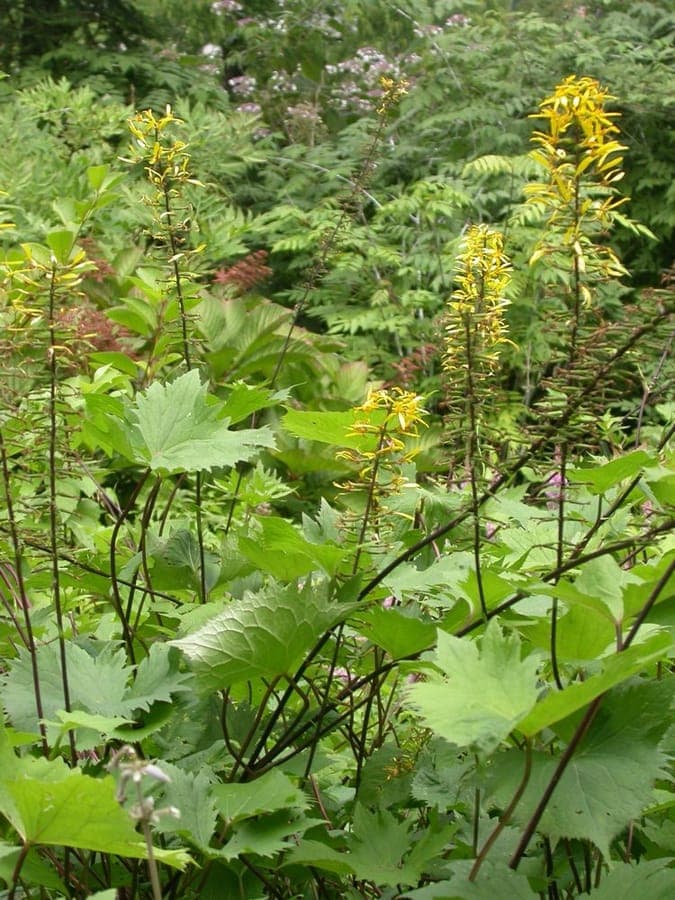
Pieter Pelser / CC BY 3.0, via Wikimedia Commons
Ligularia stenocephala: yellow spires for damp borders
Ligularia stenocephala
Want to see Ligularia stenocephala: yellow spires for damp borders in your garden?
Full design in HD: €7.99
Look after your Ligularia stenocephala with the GardenWorld app
Identify plants with your camera and get a care calendar with reminders for this plant.


Overview
Ligularia stenocephala is a substantial perennial for moist, partly shaded spots, and its strong vertical lines make it stand out. Above a broad clump of large, triangular to heart-shaped leaves, long slender spires packed with small yellow flower heads rise in summer on almost black stems. The effect is like a row of yellow candles or rockets, which is exactly where the well-known cultivar 'The Rocket' gets its name.
The species is native to China, Japan and Taiwan, where it grows in damp woodland, along streams and in wet mountain meadows. That tells you what it needs in a garden: soil that never dries out and protection from hot afternoon sun. The clump spreads about 60 to 90 cm, and in flower the stems reach 1.2 to 1.8 m, depending on soil and moisture. 'The Rocket' is often listed under this species, although some specialists regard it as a hybrid with the closely related Ligularia przewalskii; in the garden it behaves in the same way.
If you would like to see where such a tall foliage plant would look its best, on gardenworld.app you can create a garden design that takes shade, moisture and the space in your plot into account. Be aware that, like many ligularias, the plant contains pyrrolizidine alkaloids, compounds that can damage the liver if eaten. No cases of poisoning in pets are known, but the plant is not edible and does not belong in a paddock grazed by horses or other livestock.
Appearance and bloom cycle
For most of the year the foliage is the main feature. Each leaf is 15 to 30 cm across, triangular to arrow-shaped with a heart-shaped base and a sharply, irregularly toothed edge. The leaf stalks are long and often flushed dark purple-brown, giving a fine contrast with the fresh green blades. The plant emerges fairly late in spring, usually not until April, but then grows quickly.
Flowering runs from July into August, sometimes into early September. The spikes are 30 to 50 cm long and carry dozens of small, lemon-yellow flower heads, each with only a few narrow ray florets. They open from the bottom up, so each spike stays in flower for weeks. The stems are dark, almost black, which makes the yellow even brighter. Bumblebees, bees and hoverflies visit the flowers readily. After flowering, fluffy seed heads form; if you leave them, the plant may self-seed modestly in damp spots.
Ideal location
The best place is partial shade: morning sun and afternoon shade, or dappled light beneath tall trees. In full sun the large leaves wilt on warm days even when the soil is moist, because the plant loses water faster than it can take it up. That is not immediately harmful, but it does not look good. In deep shade it flowers less and the stems become weak.
Ligularia stenocephala is ideal beside a pond, along a stream, in a bog garden or in a damp shady border on the north or east side of the house. Plant 60 to 75 cm apart, or as a specimen with plenty of space around it. A sheltered position prevents the wind from snapping the tall spikes.
Soil requirements
Above all this plant needs soil that stays moist all year. Deep, humus-rich loam or clay with plenty of organic matter is ideal. Wet ground is tolerated well as long as it is not permanently under water. On dry sandy soil it only succeeds if you work in plenty of compost or leaf mould and water regularly in summer, and even then it remains a struggle.
pH is not critical: slightly acidic to slightly alkaline is fine. Add a few spadefuls of compost at planting time and spread a mulch of compost or leaf mould each spring. The mulch keeps the soil cool and moist and feeds the plant gradually.
Free preview
Want to see Ligularia stenocephala: yellow spires for damp borders in your garden? Make a free preview of your design.
Watering
Watering is the key to success with Ligularia stenocephala. In the first year, water several times a week in dry weather. Established plants also need extra water in dry summers, especially on lighter soils. A good rule of thumb: once the top few centimetres feel dry, it is time for a thorough soak.
Drooping leaves on a hot afternoon do not always mean the plant is short of water; they often recover by evening. If the leaves are still limp in the morning, the soil is too dry. Water in the morning or evening and give a generous amount at once so the water reaches the deep roots. No extra water is needed in winter.
Pruning
Pruning is limited to removing spent flower spikes. Doing this straight after flowering keeps the plant tidier and prevents self-seeding. If you like the fluffy seed heads, you can leave them until autumn.
In autumn the foliage dies back. You can cut it down to just above the ground, or leave it until early spring as protection for the crown. Either way, clear it before the new shoots appear. Every five or six years, when the centre of the clump loses vigour, divide it in spring with a sharp spade.
In spring, watch out for slugs: they love the young, soft leaves and can badly damage an emerging plant. Check in the evening and pick them off by hand, or use a slug trap.
Maintenance calendar
March: Clear old foliage. Spread a mulch of compost or leaf mould.
April: New shoots appear. Protect them from slugs.
May–June: Rapid leaf growth. Water in dry spells and keep the soil moist.
July–August: Flowering time. Water in hot, dry weather. Stake spikes in an exposed spot if needed.
September: Cut off spent spikes unless you want to keep the seed heads.
October–November: The foliage dies back. Cut it down or leave it as protection.
December–February: Winter rest. No care needed.
To keep track of these jobs month by month, the planting calendar on gardenworld.app reminds you what needs doing and when.
Winter hardiness
Ligularia stenocephala is very hardy and survives temperatures down to about -25 °C and below. The plant dies back completely below ground in winter and needs no protection anywhere in the British Isles or the Low Countries.
The only winter concern is late frost in April, when the young shoots are already above ground. It can damage the first leaves, but the plant simply sprouts again afterwards. A layer of mulch or fallen leaves around the base helps the roots in severe winters, though it is rarely necessary.
Companion plants
In a damp, shady border Ligularia stenocephala makes a strong focal point. Combine it with hostas such as Hosta sieboldiana, whose large blue-grey leaves contrast beautifully with the yellow spikes. Ostrich fern (Matteuccia struthiopteris) adds a fine, airy texture and enjoys the same moist soil.
Siberian iris (Iris sibirica) flowers earlier in the season and adds a calm line with its narrow, upright leaves. Rodgersia podophylla and astilbe (Astilbe japonica) also fit perfectly into a moist, partly shaded border: the rodgersia with its large, hand-shaped leaves, the astilbe with plumes in pink, red or white. Together they create a lush, almost jungle-like picture that stays interesting all season.
Final thoughts
Ligularia stenocephala is a perennial with presence: large, handsome leaves, dark stems and bright yellow spires that rise above the border like candles in midsummer. It does need the right spot, though. Moist, humus-rich soil and shelter from the afternoon sun are essential.
If you have a pond edge, a wet corner or a shady border, this plant will be a reliable and eye-catching resident for many years. Keep the slugs in check in spring, water in dry summers, and you will have a plant that draws attention every single year.
Frequently asked questions about Ligularia stenocephala
Is Ligularia stenocephala winter hardy?
Ligularia stenocephala is very hardy and survives temperatures down to about -25 °C and below. The plant dies back completely below ground in winter and needs no protection anywhere in the British Isles or the Low Countries.
When and how do you prune Ligularia stenocephala?
Pruning is limited to removing spent flower spikes. Doing this straight after flowering keeps the plant tidier and prevents self-seeding.
How much water does Ligularia stenocephala need?
Watering is the key to success with Ligularia stenocephala. In the first year, water several times a week in dry weather.
Where does Ligularia stenocephala grow best?
The best place is partial shade: morning sun and afternoon shade, or dappled light beneath tall trees. In full sun the large leaves wilt on warm days even when the soil is moist, because the plant loses water faster than it can take it up.
What soil does Ligularia stenocephala need?
Above all this plant needs soil that stays moist all year. Deep, humus-rich loam or clay with plenty of organic matter is ideal.

See it in your garden
See Ligularia stenocephala in your garden
One photo of your garden and a few questions. You see the result in about a minute.
Try it with a photoIdentify this plant in your own garden. Identify a plant
Similar plants
Hosta sieboldiana: complete guide
Hosta sieboldiana
Hosta sieboldiana growing guide: large blue-green shade plant from Japan. Complete care tips, placement and maintenance for shady gardens and woodland areas.
Ostrich Fern: complete guide
Matteuccia struthiopteris
The ostrich fern (Matteuccia struthiopteris) is an elegant moisture-loving fern with distinctive feathery fronds. Learn care tips, ideal locations, and propagation methods.
Iris sibirica: complete guide
Iris sibirica
Discover elegant Iris sibirica with fine blue flowers. Perfect for moist soils, 60-80cm tall. Excellent in groups and as a cut flower.
