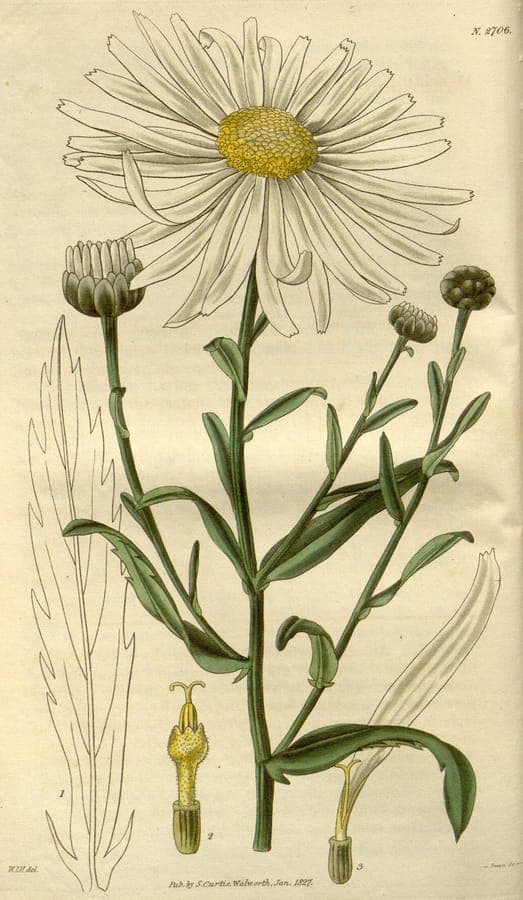
Curtis's Botanical Magazine, vol. 54 [ser. 2, vol. 1]: t. 2706 (1827) [W.J. Hooker] / Public domain, via Wikimedia Commons
Hungarian daisy: complete guide
Leucanthemella serotina
Want to see Hungarian daisy: complete guide in your garden?
Full design in HD: €7.99
Look after your Hungarian daisy with the GardenWorld app
Identify plants with your camera and get a care calendar with reminders for this plant.


Overview
Leucanthemella serotina, also known as Hungarian daisy or autumn oxeye, is an elegant perennial plant of the Asteraceae family native to Central and Southeast Europe. This plant is beloved because it blooms in autumn, when many other flowers have already faded. With its large white flowers and golden centers, it offers a fresh note to autumn gardens.
Appearance and Bloom
Leucanthemella serotina grows as an upright, bushy plant approximately 80-120 cm tall. The plant features dark green, linear foliage and large, daisy-like white flowers with yellow disks appearing from September to November. This late-season flowering makes it a valuable addition to gardens.
Ideal Location
This plant thrives best in a location with full sun to light shade, receiving at least 6 hours of direct sunlight daily. While it tolerates light shade, full sun will promote flowering. Plant it in a location not overshadowed by other plants.
Soil
Leucanthemella serotina is not particularly fussy about soil but prefers well-draining, fertile soil. The plant thrives in neutral to acidic soil (pH 6.5-7.0). It is tolerant of normal garden soil and does not require special preparation.
Watering
Once established, this plant is fairly drought-tolerant and requires minimal watering. During dry periods, you can water, but excessive watering must be avoided. The plant prefers soil with moderate moisture.
Free preview
Want to see Hungarian daisy: complete guide in your garden? Make a free preview of your design.
Pruning
Pruning is minimal. You can remove dead flowers to improve appearance, though this is not strictly necessary. In spring, you can remove dead stems. A light early summer trim can help the plant become fuller.
Maintenance Calendar
- Spring (March-May): Plant grows out. Water regularly until well established. Remove dead stems from previous year.
- Summer (June-August): Plant develops. Minimal watering needed unless extremely dry. Monitor for weeds.
- Autumn (September-October): Plant flowers profusely. Water regularly to support blooming. Remove spent flowers.
- Winter (November-February): Plant dies back. Dead biomass can remain until spring.
Winter Hardiness
Leucanthemella serotina is extremely winter-hardy and can tolerate temperatures well below freezing. It is ideal for cold climates and grows well in Northern Europe.
Companion Plants
Combine Leucanthemella serotina with:
- Asters (Aster novi-belgii)
- Heathers (Erica/Calluna)
- Astilbe (Astilbe)
- Meadow sage (Salvia x sylvestris)
These combinations create beautiful autumn borders.
Closing Thoughts
Leucanthemella serotina is a valuable plant for gardeners wanting autumn color. Its large white flowers are unmatched when other plants decline. This is ideal for autumn garden design. Find plant material at garden centers specializing in perennials. For more inspiration for autumn garden design, visit gardenworld.app for your next project.
More tips for autumn bloomers can be found on gardenworld.app.
Frequently asked questions about Hungarian daisy
Is Hungarian daisy winter hardy?
Leucanthemella serotina is extremely winter-hardy and can tolerate temperatures well below freezing. It is ideal for cold climates and grows well in Northern Europe.
When and how do you prune Hungarian daisy?
Pruning is minimal. You can remove dead flowers to improve appearance, though this is not strictly necessary.
How much water does Hungarian daisy need?
Once established, this plant is fairly drought-tolerant and requires minimal watering. During dry periods, you can water, but excessive watering must be avoided.
Where does Hungarian daisy grow best?
This plant thrives best in a location with full sun to light shade, receiving at least 6 hours of direct sunlight daily. While it tolerates light shade, full sun will promote flowering.
What soil does Hungarian daisy need?
Leucanthemella serotina is not particularly fussy about soil but prefers well-draining, fertile soil. The plant thrives in neutral to acidic soil (pH 6.5-7.0).

See it in your garden
See Hungarian daisy in your garden
One photo of your garden and a few questions. You see the result in about a minute.
Try it with a photoIdentify this plant in your own garden. Identify a plant
Similar plants
Frikart's aster (Aster × frikartii): complete guide
Aster × frikartii
Everything about Frikart's aster (Aster × frikartii): position, soil, pruning and hardiness of the aster that flowers lavender-blue from July to October.
False aster (Boltonia asteroides): complete guide
Boltonia asteroides
False aster (Boltonia asteroides) covers itself in white daisies from late August to October. How to plant, cut back and combine this tough, tall perennial.
Daisy bush (Brachyglottis greyi): care guide
Brachyglottis greyi
Brachyglottis greyi, formerly Senecio greyi, pairs silver felted leaves with yellow summer daisies. Advice on position, soil, pruning, hardiness and companions.
