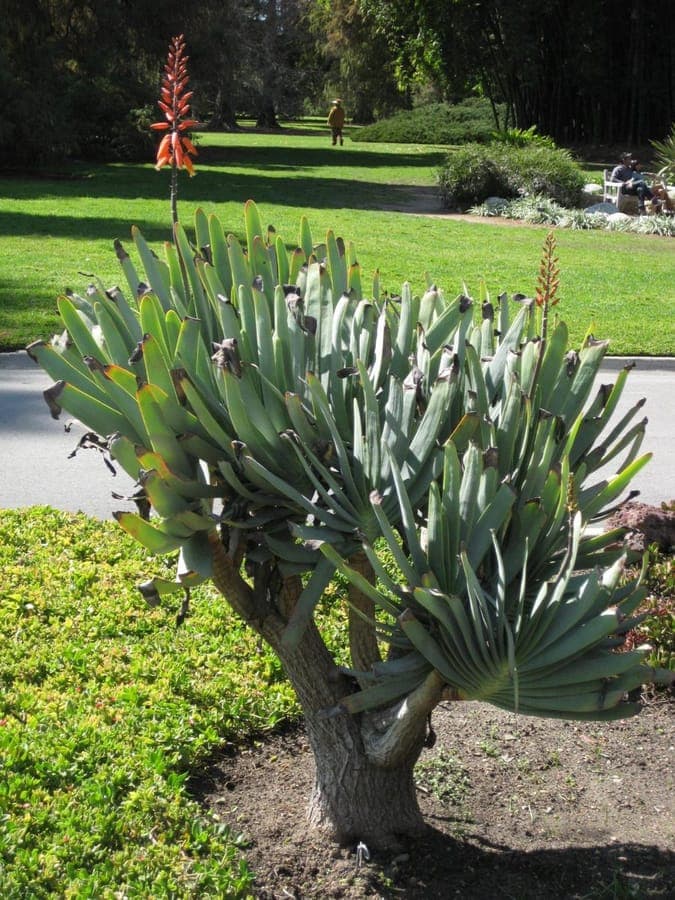
Raffi Kojian / CC BY-SA 3.0, via Wikimedia Commons
Fan aloe (Kumara plicatilis): complete guide
Kumara plicatilis
Want to see Fan aloe (Kumara plicatilis): complete guide in your garden?
Full design in HD: €7.99
Look after your Fan aloe with the GardenWorld app
Identify plants with your camera and get a care calendar with reminders for this plant.


Overview
Few succulents have a silhouette as striking as the fan aloe (Kumara plicatilis). Most aloes grow their leaves in a spiral rosette, but this one stacks them in two opposite rows, so every branch ends in a flat, upright fan. Older books, labels and nursery catalogues still list it as Aloe plicatilis. In 2013 a DNA-based revision moved it into the revived genus Kumara, which it shares with a single small relative, Kumara haemanthifolia. Whatever the label says, it is the same plant.
In the wild the fan aloe is confined to a handful of mountains in South Africa's Western Cape, roughly between Franschhoek and Elandskloof. It clings to steep, rocky slopes in fynbos, a shrubland with hot, dry summers and cool, wet winters. Afrikaans speakers call it waaier-aalwyn, and it is the only tree aloe in the fynbos. Given decades, it becomes a multi-stemmed shrub or small tree of 3 to 5 m.
In north-west Europe it is a container plant: outside on a sunny patio in summer, under glass or indoors in winter. It grows slowly, which suits a pot perfectly. A 40 cm plant will stay a manageable size for many years. If you are rethinking your patio and want to know where a statement pot like this works best, you can have a garden design made on gardenworld.app that places your containers as carefully as your borders.
Appearance and flowering
The leaves are strap-shaped, around 30 cm long and 4 cm wide, with blunt, rounded tips. They are grey-green to blue-grey with a faint waxy bloom, and the margins carry tiny teeth you only notice up close. Plicatilis means "foldable", yet the leaves never fold; the name refers to the fan arrangement. As the plant grows, the lowest leaves dry out and drop, leaving bare grey branches below each fan.
Over the years the trunk becomes thick and corky. In the wild that bark shields the plant from the fires that sweep through fynbos. Branches fork in pairs with no central leader, which gives mature specimens an almost sculpted, candelabra-like outline.
In South Africa it flowers from August to October, at the end of the southern winter. In cultivation here that shifts to late winter and spring. Each fan can send up an unbranched stem carrying a loose spike of tubular flowers around 5 cm long, orange-red to salmon. Young plants rarely bloom, so expect to wait a few years. A cool, bright winter rest makes flowering much more likely.
Light and position
Give it as much light as you can. Indoors, a south- or west-facing window is ideal. From May to September it can go outside on a sunny, sheltered patio. Move it gradually, though: a plant carried straight from the living room into full midday sun can develop pale or brown scorch marks. Give it a week of morning sun or dappled shade first.
Summer rain is no problem as long as the pot drains freely. Trouble starts only when it stays cold and wet for long spells. Bring it in before night temperatures drop below 5 °C, usually around mid-October.
Watering and rest
The fan aloe runs on a different clock from many succulents. In its homeland the rain falls in winter, and the plant grows mainly in the cool, moist seasons, slowing down in the heat of summer. In practice that means watering most generously in spring and autumn, and more sparingly in high summer and in the darkest weeks of winter.
Water thoroughly until it runs out of the drainage hole, then wait until the mix is completely dry before watering again. A finger or a wooden skewer pushed into the pot will tell you. In a cool greenhouse at 5 to 10 °C, one light watering a month in winter is plenty. In a warm room it will need a little more. Never leave water standing in the saucer: wet roots are the quickest route to rot.
Free preview
Want to see Fan aloe (Kumara plicatilis): complete guide in your garden? Make a free preview of your design.
Potting mix and repotting
In the wild Kumara plicatilis grows in sandy, slightly acidic soil, which is unusual for an aloe. Avoid lime-rich mixes. A good blend is roughly half cactus compost and half mineral grit, such as coarse sand, pumice or lava rock. A pH of 5.5 to 6.5 is ideal.
Use a heavy terracotta pot with a large drainage hole. It dries faster than plastic and balances a top-heavy plant. Repot young plants every two to three years in spring; older ones only when roots fill the pot. Hold off watering for a week after repotting so any damaged roots can callus. Feeding is barely needed: two or three doses of diluted cactus fertiliser during the growing season are enough.
Pruning
There is little to prune. Remove dried lower leaves once they are fully brown by pulling them gently sideways. Cut spent flower stems low down. If a branch becomes too long or lopsided, remove it in spring and use it as a cutting.
Propagation from cuttings
Cuttings are the most reliable way to propagate. In spring or early summer, cut off a branch with a healthy fan using a clean, sharp knife. Leave it somewhere dry and shaded for one to two weeks until the cut surface has sealed. Then set it in a barely moist mix of sand and cactus compost, in bright light but out of fierce sun. Start watering normally only once you see new growth, usually after several weeks. Seed is possible but slow: seedlings take many years to look like the plant you admired.
Care calendar
March to April: growth resumes. Water more, repot if needed, take cuttings.
May: once frosts are over, move outside gradually, starting in light shade.
June to August: sunny patio, moderate watering. Let the pot dry out completely between drinks.
September to mid-October: second growth flush. Slightly more water, last light feed.
Mid-October: bring indoors before nights fall below 5 °C.
November to February: cool and bright, little water. Flower stems may appear in late winter.
To keep these jobs on track, the plant calendar on gardenworld.app can remind you at the right moment.
Winter hardiness
The fan aloe is not hardy in Britain or the Low Countries. A brief dip to around freezing is usually survived if the roots are dry, but a real frost damages leaves and trunk. Overwinter it frost-free, ideally between 5 and 12 °C in very good light: a cool conservatory, an unheated but frost-protected greenhouse or a bright stairwell. A warm living room works too, provided the plant sits right by the window; otherwise it stretches towards the light.
Toxicity for pets
There is no reliable data on the toxicity of Kumara plicatilis itself. It is, however, closely related to the true aloes, and the yellow sap just under the skin of Aloe vera is known to cause vomiting and diarrhoea in cats and dogs. Treat it with care: keep it out of reach of cats that like to chew leaves and of young dogs. The sap may mildly irritate human skin. If a pet has eaten part of the plant and seems unwell, call your vet.
Companion plants
On a patio the fan aloe looks best among other South African and Mediterranean container plants. Aloe ferox and Aloe arborescens make a bold group with their spiny rosettes, while Aeonium arboreum, with rosettes held on stems, softens the picture. The plump little leaves of Crassula ovata or Portulacaria afra suit the same mood and need the same care: plenty of light, little water and a frost-free winter. Group tall and short pots together, with gravel between them, for a small dry-garden corner that gives structure all year.
Final thoughts
The fan aloe rewards patience and anyone who loves strong shapes. Growth is slow, but each year the outline gains character. Remember four things: maximum light, a gritty and slightly acidic mix, water mainly in spring and autumn, and a cool, frost-free winter. Treated like that, Kumara plicatilis can live for decades and eventually becomes a small tree of blue-grey fans that catches the eye from across the garden.
Frequently asked questions about Fan aloe
Is Fan aloe winter hardy?
The fan aloe is not hardy in Britain or the Low Countries. A brief dip to around freezing is usually survived if the roots are dry, but a real frost damages leaves and trunk.
When and how do you prune Fan aloe?
There is little to prune. Remove dried lower leaves once they are fully brown by pulling them gently sideways.
How much water does Fan aloe need?
The fan aloe runs on a different clock from many succulents. In its homeland the rain falls in winter, and the plant grows mainly in the cool, moist seasons, slowing down in the heat of summer.

See it in your garden
See Fan aloe in your garden
One photo of your garden and a few questions. You see the result in about a minute.
Try it with a photoIdentify this plant in your own garden. Identify a plant
Similar plants
Bitter aloe: complete guide
Aloe ferox
Everything you need to know about growing and caring for Aloe ferox: ideal conditions, watering, winter care, and companion planting for dry gardens.
Candelabra aloe: complete guide
Aloe arborescens
Everything you need to know about growing and caring for Aloe arborescens in temperate climates. Ideal conditions, watering, winter care, and more.
Aeonium arboreum: complete guide
Aeonium arboreum
Learn all about tree aeonium. Cultivation advice for successful growing, maintenance tips and suitable for pots and dry borders. Subtropical accent.
