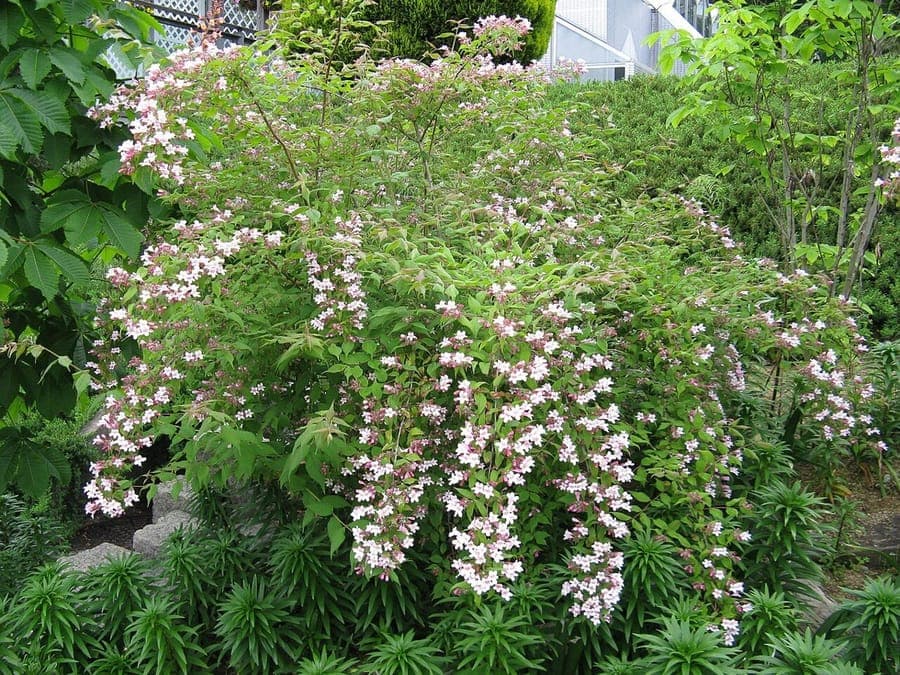
KENPEI / CC BY-SA 3.0, via Wikimedia Commons
Beauty bush: growing Kolkwitzia amabilis
Kolkwitzia amabilis
Want to see Beauty bush: growing Kolkwitzia amabilis in your garden?
Full design in HD: €7.99
Look after your Beauty bush with the GardenWorld app
Identify plants with your camera and get a care calendar with reminders for this plant.


Overview
Kolkwitzia amabilis, the beauty bush, is one of those old-fashioned shrubs you still find in established gardens, and it never fails to impress. In late May and June its long, arching branches bow under thousands of small pink bells with yellow throats, turning a mature plant into a fountain of flowers that stops passers-by in the street. For the rest of the year it settles down into a calm green mass that gives a border its backbone.
It is the only species in its genus and belongs to the honeysuckle family (Caprifoliaceae). Some botanists now place it in the genus Linnaea, as Linnaea amabilis, but gardeners and nurseries still know it as Kolkwitzia. It is native to central China, where it grows on rocky slopes and in scrub. The plant hunter Ernest Wilson introduced it to Western gardens at the start of the twentieth century. The genus honours the Berlin botanist Richard Kolkwitz, while amabilis simply means "lovely".
As far as is known, beauty bush is not toxic to people, dogs, cats or horses, and it is not considered invasive anywhere in Europe. It is a tough, undemanding shrub that lives for decades. If you are unsure whether something this broad will fit, gardenworld.app can create a garden design that already allows for the eventual size of every plant.
Appearance and bloom cycle
Kolkwitzia amabilis forms a broad, loose shrub with gracefully arching branches. After five to ten years it usually reaches 2.5 to 3 metres in both height and spread. It regularly sends up new shoots from the base and so becomes fuller with age. On older stems the light brown bark peels away in long strips, which adds interest in winter.
The leaves are oval to broadly lance-shaped, 3 to 8 cm long, dull green and softly hairy. They sometimes turn yellowish in autumn, but autumn colour is not this shrub's strong point. Flowering is the real highlight, from late May to mid-June and into late June in cool years. The bell-shaped flowers are about 1.5 cm long and borne in pairs, gathered into small clusters along the branches. They are pale pink outside with a yellow to orange-yellow throat delicately veined inside. Bees and bumblebees love them.
Small fruits covered in bristly hairs follow and stay on the shrub for a long time, giving it a faint silvery-brown haze. The best-known cultivar is 'Pink Cloud', with deeper pink flowers and the RHS Award of Garden Merit. For smaller gardens there is Dream Catcher ('Maradco'), whose leaves emerge golden to orange and which grows more compactly.
Ideal location
For generous flowering, beauty bush needs full sun. With at least six hours of sun a day, the shrub will be smothered in blooms by June. It will grow in light shade too, but flowers noticeably less and produces longer, floppier shoots.
Above all, give it room. A Kolkwitzia that has to be constantly cut back loses its finest feature, that natural fountain shape. Leave at least 1.5 metres clear around the centre of the plant, or grow it as a specimen in a lawn, at the back of a deep border or in an informal flowering hedge along a boundary. For a hedge, space plants 1 to 1.2 metres apart. It tolerates wind well and suits rural and suburban gardens alike.
Soil requirements
Kolkwitzia amabilis is not fussy. Any ordinary garden soil will do, from sand to light clay, whether acid, neutral or chalky. What it will not tolerate is ground that stays waterlogged for long periods. On heavy, wet clay, improve the planting hole with compost and grit, or plant slightly above the surrounding soil level.
Dig a hole twice as wide as the root ball and mix in a few spadefuls of compost. After that, feeding is hardly necessary: a layer of compost each spring is plenty. Overly rich soil mainly produces lots of leaves and long shoots at the expense of flowers.
Free preview
Want to see Beauty bush: growing Kolkwitzia amabilis in your garden? Make a free preview of your design.
Watering
In the first growing season after planting, give each shrub around 10 to 15 litres of water a week during dry weather, so the roots grow deep into the soil. From the second year onwards beauty bush is fairly drought tolerant and copes on rainfall in a normal summer.
Only in long, hot, dry spells, particularly in May just before and during flowering, is a thorough soak every ten days worthwhile. Water heavily now and then rather than a little every day. A mulch of compost or bark chippings helps keep the soil moist. It will grow in a large container for a few years, but this shrub is really too big to stay happy in a pot for long.
Pruning
This is where many gardeners go wrong. Kolkwitzia amabilis flowers on wood made the previous year. If you shorten every branch in winter or early spring, you cut off the flower buds and end up with a shrub full of leaves but no flowers. So always prune straight after flowering, in late June or early July.
The best approach is thinning. Each year, saw or cut out a quarter to a third of the oldest, thickest stems close to the ground. This encourages new shoots from the base, which flower freely the following year. Leave the young, arching stems alone, because they carry next year's display. If you have inherited an old, bare shrub, you can cut it right back to about 30 cm above ground in spring. It will regrow well, but needs a year or two before it flowers fully again.
Maintenance calendar
March to April: Spread a layer of compost around the base. Plant new shrubs while the ground is not frozen.
May: Buds swell. Water during dry spells so that flowering does not suffer.
Late May to June: Peak flowering. Enjoy it, and cut a few stems for a vase if you like.
Late June to July: Thinning prune straight after flowering. Remove a quarter to a third of the oldest stems at ground level.
August to September: New shoots ripen. Do not prune. Water during prolonged drought.
October to February: Dormant season. A good time to plant bare-root shrubs. The peeling bark and bristly fruits provide some winter interest.
Winter hardiness
Kolkwitzia amabilis is very hardy. The Royal Horticultural Society rates it H6, which stands for roughly -15 to -20 °C, and in practice the shrub tolerates temperatures down to around -25 °C. Throughout Britain and Ireland, including exposed northern gardens, it needs no winter protection.
Late frosts in April or May can occasionally damage young shoots or the first buds, but the plant recovers quickly. Cold, drying winds hardly bother it either. The one thing to avoid in winter is pruning: every stem you remove then costs you flowers the following season.
Companion plants
Beauty bush fits perfectly into a classic shrub border with other late-spring and early-summer flowerers. Lilac (Syringa vulgaris) flowers just before it, so the display runs on seamlessly. Mock orange (Philadelphus coronarius) and Weigela florida often bloom at the same time, adding white and deeper pink to the pink cloud.
At its feet, peonies (Paeonia lactiflora) are a strong choice: their large flowers open in the same weeks and their foliage stays handsome all summer. Allium hollandicum adds purple globes among the pink, and lady's mantle (Alchemilla mollis) makes a fresh lime-green edging. For colour later in the season, plant hydrangeas or asters in front, so the area stays interesting after June.
Final thoughts
Kolkwitzia amabilis is a rewarding, robust shrub that delivers an abundance of pink flowers in June and asks very little the rest of the year. Full sun, ordinary soil and plenty of space are all it needs. The one thing to remember is when to prune: straight after flowering, by removing old stems at the base rather than trimming the whole shrub.
The plant calendar on gardenworld.app shows the jobs for each month, so you will not forget that July pruning. Plant your beauty bush in autumn or early spring, and within a few years you will have a flowering showpiece.
Frequently asked questions about Beauty bush
Is Beauty bush winter hardy?
Kolkwitzia amabilis is very hardy. The Royal Horticultural Society rates it H6, which stands for roughly -15 to -20 °C, and in practice the shrub tolerates temperatures down to around -25 °C.
When and how do you prune Beauty bush?
This is where many gardeners go wrong. Kolkwitzia amabilis flowers on wood made the previous year.
How much water does Beauty bush need?
In the first growing season after planting, give each shrub around 10 to 15 litres of water a week during dry weather, so the roots grow deep into the soil. From the second year onwards beauty bush is fairly drought tolerant and copes on rainfall in a normal summer.
Where does Beauty bush grow best?
For generous flowering, beauty bush needs full sun. With at least six hours of sun a day, the shrub will be smothered in blooms by June.
What soil does Beauty bush need?
Kolkwitzia amabilis is not fussy. Any ordinary garden soil will do, from sand to light clay, whether acid, neutral or chalky.

See it in your garden
See Beauty bush in your garden
One photo of your garden and a few questions. You see the result in about a minute.
Try it with a photoIdentify this plant in your own garden. Identify a plant
Similar plants
Common Lilac: complete guide
Syringa vulgaris
Everything about Common Lilac (Syringa vulgaris): planting, pruning, care and propagation. Practical tips for abundant, fragrant May blooms.
Mock Orange: complete guide
Philadelphus coronarius
Everything about Mock Orange (Philadelphus coronarius): planting, pruning, care and overwintering. Practical tips for this heavenly fragrant garden classic.
Weigela florida: complete guide
Weigela florida
A detailed guide to growing and caring for Weigela florida in your garden – from planting to pruning, with tips for vibrant blooms and ideal companions.
