KENPEI / CC BY-SA 3.0, via Wikimedia Commons
Yellow wax bells (Kirengeshoma palmata): complete guide
Kirengeshoma palmata
Want to see Yellow wax bells (Kirengeshoma palmata): complete guide in your garden?
Full design in HD: €7.99
Look after your Yellow wax bells with the GardenWorld app
Identify plants with your camera and get a care calendar with reminders for this plant.


Overview
Kirengeshoma palmata, often called yellow wax bells, is one of the most refined perennials for a shady garden. It comes from the mountain forests of Japan and Korea and stands out for two things: large, maple-like leaves and, in late summer, nodding, waxy, pale yellow bells that look almost too perfect to be real. Anyone who has seen it flowering in a shady corner tends to remember it.
The name is Japanese. Ki means yellow, renge refers to the lotus flower and shōma is the Japanese name for Cimicifuga. Loosely translated, it is a yellow lotus bugbane, although botanically it has nothing to do with bugbane. Kirengeshoma palmata belongs to the hydrangea family (Hydrangeaceae) and is the only species in its genus if you count the Korean form as a variety. Those Korean plants are sold as Kirengeshoma palmata Koreana Group; they are a little more robust and hold their flowers more upright.
The plant forms a rounded clump 60 to 120 cm tall and 60 to 90 cm wide. It grows slowly but is extremely long-lived, and a well-placed specimen can stay in the same spot for decades. If you want to see where this shade lover would look its best beside ferns, hostas and shrubs, on gardenworld.app you can create a garden design that takes the light in your garden into account.
Appearance and bloom cycle
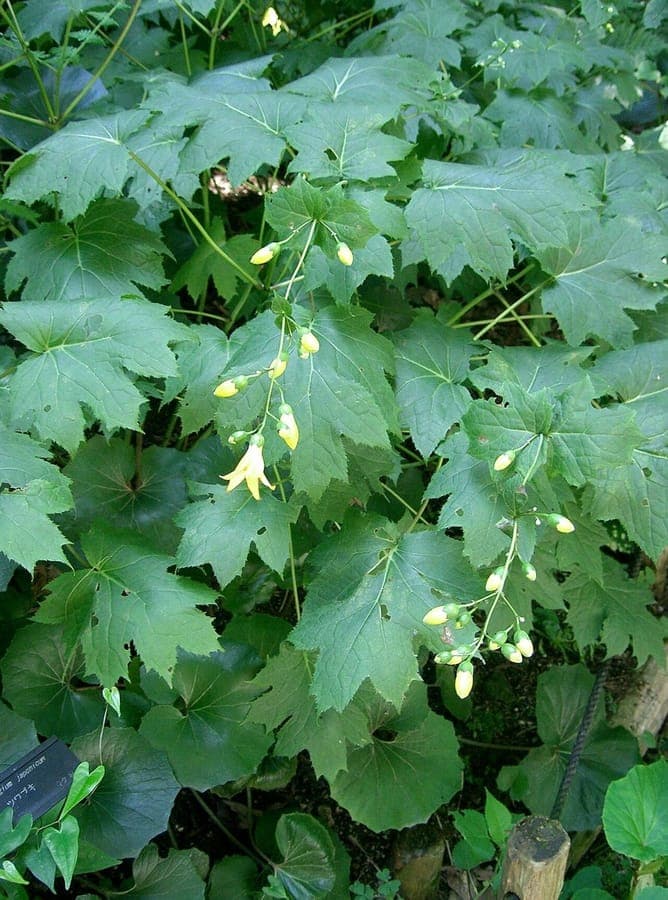
The leaves are palmately lobed, with seven to ten shallow, toothed lobes, and are strongly reminiscent of maple leaves. Each one is 10 to 20 cm across, soft light green and slightly rough to the touch. They are held in opposite pairs on dark, purple-brown stems that arch gently. The foliage alone makes the plant an ornament in the border from May to October.
From late August, loose clusters of round, greenish-yellow buds appear at the tips of the stems, looking like strings of pearls from a distance. In September and October they open into nodding, bell-shaped flowers 3 to 4 cm long, with five thick, waxy petals in soft butter yellow. The flowers never open fully, which gives them their elegant, shuttlecock shape.
After flowering, seed capsules form with three small horns. In autumn the leaves sometimes turn pale yellow before the plant dies down. Bees and bumblebees visit the flowers, but above all this is a showpiece for the gardener at a time of year when the shade garden often falls quiet.
Ideal location
Kirengeshoma palmata is first and foremost a plant for partial to light shade. In the wild it grows in moist mountain woodland, sheltered by trees. In the garden it is at home beneath tall trees, on the north or east side of a building or in a sheltered border among shrubs. Morning sun is fine, but strong midday sun quickly scorches the leaves.
Shelter from wind matters too, as the large leaves tear and dry out in an exposed position. Plant it somewhere you walk past in late summer so you can admire the unusual flowers up close. It also does well in a large container on a shaded patio, provided the pot is generous and the compost never dries out.
Soil requirements
This plant needs humus-rich, cool and evenly moist soil that is slightly acidic to neutral. Woodland soil, loam enriched with leaf mould and well-improved clay are ideal. On chalky soil it grows less well and the leaves can turn yellow; in that case, mix plenty of leaf mould or ericaceous compost into the top layer. A good guide is any border where rhododendrons or hydrangeas thrive.
Plant in spring, in a generous hole with plenty of compost or leaf mould, with the crown level with the soil surface. A mulch of leaf mould or bark keeps the soil cool and moist and feeds the plant slowly. Extra fertiliser is unnecessary.
Free preview
Want to see Yellow wax bells (Kirengeshoma palmata): complete guide in your garden? Make a free preview of your design.
Watering
Kirengeshoma palmata does not tolerate drought. Particularly in the first two years, water regularly during dry spells, and even later it will need watering in hot summers. Drooping leaves and brown leaf margins are signs of thirst. Water deeply when you see them, ideally with rainwater, as tap water in many regions is fairly hard.
At the same time, the soil must not stay waterlogged for long periods. Moist but free-draining ground is the key. In a container you will need to water almost daily in summer, depending on the size of the pot and the weather.
Pruning
Pruning is straightforward. The plant dies back completely in autumn. You can cut away the withered stems in November or leave them until February to give insects shelter. Either way, cut them to just above ground level before the new shoots appear in April.
Division is hardly ever necessary. If you want more plants, carefully split a mature clump with a sharp spade in early spring. Each piece should have several buds and a good root ball. Afterwards the plant needs about a year to regain its strength.
Maintenance calendar
- February - March: cut back old stems and spread a layer of leaf mould or compost.
- April: new shoots appear; protect them from slugs.
- May - July: foliage unfurls; water during dry spells.
- August: buds form at the stem tips.
- September - October: the yellow wax bells are in flower.
- November - January: the plant dies down and rests.
The planting calendar on gardenworld.app shows you month by month which jobs are waiting in your garden, so you will not miss the slug season in April.
Winter hardiness
Kirengeshoma palmata is fully hardy. The Royal Horticultural Society gives it its highest hardiness rating, H7, and in the ground it withstands temperatures down to around -25 °C. In Britain, Ireland and the Low Countries it needs no winter protection, although a layer of leaves or mulch over the root zone is a good habit because it keeps the soil cool and moist.
The greatest risk comes in spring. The young, succulent shoots are a favourite of slugs and snails, which can strip a young plant in a single night. Protect the shoots in April and May with a barrier, ferric phosphate pellets or evening patrols. A late frost may occasionally damage the young leaves, but the plant simply reshoots afterwards.
Little is known about toxicity. As far as is known, Kirengeshoma palmata is not recorded as poisonous to people or pets, but data are scarce, so discourage children and animals from eating it. The species is not invasive in Europe.
Companion plants
In a shade border, Kirengeshoma palmata looks superb with ferns. The shuttlecock fern (Matteuccia struthiopteris) offers a fine contrast with its tall, funnel-shaped clumps, while the soft shield fern (Polystichum setiferum) works as evergreen underplanting and keeps the scene attractive in winter.
Hostas such as Hosta sieboldiana complete the picture with their large, blue-green leaves. For early colour in spring, Brunnera macrophylla with its sky-blue flowers is a lovely partner. For a backdrop, choose a Japanese maple (Acer palmatum), which not only enjoys the same conditions but also echoes the maple-like foliage. Together they create a calm, Japanese-inspired shade garden.
Final thoughts
Kirengeshoma palmata is a plant for gardeners who want to look beyond the usual shade plants. Its maple-like foliage graces the border all season, and the waxy yellow bells give the shade garden something special in September and October. Give it a cool, moist, humus-rich spot out of the wind, protect the young shoots from slugs and be a little patient. In return you get a strong, long-lived plant that becomes more beautiful every year.
Frequently asked questions about Yellow wax bells
Is Yellow wax bells winter hardy?
Kirengeshoma palmata is fully hardy. The Royal Horticultural Society gives it its highest hardiness rating, H7, and in the ground it withstands temperatures down to around -25 °C.
When and how do you prune Yellow wax bells?
Pruning is straightforward. The plant dies back completely in autumn.
How much water does Yellow wax bells need?
Kirengeshoma palmata does not tolerate drought. Particularly in the first two years, water regularly during dry spells, and even later it will need watering in hot summers.
Where does Yellow wax bells grow best?
Kirengeshoma palmata is first and foremost a plant for partial to light shade. In the wild it grows in moist mountain woodland, sheltered by trees.
What soil does Yellow wax bells need?
This plant needs humus-rich, cool and evenly moist soil that is slightly acidic to neutral. Woodland soil, loam enriched with leaf mould and well-improved clay are ideal.

See it in your garden
See Yellow wax bells in your garden
One photo of your garden and a few questions. You see the result in about a minute.
Try it with a photoIdentify this plant in your own garden. Identify a plant
Similar plants
Hosta sieboldiana: complete guide
Hosta sieboldiana
Hosta sieboldiana growing guide: large blue-green shade plant from Japan. Complete care tips, placement and maintenance for shady gardens and woodland areas.
Ostrich Fern: complete guide
Matteuccia struthiopteris
The ostrich fern (Matteuccia struthiopteris) is an elegant moisture-loving fern with distinctive feathery fronds. Learn care tips, ideal locations, and propagation methods.
Soft shield-fern: complete guide
Polystichum setiferum
How to grow and care for Polystichum setiferum in your garden. Ideal for shady borders, with soft, arching fronds and year-round interest.
