Wikimedia Commons / CC BY-SA 3.0, via Wikimedia Commons
Wavy hosta (Hosta undulata): complete guide
Hosta undulata
Want to see Wavy hosta (Hosta undulata): complete guide in your garden?
Full design in HD: €7.99
Look after your Wavy hosta with the GardenWorld app
Identify plants with your camera and get a care calendar with reminders for this plant.


Overview
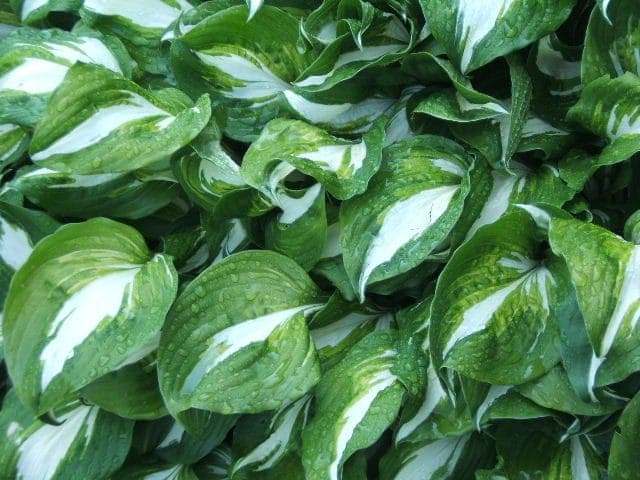
Hosta undulata is the variegated hosta that turns up in countless older gardens: under a hedge, beside a shady path or tucked into a forgotten corner by the garage. It catches the eye straight away with its wavy, slightly twisted leaves, each with a broad creamy-white centre and a green margin. Once established it tends to stay put for decades, asking for very little attention.
There is a small botanical wrinkle. For many years Hosta undulata was treated as a true species, but it is now generally regarded as an old Japanese garden selection, probably of hybrid origin. That is why you will also see it sold as Hosta 'Undulata', 'Mediovariegata' or 'Undulata Variegata'. The plant does not set viable seed, so every specimen in cultivation descends by division from the same old clone. For the gardener none of this matters: it remains a dependable, vigorous perennial for partial shade.
Hostas belong to the Asparagaceae family and are grown almost entirely for their foliage. The flowers are a welcome bonus, but the white heart of each leaf is the real draw. On gardenworld.app you can have a garden design made in which this hosta lights up the darker parts of your plot, for instance as a drift beneath trees or as an edging along a shaded walk.
Appearance and bloom cycle
The plant forms a compact mound roughly 30 to 45 cm tall and 45 to 60 cm across. The leaves are oval to lance-shaped, 12 to 18 cm long and clearly rippled along the edges. The tip often twists through a quarter turn, which gives the clump a playful, slightly tousled look. On the first spring leaves the white centre can cover more than half the blade. The photo shows this well: a dense mass of twisted leaves with wide white stripes and green edges.
As summer goes on, the picture changes. Leaves produced later carry less white and are sometimes almost entirely green. This is typical of the plant and not a sign of disease. Some divisions even revert permanently to an all-green form, which is covered under pruning below.
In July and August flower stems 60 to 90 cm tall rise well above the foliage, carrying funnel-shaped lilac flowers about 5 cm long. Bumblebees visit them readily, and they give the plant a second season of interest in late summer. If you prefer a tidy carpet of leaves, simply cut the stems off; the plant will not mind.
A word of caution for pet owners: hostas contain saponins and are considered mildly toxic to dogs, cats and horses. A dog that chews the leaves may vomit or have diarrhoea. Serious poisoning is rare, but it is best to discourage young animals from nibbling.
Ideal location
Hosta undulata prefers light to partial shade. The perfect spot gets some morning sun and dappled light for the rest of the day, for example beneath a tall tree or on the east side of a house. The white part of the leaf contains no chlorophyll and scorches quickly in strong afternoon sun, leaving brown, papery patches.
It will also grow in deep shade, though more slowly and with fewer flowers. The white stays crisp there, which is exactly why the plant is so useful in gloomy corners. Shelter from strong wind is a bonus, because the fairly thin leaves tear and crumple in a gale. Space plants 40 to 50 cm apart; as ground cover, allow about five plants per m².
This hosta also does surprisingly well in containers. A pot of at least 30 cm diameter on a shaded patio keeps slugs at bay more easily and shows off the pale foliage beautifully.
Soil requirements
A humus-rich soil that holds moisture yet drains freely is ideal. Loam and humus-rich sandy soil suit it perfectly; improve heavy clay with leaf mould or compost so that the roots do not sit in water over winter. The pH can range from 6 to 7.5, so slightly acidic to neutral.
When planting, work a few spadefuls of well-rotted compost into the hole. A mulch of 3 to 5 cm of leaf mould or bark chippings keeps the soil cool and moist and tops up the organic matter every year. In spring a handful of organic fertiliser per plant is enough. Do not overdo it: too much nitrogen produces lush, soft growth that slugs find irresistible.
Free preview
Want to see Wavy hosta (Hosta undulata): complete guide in your garden? Make a free preview of your design.
Watering
With their large leaf area, hostas lose a lot of water. After planting, water weekly during the first year, around 5 to 10 litres per plant in dry spells. Established plants in a humus-rich soil cope with a short dry period, but in prolonged drought the leaf edges turn brown and the foliage goes limp.
In those conditions, give a thorough soaking once a week rather than a little every day, and water in the morning at the base of the plant. Wet leaves in the evening are an open invitation to slugs. Check potted plants every two or three days in summer. Under trees with greedy roots, such as birch or maple, water more often, as the tree takes most of the moisture.
Pruning
Hostas need no real pruning, but a few jobs keep the plant looking good. Cut faded flower stems at the base in late summer. In autumn the leaves collapse into a brown, soggy mass. You may leave this as winter cover, but clear it away before the new shoots appear in April, because old leaves give slugs a hiding place.
With this variegated form, reversion is the key point. If a shoot appears with entirely green leaves, dig it out with a piece of rhizome. Green shoots grow more strongly and will gradually crowd out the variegated part. Leave them, and within a few years you will have an ordinary green hosta.
Divide every four to six years, or when the clump becomes bare in the middle. The best times are April, just as the tips push through, or from late August to mid-September. Slice the clump with a sharp spade into pieces with at least three shoots each and replant them straight away.
Maintenance calendar
March: Clear old foliage, scatter organic fertiliser around the clumps and lay fresh mulch.
April: Shoots emerge. Begin slug control now, for example with ferric phosphate pellets, beer traps or evening hand-picking. An ideal time to divide or plant.
May-June: The foliage is at its best. Remove green, reverted shoots and water in dry weather.
July-August: Flowering time. Water regularly in hot spells and cut off spent stems.
September: A second window for dividing. Plant new hostas so they root before winter.
October-November: Leaves collapse after the first frosts. Leave them or clear them and replace them with leaf mould.
December-February: Dormant period, nothing to do.
For an overview of what you can do in your garden each month, the planting calendar on gardenworld.app is a handy guide.
Winter hardiness
Hosta undulata is extremely hardy and survives temperatures down to about -35 °C (USDA zone 3). In Britain and the Low Countries no winter protection is needed. The plant retreats completely into its rhizome in autumn and does not reappear until April.
The only real risk is a late frost in April or May. The young, furled leaves can freeze and develop brown edges or holes. When frost is forecast, cover emerging shoots overnight with a bucket or a sheet of horticultural fleece. Plants in containers overwinter outdoors without trouble provided the pot is frost-proof and has a drainage hole; move it against a wall to shield the roots in a hard winter.
Companion plants
The white foliage looks its best beside plants with a different shape or texture. Ferns are the classic partners: the male fern (Dryopteris filix-mas), with its fine, upright fronds, contrasts beautifully with the broad, wavy leaves. Astilbe adds pink, red or white plumes in June and July in the same moist partial shade.
Siberian bugloss (Brunnera macrophylla) flowers sky-blue in April and May, just as the hosta unfurls. Bigroot cranesbill (Geranium macrorrhizum) forms a dense, aromatic ground cover that smothers weeds. If you want a small tree for the same conditions, a Japanese maple (Acer palmatum) is ideal: its fine red or green foliage above white-centred hostas creates a calm, Japanese-style scene. Japanese forest grass (Hakonechloa macra) and heucheras also fit well in such a shade border.
Final thoughts
Hosta undulata proves that an old favourite never really goes out of fashion. It is hardy, long-lived and brings light to the darkest parts of the garden. Give it partial shade and a moist, humus-rich soil, and keep slugs in check in spring. Remove green reversions and divide the clump every few years, and you will enjoy that fresh white heart for decades.
Frequently asked questions about Wavy hosta
Is Wavy hosta winter hardy?
Hosta undulata is extremely hardy and survives temperatures down to about -35 °C (USDA zone 3). In Britain and the Low Countries no winter protection is needed.
When and how do you prune Wavy hosta?
Hostas need no real pruning, but a few jobs keep the plant looking good. Cut faded flower stems at the base in late summer.
How much water does Wavy hosta need?
With their large leaf area, hostas lose a lot of water. After planting, water weekly during the first year, around 5 to 10 litres per plant in dry spells.
Where does Wavy hosta grow best?
Hosta undulata prefers light to partial shade. The perfect spot gets some morning sun and dappled light for the rest of the day, for example beneath a tall tree or on the east side of a house.
What soil does Wavy hosta need?
A humus-rich soil that holds moisture yet drains freely is ideal. Loam and humus-rich sandy soil suit it perfectly; improve heavy clay with leaf mould or compost so that the roots do not sit in water over winter.

See it in your garden
See Wavy hosta in your garden
One photo of your garden and a few questions. You see the result in about a minute.
Try it with a photoIdentify this plant in your own garden. Identify a plant
Similar plants
Astilbe: complete guide
Astilbe
Everything about Astilbe: planting, care, division and best cultivars. Practical tips for stunning feathery plumes in shade and part shade.
Male fern: complete guide
Dryopteris filix-mas
Learn how to grow Male fern (Dryopteris filix-mas) successfully: care, soil, watering, and ideal companion plants for lush green woodland gardens.
Great forget-me-not: complete guide
Brunnera macrophylla
Brunnera macrophylla, also known as Great forget-me-not, is a shade-loving perennial with heart-shaped leaves and spring blue flowers. Learn care, soil and planting tips.
