
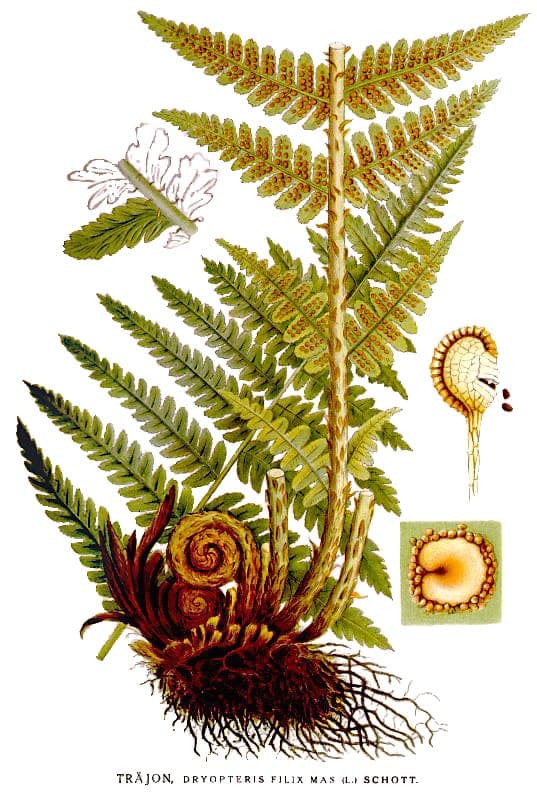
Carl Axel Magnus Lindman / Public domain, via Wikimedia Commons
Male fern: complete guide
Dryopteris filix-mas
Want to see Male fern: complete guide in your garden?
1 minute, no credit card
Overview
Dryopteris filix-mas, commonly known as Male fern, is a staple in woodland and shade gardens across temperate climates. Native to forests and rocky slopes from Europe to Central Asia, this hardy fern brings reliable greenery without fuss. It's especially useful in areas where other plants struggle – under trees, on north-facing banks, or in dry shade spots once established. On gardenworld.app, you can design a garden layout that highlights the fern's lush texture in shaded zones.
This fern grows in clumps up to 120 cm tall and spreads slowly via underground rhizomes. It's evergreen in milder climates (USDA zones 5–9), holding its fronds through winter. In colder areas, the fronds may die back but regrow vigorously in spring. With no flowers to speak of, its appeal lies entirely in its foliage – dense, arching, and deeply cut.
Appearance & bloom cycle
Male fern produces large, lance-shaped fronds that unfurl in spring from tight, woolly buds. These fiddleheads emerge with a bronze or reddish tint and mature into glossy, dark green fronds 60–120 cm long. Each frond is bipinnate – meaning the leaflets are divided twice – giving it a finely textured, feathery look.
Though it doesn't bloom, it reproduces via spores. From July to October, small clusters of spore cases (sori) appear in neat rows on the undersides of mature fronds. These start green, turn brown, and eventually release spores. While not flashy, this adds subtle seasonal interest.
The fronds remain attractive all season and often persist into winter, especially when sheltered. In exposed sites, they may brown but rarely need cutting until spring.
Ideal location
Male fern thrives in partial to full shade (light level 3/10). It tolerates deep shade but grows slower and less densely. Avoid hot, direct sun, especially in southern exposures – it scorches the fronds in dry summers. The best spots are under deciduous trees with open canopies, like oaks or birches, where dappled light reaches the ground.
It also does well along shaded pathways, in rock gardens with moisture retention, or on north-facing slopes. Protect from strong winds, which can tear the delicate fronds. On gardenworld.app, you can simulate how this fern fits into a shaded border or woodland scheme with companion plants.
Soil requirements
This fern prefers moist, well-drained, humus-rich soil with a pH between 5.5 and 6.5. It tolerates clay if it doesn't stay waterlogged, and sandy soils if mulched regularly to retain moisture. Amend poor soils with leaf mould, compost, or well-rotted manure.
Avoid alkaline soils – if your pH is above 7.0, consider growing it in a raised bed with acidic compost. Good drainage is essential; wet, stagnant soil leads to rhizome rot, especially in winter.
Free design
Want to see Male fern: complete guide in your garden? Make a free design now.
Watering
Keep the soil consistently moist, especially during the first growing season and in dry spells. Water deeply once a week (about 15–20 litres per m²) if rainfall is low. Mulch with leaf litter or bark chips to reduce evaporation and maintain even soil temperature.
Once established, Male fern shows moderate drought tolerance, but prolonged dryness causes frond browning and stunted growth. Never let it sit in standing water.
Pruning
Pruning is minimal. In late winter or early spring (February–March), cut back dead or damaged fronds to the base. Wait until new fiddleheads emerge before removing old foliage – this protects the crown from late frosts.
Use clean, sharp shears to prevent disease. Avoid cutting healthy green fronds – they photosynthesize and feed the plant year-round.
Maintenance calendar
- January: Check for winter damage. No action needed.
- February: Begin clearing old fronds as new growth appears.
- March: Remove all dead foliage. Top-dress with compost.
- April: Start regular watering if dry. Watch for slugs on new shoots.
- May–August: Maintain moisture. Replenish mulch if needed.
- September: Reduce watering gradually.
- October: Leave fronds for winter protection.
- November–December: No care required. Ensure good drainage before frost.
Winter hardiness
Male fern is hardy to USDA zone 5 (–29°C to –23°C). It survives most UK and northern US winters without protection. In zone 5, a light mulch of leaves or compost helps young plants. Older clumps are self-protecting, with fronds shielding the crown.
Even if fronds turn brown, the plant rebounds in spring. Avoid heavy winter coverings – they can trap moisture and promote rot.
Companion plants
Pair Male fern with other shade lovers: Hostas, Hellebores, Lungworts (Pulmonaria), and Solomon's Seal (Polygonatum). It contrasts beautifully with bold-leaved plants or softens the look of woody shrubs like Rhododendron.
Avoid aggressive spreaders like mint or bindweed. For a natural look, plant in groups of 3–5, spaced 40–50 cm apart.
Closing
Male fern is a low-maintenance, resilient plant that brings structure and texture to shady areas. Once settled, it asks for little and gives back lush greenery year after year. You can find healthy specimens at garden centres like Wyevale, Dobbies, or local independents. Combine it with other shade-tolerant perennials for a serene, woodland feel. On gardenworld.app, explore design ideas that use Male fern as a backbone for shade gardens, creating depth and continuity with minimal effort.
Want to see Male fern: complete guide in your garden? Make a free design now.
Upload a photo, pick a style, and get a photorealistic design with plant list in under a minute.
No credit card required


Similar plants
Dryopteris sieboldii: complete guide
Dryopteris sieboldii
Discover Dryopteris sieboldii (Siebold's Buckler Fern), an elegant evergreen fern from Asia. Growing tips, care, and uses in shade gardens.
Dryopteris tyrrhena: complete guide
Dryopteris tyrrhena
Discover Dryopteris tyrrhena (Mediterranean Buckler-fern), a rare and exquisite fern species. Growing tips, care, and shade garden design.
Dryopteris villarii: complete guide
Dryopteris villarii
Dryopteris villarii, known as rigid buckler fern, is a shade-loving fern form from the Alps. Discover how to grow and maintain this elegant alpine fern in your garden.