
Wikimedia Commons / CC BY-SA 3.0, via Wikimedia Commons
Astilbe: complete guide
Astilbe
Want to see Astilbe: complete guide in your garden?
1 minute, no credit card
Overview
Astilbe is one of the most valuable perennials for shaded gardens. Where many plants falter in low light, astilbe thrives, producing spectacular feathery plumes that illuminate the darkest corners of any garden. This herbaceous perennial from the Saxifragaceae (saxifrage) family originates in the moist mountain forests of East Asia and North America, and it adapts exceptionally well to the temperate maritime climates of Western Europe and the British Isles.
The genus Astilbe comprises roughly 25 species and hundreds of cultivars ranging from 30 to 120 cm in height. On gardenworld.app you can create a garden design where astilbe takes the leading role in your shade border - as a specimen, in groups of three or five, or as lush ground-level planting beneath trees. The plume-shaped inflorescences appear from June to August in shades of pink, red, white, purple, and even salmon, delivering weeks of colour in spots where few other plants will bloom.
Appearance and bloom cycle
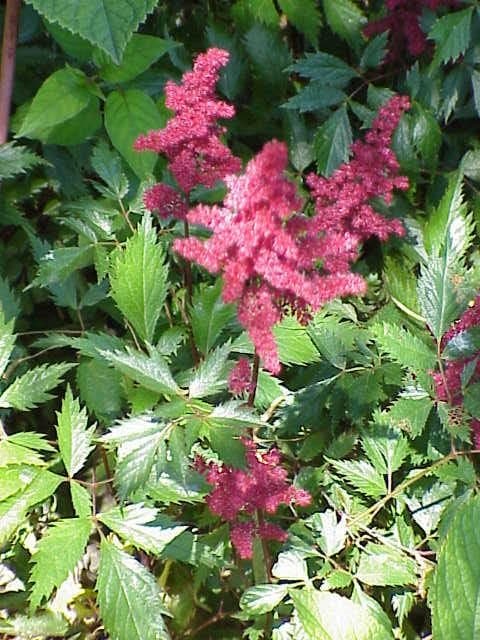
The flowers of astilbe are the undisputed star attraction. The plume-shaped inflorescences consist of hundreds of tiny individual florets that together create imposing, feather-light trusses. Depending on species and cultivar, the plumes can be firmly upright, elegantly arching, or loose and airy. Flower colours span the full spectrum from pure white through soft pink and hot pink to deep crimson, lavender purple, and silver-pink. Some cultivars feature bicoloured plumes that shift in hue as they mature.
The foliage of astilbe is at least as decorative as the flowers. The compound, fern-like leaves are deeply dissected and glossy, ranging from fresh green to bronze-green and even deep purple-brown in certain cultivars. Foliage emerges early in spring and forms dense clumps that provide excellent ground cover. After flowering, the seed heads remain ornamental well into winter - when touched by frost they become a true spectacle. Plants reach 30 to 120 cm in height depending on cultivar, with a spread of 30 to 60 cm.
Top cultivars
The choice of astilbe cultivars is overwhelming, but a handful have proven themselves over the decades as particularly reliable and elegant. 'Fanal' is a classic cultivar with deep red, firmly upright plumes reaching 50–60 cm. Its dark green, lightly bronze-tinted foliage provides a handsome contrast with the crimson blooms. 'Fanal' flowers early, from the beginning of June, and is an excellent choice for the front of a shade border.
'Brautschleier' (Bridal Veil) is the finest white astilbe, with gracefully drooping plumes that recall a cascade of white lace. This cultivar reaches 70–80 cm and flowers from late June to late July. The white blooms glow in twilight and are particularly beautiful in an evening or moonlight garden. The 'Visions' series offers compact plants of 30–45 cm with extra-wide, dense plumes in shades of pink, red, and purple. They are ideal for the front of borders and for large containers on a shaded patio. Most well-stocked garden centres carry a good range of astilbe cultivars, often in flower so you can select the precise colour.
Ideal location
Astilbe is the queen of shade, but that does not mean every shady spot will do. The ideal position is part shade: morning sun with afternoon shade, or dappled light beneath a leaf canopy. In deep, permanent shade astilbe flowers less profusely but still forms an attractive foliage plant. Full sun is tolerable only if the soil remains consistently moist - in a dry, sunny border the leaf edges scorch and the plant wilts rapidly.
The best positions for astilbe are beneath deciduous trees with a light canopy, on the north side of a wall or fence, beside a pond or stream, or in a woodland-style garden. The plant appreciates a sheltered spot where wind does not dry out the foliage. Combined with hostas, ferns, and brunnera, you can create a lush shade border that remains attractive from spring to autumn. On gardenworld.app you can see exactly how astilbe will perform in your specific garden situation.
Soil requirements
Astilbe makes clear demands of its soil: moisture-retentive, humus-rich, and slightly acidic to neutral. The ideal soil pH sits between 5.5 and 7.0. Unlike many other garden plants, astilbe prefers soil that never dries out completely. This makes it ideal for gardens with heavy clay that stays moist through summer, or for low-lying areas where water collects naturally.
Improve the soil before planting with a generous quantity of compost, leaf mould, or well-rotted garden compost. Work this into the top 30 cm. On dry sandy soil, astilbe is harder to maintain - here a thick mulch layer of 5–8 cm is indispensable for retaining moisture. Use composted bark, cocoa shells, or leaf mould. Refresh the mulch each spring. A planting hole twice the width of the root ball, backfilled with an enriched mix, gives new plants the best start.
Watering
Moisture is the keyword with astilbe. This plant hails from damp mountain forests and needs consistently moist - but not waterlogged - soil. During dry spells, regular watering is absolutely essential. In summer, water two to three times per week generously, preferably early in the morning so the foliage can dry before evening. Budget 5–10 litres per plant per watering session in dry weather.
Drought stress shows as limp, drooping leaves and brown leaf edges. If you notice this too late, the plant dies back above ground - but do not panic, because the roots usually survive and the plant returns the following spring. To prevent drought stress, a mulch layer of 5–8 cm around the plants is essential. This layer retains moisture, moderates soil temperature, and suppresses weeds. Astilbe in containers needs daily watering in warm weather - consider using a pot with a built-in water reservoir.
Free design
Want to see Astilbe: complete guide in your garden? Make a free design now.
Planting and propagation
Plant astilbe in spring or autumn when the soil is moist and temperatures are mild. Dig a planting hole twice as wide and as deep as the root ball. Mix the excavated soil with compost at a ratio of two parts soil to one part compost, and plant the root ball at the same depth as it sat in its nursery pot. Water generously immediately after planting and apply a mulch layer.
Spacing depends on cultivar: 30 cm for compact varieties (30–45 cm tall), 40–50 cm for medium types (50–80 cm), and 50–60 cm for tall cultivars (80–120 cm). Plant in groups of at least three - odd numbers look most natural. The easiest method of propagation is division in spring (March–April) or autumn (September–October). Lift the entire clump, divide it with a sharp spade into sections of at least three growth points, and replant immediately. Division also rejuvenates older clumps that have become woody in the centre - every three to four years is ideal.
Maintenance calendar
March–April: Cut away the old brown foliage and last year's seed heads as soon as new shoots emerge. Apply a fresh mulch layer of 5–8 cm. Give the first feed with an organic fertiliser such as garden compost or composted manure.
May: Growth accelerates. Monitor soil moisture regularly and begin watering if the topsoil feels dry. Remove any weeds around the plants.
June–July: Flowering begins. Enjoy the plumes - they also make lovely cut flowers for a vase. Give a second feed in mid-June.
August: Flowering winds down. Leave the seed heads in place for autumn and winter interest. Continue watering during dry spells.
September–October: Ideal planting time for new astilbes and for dividing established clumps. Apply an extra layer of mulch before winter.
November–February: Leave the spent top growth and seed heads in place until spring - they provide winter decoration and crown protection. Astilbe is fully hardy (USDA 4–8) and needs no additional winter protection.
Winter hardiness
Astilbe is outstandingly winter-hardy, surviving temperatures down to -30 C or lower (USDA zones 4–8). Across the British Isles and Western Europe, winter hardiness is never a concern. The above-ground parts die back in autumn, but the underground rhizomes endure the severest winters with ease and reliably push fresh growth in spring.
The only winter risk is not cold but desiccation of the rhizomes. Ensure the soil remains lightly moist even in winter, especially for container-grown plants. A mulch layer protects roots from temperature fluctuations and drying out. Late spring frosts can damage newly emerging foliage, but the plant recovers quickly by producing replacement shoots from the crown.
Pests and diseases
Astilbe is a remarkably healthy plant with few pest or disease problems. The most common issues relate to incorrect growing conditions: too dry, too sunny, or too lean a soil. Brown leaf edges and wilting always point to drought stress and are resolved by increasing water and topping up the mulch layer.
In rare cases powdery mildew can develop where air circulation is poor. Ensure adequate spacing and avoid watering foliage in the evening. Aphids sometimes appear on young shoots in spring but usually vanish on their own once natural predators such as ladybirds and lacewings become active. Slugs and snails can damage young shoots - use a ring of slug pellets around valuable plants or set out organic slug traps.
Companion plants
Astilbe is the ideal partner for a shade border and combines beautifully with other shade-loving plants. The classic pairing is astilbe with hostas - the large, rounded hosta leaves create a striking contrast with the finely dissected, fern-like astilbe foliage. Plant gold-leaved hostas beside red astilbes for a bold colour clash, or blue hostas alongside white astilbes for a serene atmosphere.
Other excellent partners include ferns (Dryopteris, Athyrium, Matteuccia) for textural contrast, brunnera (Brunnera macrophylla) for spring bloom, rodgersia for bold foliage, and foxglove (Digitalis purpurea) for vertical accents. Beside water, combine astilbe with ligularia, Siberian iris, and darmera. For a long-season shade border, interplant early, mid-season, and late astilbe cultivars so you enjoy uninterrupted plumes from June through September. Hydrangeas (Hydrangea macrophylla) are the ultimate shrubby partner for astilbe - they share the same preference for part shade and moist soil.
Final thoughts
Astilbe is the undisputed queen of the shade border and a plant that enriches every garden with its elegant plumes and graceful foliage. It asks for little more than moist, humus-rich soil and a spot out of the fierce afternoon sun. Meet those simple requirements and you will be rewarded with months of colour in places where other plants produce nothing but green leaves.
Choose your astilbe from a reputable garden centre - ideally pick a plant in flower so you can judge the exact colour. On gardenworld.app you can create a garden design that combines astilbe with hostas, ferns, and other shade plants tailored to your specific garden. Plant a group of five astilbes beneath a tree this autumn and discover just how spectacular shade can be.
Want to see Astilbe: complete guide in your garden? Make a free design now.
Upload a photo, pick a style, and get a photorealistic design with plant list in under a minute.
No credit card required


Similar plants
Hosta: complete guide
Hosta
Everything about hostas (plantain lilies): varieties, planting, care and slug control. Expert tips for stunning foliage in shade gardens.
Bigleaf Hydrangea: complete guide
Hydrangea macrophylla
Everything about the Bigleaf Hydrangea (Hydrangea macrophylla): planting, pruning, flower colour control and winter protection. Practical tips for lush blooms.
Foxglove: complete guide
Digitalis purpurea
Everything about the foxglove (Digitalis purpurea): dramatic flower spires, shade performer, self-seeder and toxicity. Expert tips for this spectacular border plant.