Cillas / CC BY-SA 4.0, via Wikimedia Commons
Sausage vine (Holboellia coriacea): scented evergreen climber
Holboellia coriacea
Want to see Sausage vine (Holboellia coriacea): scented evergreen climber in your garden?
Full design in HD: €7.99
Look after your Sausage vine with the GardenWorld app
Identify plants with your camera and get a care calendar with reminders for this plant.


Overview
The sausage vine, Holboellia coriacea, is an evergreen twining climber from the mountain forests of central and western China. It belongs to the Lardizabalaceae, the same family as the better-known chocolate vine (Akebia quinata), and owes its common name to its sausage-shaped purple fruits. Botanists have recently moved it to the genus Stauntonia, as Stauntonia coriacea, but nurseries almost always label it Holboellia coriacea.
The plant is prized above all for its scent. In April and May it hangs with dozens of clusters of small bells, and on a still evening you can smell them metres away. For the rest of the year it is a dense green covering for a wall, fence or pergola. It grows briskly to 4 to 8 metres and becomes a substantial plant within a few years.
Check the name when buying. According to specialist growers, Stauntonia hexaphylla, a related species with more and broader leaflets, is sometimes sold as Holboellia coriacea. A good nursery will be able to show you the difference.
Appearance and bloom cycle
Each leaf is made up of three leathery, glossy dark green leaflets 6 to 12 cm long. They feel firm, hence the species name coriacea, meaning leathery. Young shoots are often tinged purple. The stems twine around anything they meet.
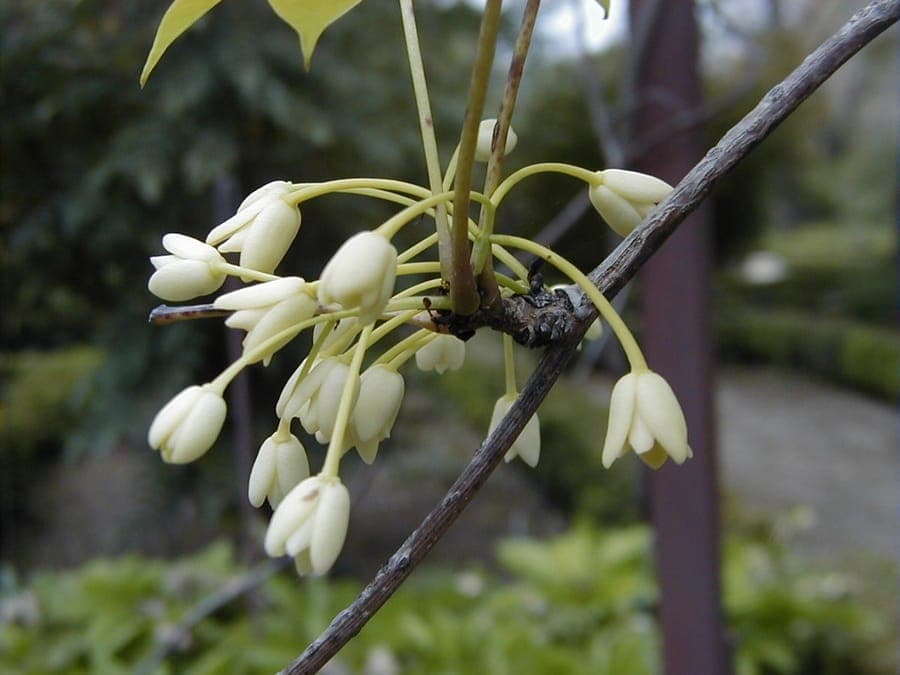
The plant carries separate male and female flowers on the same plant. Male flowers are creamy white, bell-shaped, about 1 cm long and hang in clusters on long stalks from the old wood, as in the photo. Female flowers are slightly larger and greenish white flushed purple. Both have a sweet, slightly citrus scent. Flowering is in April and May, sometimes from late March.
After a hot summer, sausage-shaped purple fruits of 5 to 6 cm may follow, but in our climate this is rare. There are no known reports of toxicity, but this is not a fruit plant: never taste fruit you cannot identify with certainty.
Ideal location
Holboellia coriacea grows in sun or partial shade. For good flowering it needs some sun, and an east- or west-facing wall is ideal. It will tolerate a fairly cool, shady wall but flowers less there. Always choose a sheltered spot, because evergreen foliage struggles in cold, drying easterly winds.
A position near a terrace, a bench or a window that is open in May is perfect, so you get the full benefit of the fragrance. Plant 30 to 40 cm from a wall or fence so the roots are clear of the dry strip at its base.
Providing support
This plant twines; it does not cling. It winds its stems around wires, battens and other plants but cannot hold onto a bare wall. Put up a sturdy trellis, tensioned wires or a pergola before planting. Horizontal wires 30 to 40 cm apart, with a few vertical links, work well on a wall. Keep a 5 cm gap between wire and brickwork.
A mature plant becomes dense and heavy, so use solid materials. In the early years, spread the shoots out across the support; otherwise they all twine around each other and form a tangle at the top. It can also climb into a sturdy old tree or over a large shrub, provided the host is strong enough.
Soil requirements
Holboellia coriacea is not fussy. Ordinary humus-rich garden soil that holds moisture yet drains well is perfect. It tolerates both slightly acid and slightly alkaline conditions. On poor sandy soil, mix compost into the planting hole; on heavy clay, add compost and grit to avoid wet roots in winter.
In March, give a handful of organic fertiliser and lay a 5 cm mulch. Too much feeding mainly produces leaves, so keep it modest.
Free preview
Want to see Sausage vine (Holboellia coriacea): scented evergreen climber in your garden? Make a free preview of your design.
Watering
In the first year, water weekly in dry spells with a full 10-litre can. Less rain reaches the base of walls and fences, so check that the soil is truly wet even after a shower. An established plant copes with a dry spell, but in long summer droughts an extra soak is still needed. During dry, sunny frosty spells, water on a mild day so the evergreen leaves do not dry out.
Pruning
Holboellia coriacea flowers on the previous year's wood. Prune straight after flowering, in late May or June. Cut back flowered shoots, remove stems that stick out too far and thin the plant where it becomes congested. That gives it the whole summer to make new shoots that will flower the following spring.
A vigorous plant can have a second, light trim in summer to shorten long whippy growths. Do not prune in winter or early spring, as you will remove the flower buds. If an old plant has got completely out of hand, cut it back hard after flowering; it usually reshoots well, although you lose a year of flowers.
Maintenance calendar
March: Feed with organic fertiliser and top up the mulch. Cut out any frost damage.
April–May: Flowering and fragrance. Tie young shoots into the support.
Late May–June: Main prune straight after flowering.
July–August: Water in dry spells. Optional light summer trim of long growths.
September–October: A good time to plant. Fruit may appear after a hot summer.
November–February: Protect young plants with fleece in hard frost. Water on mild days in dry frosty spells.
The plant calendar on gardenworld.app sets out these jobs month by month, so you never forget the prune after flowering.
Winter hardiness
The RHS rates Holboellia coriacea H4, meaning it tolerates frost down to about -10 °C. An established plant against a sheltered wall survives most winters in much of Britain. In prolonged frost below -5 °C, leaves and young stems can be damaged, and after a hard winter some foliage may brown. The plant usually reshoots from older wood in spring.
Protect young plants in their first winters with leaf mould around the base and fleece over the shoots in severe frost. In the coldest areas, the deciduous Akebia quinata, which tolerates more cold, is a safer choice.
Companion plants
Holboellia coriacea pairs well with other scented evergreens. Star jasmine (Trachelospermum jasminoides) flowers in June and July, taking over the fragrance where the sausage vine leaves off. Its relative, the chocolate vine (Akebia quinata), can share a pergola with it. At the foot of the wall, Mexican orange blossom (Choisya ternata) and Pittosporum tobira give an evergreen, scented underplanting. A Camellia japonica nearby brings early spring flowers just before the Holboellia begins.
Final thoughts
Holboellia coriacea is a plant for anyone who wants scent in the garden. Give it a sheltered wall with strong wires, a bit of sun, and prune straight after flowering. Year after year you will have a green wall that fills the whole garden with sweet fragrance in spring.
Not sure where to put a scented climber like this? On gardenworld.app you can create a garden design that places fragrant plants close to seating and windows. Plant it against a sheltered wall this autumn and enjoy a May scent that has visitors asking where it comes from.
Frequently asked questions about Sausage vine
Is Sausage vine winter hardy?
The RHS rates Holboellia coriacea H4, meaning it tolerates frost down to about -10 °C. An established plant against a sheltered wall survives most winters in much of Britain.
When and how do you prune Sausage vine?
Holboellia coriacea flowers on the previous year's wood. Prune straight after flowering, in late May or June.
How much water does Sausage vine need?
In the first year, water weekly in dry spells with a full 10-litre can. Less rain reaches the base of walls and fences, so check that the soil is truly wet even after a shower.
Where does Sausage vine grow best?
Holboellia coriacea grows in sun or partial shade. For good flowering it needs some sun, and an east- or west-facing wall is ideal.
What soil does Sausage vine need?
Holboellia coriacea is not fussy. Ordinary humus-rich garden soil that holds moisture yet drains well is perfect.

See it in your garden
See Sausage vine in your garden
One photo of your garden and a few questions. You see the result in about a minute.
Try it with a photoIdentify this plant in your own garden. Identify a plant
Similar plants
Chocolate vine: complete guide
Akebia quinata
Everything you need to know about Akebia quinata, the fast-growing, evergreen climber with chocolate-scented flowers. Perfect for pergolas and privacy screens.
Star jasmine: complete guide
Trachelospermum jasminoides
Everything about Star Jasmine (Trachelospermum jasminoides): planting, care, pruning and winter protection. Expert tips for a fragrant evergreen climber.
Japanese Camellia: complete guide
Camellia japonica
Everything about Japanese Camellia (Camellia japonica): planting, care, pruning and overwintering. Practical tips for stunning winter and spring blooms.
