
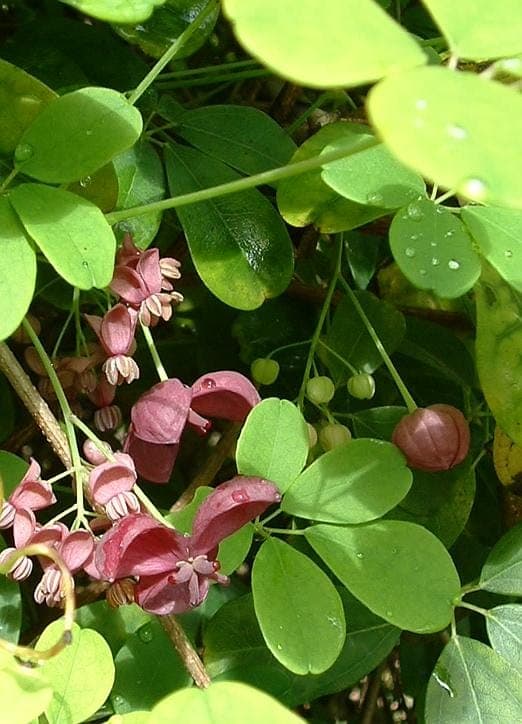
Wikimedia Commons / CC BY-SA 3.0, via Wikimedia Commons
Chocolate vine: complete guide
Akebia quinata
Want to see Chocolate vine: complete guide in your garden?
1 minute, no credit card
Overview
Akebia quinata, commonly known as chocolate vine, is a vigorous, semi-evergreen climber native to Japan, Korea, and parts of China. It's earned its nickname from the rich, cocoa-like fragrance of its early spring flowers. This fast-growing vine is ideal for covering pergolas, fences, and arbours, offering dense foliage and subtle seasonal interest. It climbs by twining stems, so it needs something to wrap around - no suckers or adhesive pads.
If you're planning a vertical garden, check out gardenworld.app to visualise how chocolate vine can transform your space over time. It's a low-fuss choice that delivers real impact with minimal effort.
Appearance & bloom cycle
The foliage of Akebia quinata is one of its highlights: palmate, five-leaflet leaves that look like open hands, deep green and slightly glossy. In mild winters, the leaves often persist, giving the plant semi-evergreen status in USDA zones 5 to 9. From late winter to early spring (February to April), clusters of maroon to purple-brown flowers appear directly on the stems. These cup-shaped blooms, about 2–3 cm wide, emit a sweet, chocolatey scent - especially on warm days.
Akebia quinata is dioecious, meaning male and female flowers grow on separate plants. For fruit set, you need both. If pollination occurs, sausage-shaped, bluish-purple fruits develop, reaching 5–8 cm in length. Though edible, they're often bland in cooler climates and rarely form outside ideal conditions.
Ideal location
Chocolate vine thrives in partial shade, especially morning sun with afternoon shade. Full sun is acceptable in cooler regions, but in hot summers, direct midday sun can scorch the leaves. A north- or east-facing wall or fence works best. It's also effective as a ground cover in shaded areas, though it really shines when trained vertically.
Use it to soften hardscaping - think wooden trellises, wire mesh, or pergola beams. On gardenworld.app, you can simulate how this vine will drape over your structure in 2–3 years, helping you plan spacing and support.
Soil requirements
This vine isn't picky about soil, as long as it's well-drained. It grows well in loamy, clay, or sandy soils with a pH from 6.0 to 7.5. Heavy clay is fine if it doesn't stay waterlogged. For sandy soils, mixing in compost improves moisture retention and fertility.
Amend the planting hole with a bucket of compost, and top-dress with organic matter each spring. No need for chemical fertilisers unless growth is sluggish.
Free design
Want to see Chocolate vine: complete guide in your garden? Make a free design now.
Watering
During the first growing season, water weekly with 5–10 litres per plant, especially during dry spells. Once established, Akebia quinata is drought-tolerant and rarely needs supplemental watering. In prolonged dry periods, a deep soak every two weeks is sufficient.
Avoid overhead watering to reduce fungal risks. Water at the base and allow the soil to dry slightly between sessions. Potted plants dry out faster - check moisture weekly in summer.
Pruning
Pruning isn't essential but helps control size and shape. The best time is right after flowering, in late spring. Cut back overlong shoots to maintain structure and remove dead or weak growth. Never prune in autumn or winter - you'll remove the flower buds that form on old wood.
Use sharp, clean secateurs. Train new growth by gently tying stems to supports. For a neat look on a trellis, pinch out tips during the growing season to encourage bushier growth.
Maintenance calendar
- January: Inspect for winter damage. Remove any dead stems.
- February: Flowers begin to open. Monitor for aphids on new growth.
- March: Peak bloom. Keep base free of weeds.
- April: Post-flower pruning window opens. Apply compost around the base.
- May: Train new shoots. Check for pests.
- June–August: Minimal care. Water only in drought.
- September: Stop feeding. Begin reducing water.
- October–December: Plant enters dormancy. Leaves may drop in colder zones.
Winter hardiness
Chocolate vine is hardy in USDA zones 5 to 9 (-20°C to -30°C). Mature plants withstand harsh winters, though young vines may suffer tip dieback in zone 5. Protect first-year plants with mulch or horticultural fleece around the base.
In containers, move pots to a sheltered spot or insulate with bubble wrap. Use a pot at least 40 cm wide to reduce root freeze risk.
Companion plants
Pair chocolate vine with shade-loving perennials like ferns, hellebores, or hostas. Underplant with creeping Jenny or vinca for ground cover. Avoid aggressive spreaders like mint or ivy, which may compete for resources.
For vertical harmony, grow it alongside climbing hydrangea (Hydrangea petiolaris), which has similar cultural needs but blooms in summer, extending seasonal interest.
Closing
Akebia quinata is a reliable, attractive climber that asks for little and gives much. With its glossy foliage, fragrant blooms, and year-round presence, it's a standout choice for gardeners wanting fast coverage and natural charm. Train it up a support, and within two to three years, you'll have a lush green screen.
You can find chocolate vine at garden centres across the UK and US. Look for healthy plants in 3–5 litre pots. And remember - gardenworld.app lets you design a garden layout where this vine plays a starring role.
Want to see Chocolate vine: complete guide in your garden? Make a free design now.
Upload a photo, pick a style, and get a photorealistic design with plant list in under a minute.
No credit card required


Similar plants
Acer pycnanthum: complete guide
Acer pycnanthum
Acer pycnanthum, the Japanese swamp maple, is a fast-growing tree with early red flowers and brilliant autumn color, ideal for damp garden settings.
Freeman maple: complete guide
Acer × freemanii
Everything about the Freeman maple (Acer x freemanii): a fast-growing shade tree with spectacular autumn colour for large gardens.
Silver vine: complete guide
Actinidia polygama
Discover silver vine (Actinidia polygama): a hardy climbing plant with silvery foliage, loved by gardeners and cats alike.