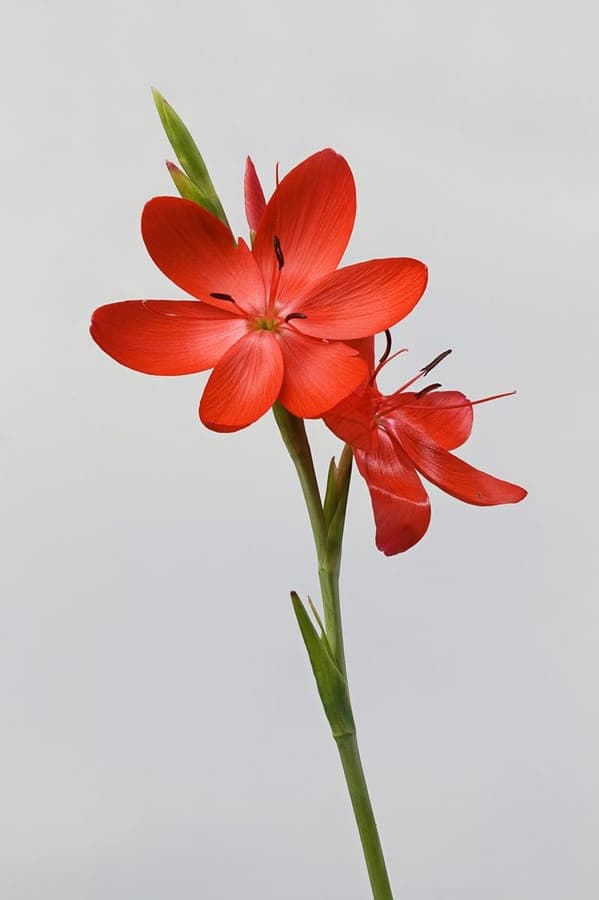
JJ Harrison (https://www.jjharrison.com.au/) / CC BY-SA 3.0, via Wikimedia Commons
Hesperantha coccinea (Schizostylis): autumn stars for your border
Hesperantha coccinea
Want to see Hesperantha coccinea (Schizostylis): autumn stars for your border in your garden?
Full design in HD: €7.99
Look after your Hesperantha coccinea with the GardenWorld app
Identify plants with your camera and get a care calendar with reminders for this plant.


Overview
Hesperantha coccinea is the perennial to choose if you want your garden to keep flowering through October and November. Just as most borders turn brown, this South African member of the iris family opens one starry flower after another in bright scarlet, salmon, soft pink or white. Many nurseries and older gardening books still list it under its former name, Schizostylis coccinea. Botanists merged the genus Schizostylis into Hesperantha in 1996, but the old name lingers on labels. Common names include crimson flag lily and river lily.
The species belongs to the Iridaceae and grows wild in eastern South Africa, Lesotho, Eswatini and Zimbabwe. There it lines streams and riverbanks, often with its roots in wet gravel and its leaves in full sun. That origin explains exactly what it needs in a garden: moisture in the growing season, plenty of light and a sheltered spot.
It spreads slowly by short rhizomes into broad clumps of sword-shaped leaves. It is not considered invasive anywhere in Europe, although it has naturalised locally in New Zealand. There are no reports of it being toxic to people or pets, but it is not edible either. Popular selections include 'Major' with large red flowers, salmon-pink 'Sunrise', soft pink 'Mrs Hegarty' and the white f. alba.
Appearance and bloom cycle
The leaves are narrow, sword-shaped and bright green, 30 to 45 cm long, and stay partly evergreen in mild winters. From late August or September, sturdy stems 40 to 60 cm tall rise between them. Each stem carries four to twelve buds that open from the bottom upwards. The flowers are 4 to 6 cm across, with six glossy tepals and a split style, which is what the old name Schizostylis (split style) refers to.
In mild weather flowering continues into November and sometimes until the first hard frost. That also makes it a much-loved cut flower: cut a stem when the lowest bud opens and the rest will keep flowering in the vase.
Colour depends on the selection. The wild form is a clear scarlet, almost orange-red in bright light. 'Major' has larger flowers in the same red and often starts in late August. 'Sunrise' is a warm salmon pink, 'Mrs Hegarty' a soft pink that tends to flower a little earlier, and the white form brings light to a dark corner of the autumn garden. Growing several selections together stretches the season by a few more weeks.
Ideal location
Give Hesperantha coccinea full sun or, at most, light shade. The more sun, the richer the autumn display. A warm spot in front of a south-facing wall, the sunny margin of a pond or a sheltered corner by the patio is ideal. Shelter from cold, drying easterly winds helps it through winter.
Plant in spring, in April or May, once the soil has warmed up. Space plants 20 to 30 cm apart. Groups of five or more show off the colour best. It also grows well in a large container, provided the compost never dries out.
Soil requirements
The ideal soil is fertile, rich in organic matter and moisture-retentive, yet without standing water in winter. That sounds contradictory, but think of its natural home: running water and gravel, never a stagnant puddle. On sandy soil, dig plenty of compost into the top 20 cm. On heavy clay, add grit and compost so the rhizomes do not suffocate in winter.
Soil pH is not critical; neutral to slightly acid is ideal. Plant the rhizomes shallowly, about 5 cm below the surface, and firm the soil well. A layer of compost or well-rotted manure in spring keeps the ground rich and moist.
Free preview
Want to see Hesperantha coccinea (Schizostylis): autumn stars for your border in your garden? Make a free preview of your design.
Watering
For a plant that flowers in autumn, summer is the critical season. If the soil dries out in July and August, the flower stems fail to appear or stay short. In dry spells, water thoroughly twice a week, roughly 10 litres per square metre, straight at the base. A mulch of compost or leaf mould holds the moisture in.
From October to March there is no need to water. Container plants still need attention: check them every few days in summer, and avoid standing the pot in a saucer that stays full of water in winter.
Pruning
Pruning here is mostly tidying. Cut spent flower stems back to the base after flowering. Leave the foliage in autumn, as it protects the rhizomes from cold. In March or early April, cut away brown or damaged leaves to make room for new growth.
Every two to three years clumps become congested and flower less. Lift them in spring, split them into pieces with a few shoots each and replant straight away in fresh soil improved with compost. That is also the easiest way to increase your stock.
Maintenance calendar
January to February: dormant. Keep the mulch in place.
March to April: remove old leaves, divide large clumps and add compost.
May: plant new specimens and mulch the soil.
June to August: keep the soil moist, especially in dry weather.
September to November: full flower. Cut stems for the vase and remove spent ones.
December: spread a layer of straw or leaf mould around the clumps.
The planting calendar on gardenworld.app gives you a month-by-month overview of what Hesperantha coccinea and the rest of your garden need.
Winter hardiness
Hesperantha coccinea is moderately hardy. The rhizomes tolerate frost down to about -10 °C, particularly in free-draining soil under a protective mulch. In most of the UK it survives outdoors without trouble, especially in a sheltered spot. In severe, prolonged cold it may be cut back to the ground and be slower to reappear in spring.
Cold, wet soil is more dangerous than dry cold. In December, spread 5 to 10 cm of straw, leaf mould or bark over the clump and remove it again in March. Move pots into a cold greenhouse, a garage or against a sheltered wall for the winter.
Companion plants
Hesperantha coccinea looks its best among plants that still provide structure in autumn. Ornamental grasses such as Miscanthus sinensis add movement and a calm, golden-brown backdrop for the red stars. Aster amellus flowers at the same time in blue-violet and creates a lively contrast. Verbena bonariensis floats its airy purple heads through the planting.
For a moist border, Salvia uliginosa makes a lovely partner, with sky-blue spikes that keep going until the frosts. Sanguisorba officinalis, great burnet, adds playful dark red buttons and enjoys the same moist soil. Would you like to plan a whole autumn border around these late performers? gardenworld.app can create a garden design for you that takes your soil, aspect and flowering times into account.
Final thoughts
Hesperantha coccinea, still widely known as Schizostylis coccinea, is one of the best plants for stretching your garden's flowering season deep into autumn. It asks for a sunny, sheltered spot, soil that does not dry out in summer and a warm blanket in winter. Give it that and you will be rewarded year after year with a stream of red or pink stars at a time when almost nothing else is in bloom. Plant a group by your patio or pond in spring, and you will be glad you did when October comes round.
Frequently asked questions about Hesperantha coccinea
Is Hesperantha coccinea winter hardy?
Hesperantha coccinea is moderately hardy. The rhizomes tolerate frost down to about -10 °C, particularly in free-draining soil under a protective mulch.
When and how do you prune Hesperantha coccinea?
Pruning here is mostly tidying. Cut spent flower stems back to the base after flowering.
How much water does Hesperantha coccinea need?
For a plant that flowers in autumn, summer is the critical season. If the soil dries out in July and August, the flower stems fail to appear or stay short.
Where does Hesperantha coccinea grow best?
Give Hesperantha coccinea full sun or, at most, light shade. The more sun, the richer the autumn display.
What soil does Hesperantha coccinea need?
The ideal soil is fertile, rich in organic matter and moisture-retentive, yet without standing water in winter. That sounds contradictory, but think of its natural home: running water and gravel, never a stagnant puddle.

See it in your garden
See Hesperantha coccinea in your garden
One photo of your garden and a few questions. You see the result in about a minute.
Try it with a photoIdentify this plant in your own garden. Identify a plant
Similar plants
Chinese Silver Grass: complete guide
Miscanthus sinensis
Everything about Chinese Silver Grass (Miscanthus sinensis): planting, cutting back, cultivars and winter silhouette. Expert tips for a spectacular ornamental grass.
European michaelmas daisy: complete guide
Aster amellus
A complete guide to growing Aster amellus: care, ideal conditions, bloom time, and companion planting for late-season gardens.
Argentine vervain: complete guide
Verbena bonariensis
Discover how to grow Verbena bonariensis: ideal conditions, pruning tips, hardiness and plant partners. Perfect for wildlife gardens in USDA zones 7-11.
