Daderot / CC0, via Wikimedia Commons
Hebe rakaiensis: complete guide
Hebe rakaiensis
Want to see Hebe rakaiensis: complete guide in your garden?
Full design in HD: €7.99
Look after your Hebe rakaiensis with the GardenWorld app
Identify plants with your camera and get a care calendar with reminders for this plant.


Overview
Hebe rakaiensis is the hebe for anyone who loves rounded shapes. With hardly any effort on your part, it grows into a dense, fresh green dome that looks well kept all year. In June and July that dome is studded with white flower spikes humming with bees. Since box has struggled in so many gardens with box tree caterpillar and blight, more and more gardeners are turning to this hebe as an evergreen alternative for low domes and edging.
The species comes from the South Island of New Zealand and is named after the Rakaia River in Canterbury, where it grows wild on river terraces and open, stony slopes. Like all hebes, it is now placed in the genus Veronica in current botanical classification, as Veronica rakaiensis, but it is almost always sold as Hebe rakaiensis. The RHS has given it the Award of Garden Merit, a sign that it performs reliably in gardens.
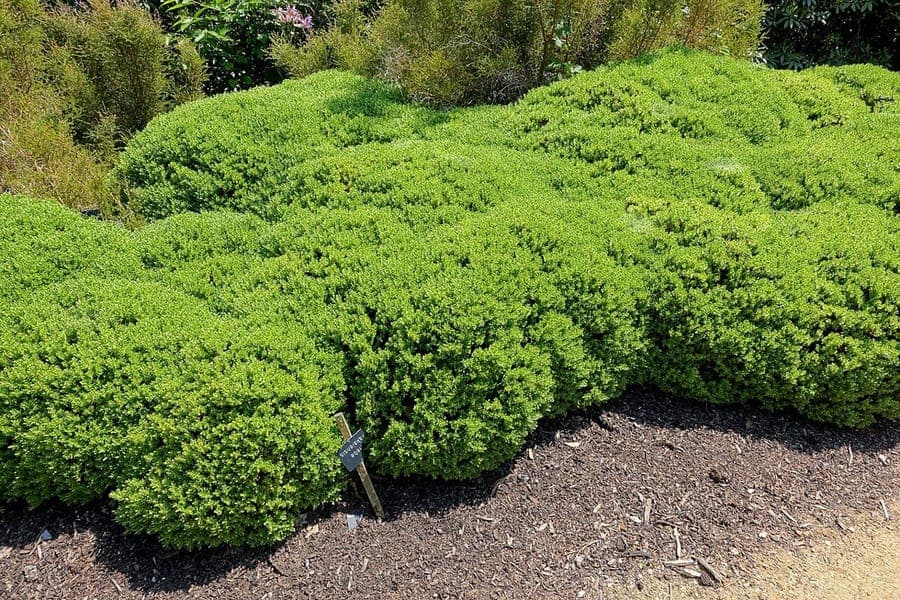
A mature plant reaches 60 to 90 cm in height and 1 to 1.5 metres across. It grows evenly and keeps its domed shape almost by itself, without pruning. That makes it a good fit for a contemporary front garden, as a rhythmic element along a path, as a low hedge or as a green ball in a large container. On gardenworld.app you can have a garden design made that shows how a row of green domes like these gives structure to your border or drive.
Appearance and bloom cycle
The leaves are small, elliptic, 1 to 2 cm long and a clear apple green with a light sheen. They sit closely along the stems, so up close the plant looks almost scaly and from a distance it reads as a smooth green ball. That fresh, light colour holds right through winter and brings a cheerful note to the garden in January.
Around June, short white flower spikes appear at the tips of the shoots. The individual flowers are small and four-lobed, with long stamens that give the spikes a slightly fluffy look. In full bloom the plant is so densely covered that the foliage almost disappears under a layer of white. The photo at the top shows a plant in flower, with dense white spikes among bright green leaves and a bumblebee feeding. Bees, bumblebees and hoverflies are regular visitors, which makes it a good choice for a pollinator-friendly garden.
Flowering usually lasts three to four weeks. Afterwards the spikes turn brown and form small dry seed capsules, which are best trimmed off once flowering is over.
Ideal location
Give Hebe rakaiensis a spot in full sun or light partial shade. The more light it gets, the more compact the growth and the better the flowering. In deep shade it becomes thin and loses its neat dome.
It tolerates wind and salt well, which makes it an excellent choice for coastal gardens. It also does very well in town gardens, where temperatures stay a little higher. Avoid low, wet ground and frost pockets where cold air collects. In colder inland areas, where winters can bring hard frosts, choose a sheltered position against a south- or west-facing wall.
For a loose group, allow 80 to 100 cm between plants. For a low hedge or an edging of touching domes, plant 50 to 60 cm apart so the plants grow together into a gently undulating band after a few years.
Soil requirements
Hebe rakaiensis likes free-draining, moderately fertile soil. Sand, loam and light clay are all suitable, as long as water drains away readily in winter. On heavy, wet clay, improve the structure with coarse sand and grit, or plant on a slightly raised bed.
The plant grows in slightly acidic to slightly alkaline soil, roughly pH 5.5 to 7.5. Mix some compost into the planting hole; after that, a thin layer of compost in spring is enough. Too much nitrogen produces soft growth that is more prone to frost damage and fungal problems.
Free preview
Want to see Hebe rakaiensis: complete guide in your garden? Make a free preview of your design.
Watering
In the first year after planting, regular watering is needed, especially in a dry spring. Give a thorough soak once or twice a week so the roots are encouraged to go deep. Established plants in the ground usually manage on rainfall and only need extra water during prolonged drought.
Container plants dry out faster. Check them every two or three days in summer and water as soon as the top few centimetres are dry. In winter keep the rootball on the dry side rather than wet; standing water in a cold pot is the quickest route to root rot.
Pruning
The great advantage of this hebe is that it stays round more or less on its own. A light trim after flowering, in July or early August, is enough. Remove the spent spikes and lightly shear the plant to keep the dome crisp. It will then produce new shoots that still have time to harden before winter.
Do not prune too late in the season: young shoots still growing in September and October are more likely to be damaged by frost. Never cut hard into bare old wood either, because hebes resprout poorly from it. If a plant becomes too large or bare at the base after many years, you can cut it back a little harder in stages in April, but replacing it is often quicker.
Fortunately, Hebe rakaiensis is easy to propagate. Semi-ripe cuttings of 8 to 10 cm, taken in July or August, root readily in a mix of compost and sand.
Maintenance calendar
March-April: Remove frost damage once you can see which shoots are breaking. Spread a thin layer of compost around the plants. A good time to plant.
May-June: Water young plants in dry weather. Flowering begins in June.
July-August: After flowering, remove the spent spikes and lightly shear the plant into shape. Take cuttings.
September: Last chance to plant before winter. No more pruning.
October-November: Clear fallen tree leaves from the plants. Raise pots on feet.
December-February: Rest period. In hard frost below -10 °C, cover young plants with fleece; wrap pots and move them against the house.
Winter hardiness
The RHS rates Hebe rakaiensis H4, which means hardy to roughly -5 °C to -10 °C. In practice it is one of the tougher hebes and, in a dry and sheltered spot, will also come through short spells of somewhat harder frost. In coastal areas and towns across Britain and the Low Countries it generally overwinters without trouble. In colder inland and upland areas, a sheltered position and some fleece during severe frost are sensible.
Cold, dry easterly winds can brown the foliage. That can look alarming after winter, but the plant usually recovers well in May. So wait before pruning until you can see which shoots are genuinely dead. Wet soil in winter greatly increases the risk of damage.
There are no reports of Hebe rakaiensis being toxic to people or pets.
Companion plants
As a green dome, Hebe rakaiensis works best next to plants with a looser shape or a different leaf colour. English lavender (Lavandula angustifolia) and Balkan clary (Salvia nemorosa) bring purple flowers in summer and contrast nicely with the fresh green. Lady's mantle (Alchemilla mollis) and Bulgarian geranium (Geranium macrorrhizum) fill the gaps between domes with soft, low carpets.
For a crisp, modern garden, repeat the hebe domes along a path and plant ornamental grasses such as Hakonechloa or Stipa between them. In a seaside garden, combine them with sea kale, thrift and other salt-tolerant plants. Used next to box (Buxus sempervirens), the difference in leaf colour stands out and creates a lively play of greens.
Want to know what to do in the garden and when? On gardenworld.app you will find a plant calendar that shows, month by month, which plants need pruning, water or attention.
Final thoughts
Hebe rakaiensis is an easy, evergreen shrub that forms a neat dome by itself and flowers generously in white in early summer. It is a strong alternative to box for edging and topiary-style balls, especially in sunny spots with free-draining soil. Give it a light trim after flowering, keep its roots out of winter wet and choose a sheltered position in colder areas. In return you get a fresh green, bee-friendly dome that asks very little of you for years.
Frequently asked questions about Hebe rakaiensis
Is Hebe rakaiensis winter hardy?
The RHS rates Hebe rakaiensis H4, which means hardy to roughly -5 °C to -10 °C. In practice it is one of the tougher hebes and, in a dry and sheltered spot, will also come through short spells of somewhat harder frost.
When and how do you prune Hebe rakaiensis?
The great advantage of this hebe is that it stays round more or less on its own. A light trim after flowering, in July or early August, is enough.
How much water does Hebe rakaiensis need?
In the first year after planting, regular watering is needed, especially in a dry spring. Give a thorough soak once or twice a week so the roots are encouraged to go deep.
Where does Hebe rakaiensis grow best?
Give Hebe rakaiensis a spot in full sun or light partial shade. The more light it gets, the more compact the growth and the better the flowering.
What soil does Hebe rakaiensis need?
Hebe rakaiensis likes free-draining, moderately fertile soil. Sand, loam and light clay are all suitable, as long as water drains away readily in winter.

See it in your garden
See Hebe rakaiensis in your garden
One photo of your garden and a few questions. You see the result in about a minute.
Try it with a photoIdentify this plant in your own garden. Identify a plant
Similar plants
Common Boxwood: complete guide
Buxus sempervirens
Everything about Common Boxwood (Buxus sempervirens): planting, pruning, topiary and box moth control. Practical tips for healthy, green hedges and shapes.
English Lavender: complete guide
Lavandula angustifolia
Everything about English Lavender (Lavandula angustifolia): planting, pruning, care and overwintering. Practical tips for lush purple blooms.
Woodland sage: complete guide
Salvia nemorosa
Everything about Woodland Sage (Salvia nemorosa): planting, care, pruning and combinations. Expert tips for months of blue-violet flower spikes.
