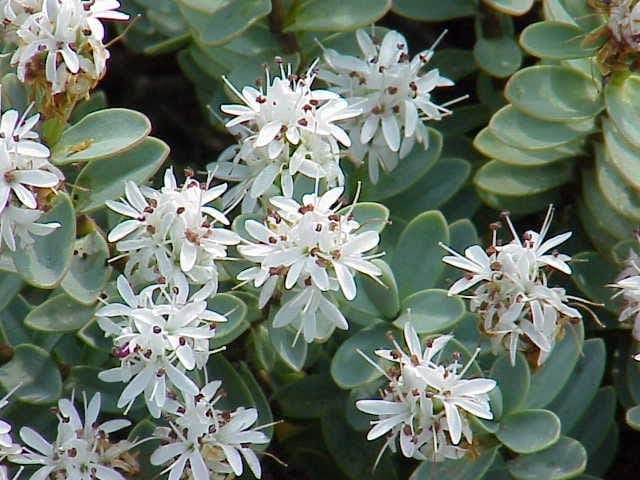
Kurt Stüber [1] / CC BY-SA 3.0, via Wikimedia Commons
Disc-leaved hebe: complete guide
Hebe pinguifolia
Want to see Disc-leaved hebe: complete guide in your garden?
Full design in HD: €7.99
Look after your Disc-leaved hebe with the GardenWorld app
Identify plants with your camera and get a care calendar with reminders for this plant.


Overview
Hebe pinguifolia is one of those small shrubs that gives a border structure all year round. While many plants look bare or untidy in winter, this hebe stays compact, blue-grey and neat. Its leaves are thick, rounded and slightly waxy, as if they had been dusted with frost. In May and June short clusters of white flowers appear on top, bringing in bees and hoverflies.
The species comes from the mountains of New Zealand's South Island, where it grows on rocky slopes, scree and open tussock grassland above the tree line. Botanists now place the hebes in the genus Veronica, so recent references list the plant as Veronica pinguifolia, while nurseries and garden centres still sell it as Hebe pinguifolia. The species name means "with fatty leaves", a nod to the thick, slightly glossy foliage. In New Zealand it is known as the disc-leaved hebe.
Two cultivars dominate in European gardens. 'Pagei' is a low, spreading form, 15 to 30 cm tall and up to 80 cm across, which makes it an excellent ground cover. 'Sutherlandii' grows into an upright, rounded shrub of 40 to 60 cm, with slightly greener leaves. Both are evergreen, slow-growing and small enough for a rock garden, a front garden or a container on the patio. On gardenworld.app you can have a garden design made in which a blue-grey accent plant like this lands in exactly the right place, for example as a low edge along a path or among grasses in a gravel garden.
Appearance and bloom cycle
The foliage is the star. The leaves are 5 to 15 mm long, obovate to almost round, firm and slightly fleshy. They are packed tightly in four ranks along the stems, giving the shoots a scaly look. The colour ranges from blue-green to silvery grey, and on some plants the leaf margins take on a thin reddish edge in winter. Young stems are often reddish brown, which contrasts nicely with the cool foliage.
Flowering usually happens in May and June, sometimes with a small second flush in summer. The flowers are held in short, dense spikes of 2 to 4 cm at the tips of the shoots. Each floret is white, four-lobed and less than a centimetre across, with prominent stamens whose anthers are reddish brown to purple. The photo at the top shows this well: white flower clusters among dense, rounded, blue-grey leaves. Bees, bumblebees and hoverflies visit them readily.
After flowering, small dry seed capsules form, but they hardly show. From then on the plant is mainly a foliage plant, and that is its real strength: from November to April it looks just as tidy as it does in summer.
Ideal location
Hebe pinguifolia wants light. Give it full sun to light partial shade, with at least five or six hours of sun a day. In too much shade the plant becomes loose and floppy, and the foliage loses its blue tint. A sunny border, a rock garden, the edge of a raised bed or a spot between paving stones near a terrace are all ideal.
The species copes well with wind and salt, so it thrives in coastal gardens and is equally at home in town gardens surrounded by hard landscaping. What it dislikes are places where the soil stays wet through winter or where cold, damp air settles, such as a low corner of the garden. For a ground-cover planting, space 'Pagei' 40 to 50 cm apart; for 'Sutherlandii' allow 50 to 60 cm.
In a pot, this hebe is a rewarding plant for balconies and patios. Choose a container at least 30 cm across with a good drainage hole and raise it on pot feet so excess water can run away.
Soil requirements
Drainage matters more than anything. In the wild this hebe grows on gritty, fast-draining ground, and that is what to aim for in the garden. A light sandy soil or a loam with plenty of grit is ideal. On heavy clay, work a generous amount of coarse sand, gravel or crushed lava rock into the top 30 cm when planting, or plant on a slight mound.
The plant is not fussy about pH: anything from roughly 5.5 to 7.5 is fine. It needs little feeding. A handful of compost at planting time is enough; heavy feeding makes growth soft and the leaves less blue. For containers, use a peat-free compost mixed with about one third grit or perlite.
Free preview
Want to see Disc-leaved hebe: complete guide in your garden? Make a free preview of your design.
Watering
Water newly planted specimens regularly through their first growing season, especially in dry spells in spring and summer. A thorough soak once a week is better than a splash every day. Let the top few centimetres of soil dry out between waterings.
Once established, Hebe pinguifolia is fairly drought tolerant. Only during prolonged dry periods of three weeks or more does it need extra water. Do not water plants in the open ground in winter. Check potted plants every few days in summer; in winter keep them on the dry side, ideally under cover so the rootball never becomes waterlogged.
Pruning
This compact hebe needs very little pruning. After flowering, in June or July, snip off the faded spikes with sharp secateurs or shears. That keeps the plant tidy and encourages fresh, dense growth. At the same time you can shorten a few overlong shoots to keep the shape.
Be careful about cutting hard into old, bare wood. Hebes resprout poorly or not at all from it, so always cut just above a green, leafy section. If an old plant becomes woody and open in the centre after eight to ten years, it is often better to replace it or take cuttings in summer. Hebe pinguifolia roots easily: semi-ripe cuttings of 5 to 8 cm taken in July or August root quickly in a gritty mix.
Leave any frost damage until April, when you can clearly see which shoots are coming back.
Maintenance calendar
March-April: Remove frost damage and dead twigs. Add a thin layer of compost or a little organic fertiliser around the plant if you like. A good time to plant.
May-June: Flowering season. Water young plants in dry weather.
July: Trim off the faded flower spikes and lightly shape the plant. Take cuttings if you want more plants.
August-September: Little to do. Water only in long dry spells. September is also a good month for planting.
October-November: Clear fallen leaves from trees off the plant, because a wet blanket of leaves can make the foliage rot.
December-February: Rest period. Move pots against a sheltered wall and keep them dry. In severe frost, drape horticultural fleece over young plants.
Winter hardiness
Hebe pinguifolia is among the hardiest hebes. The RHS rates 'Pagei' H5, which means it tolerates frost down to roughly -10 °C to -15 °C. In most gardens in Britain and the Low Countries it comes through winter without protection, particularly in a dry, sunny spot.
As with lavender, wet soil is a bigger threat than cold. A plant with wet roots in a hard winter can develop root rot and die. Cold, dry easterly winds can also brown the foliage. Protect young plants with fleece in their first winter if it freezes below -10 °C for more than a few days. Pots are more vulnerable because the whole rootball can freeze, so wrap them in hessian or bubble wrap and move them against the house.
There are no reports of Hebe pinguifolia being toxic to people or pets, which makes it a sensible choice for gardens with children, dogs and cats.
Companion plants
The blue-grey foliage works beautifully with other silver and grey plants. Think of blue fescue (Festuca glauca), lamb's ear (Stachys byzantina), English lavender (Lavandula angustifolia) and cotton lavender. Together they make a drought-tolerant, Mediterranean-looking border that needs little water.
For colour alongside, low flowering plants such as thrift (Armeria maritima), wild thyme (Thymus serpyllum) and bloody cranesbill (Geranium sanguineum) work well. In a rock garden, combine 'Pagei' with sedums and houseleeks, and in spring with small bulbs such as Crocus tommasinianus or species tulips pushing up through the low foliage.
Want to know which plants need attention in which month? On gardenworld.app you will find a plant calendar that helps you keep track of pruning, planting times and flowering for every plant in your garden.
Final thoughts
Hebe pinguifolia is a modest plant with a big effect. It stays small, keeps its neat foliage all year and flowers white in late spring with bees all over it. Give it sun, free-draining soil and a light trim after flowering, and it will stay attractive for many years. Choose 'Pagei' if you want a low ground cover and 'Sutherlandii' if you prefer a rounded, slightly taller shrub. Either way, one species gives you a reliable blue-grey backbone for a border, rock garden or patio pot.
Frequently asked questions about Disc-leaved hebe
Is Disc-leaved hebe winter hardy?
Hebe pinguifolia is among the hardiest hebes. The RHS rates 'Pagei' H5, which means it tolerates frost down to roughly -10 °C to -15 °C.
When and how do you prune Disc-leaved hebe?
This compact hebe needs very little pruning. After flowering, in June or July, snip off the faded spikes with sharp secateurs or shears.
How much water does Disc-leaved hebe need?
Water newly planted specimens regularly through their first growing season, especially in dry spells in spring and summer. A thorough soak once a week is better than a splash every day.
Where does Disc-leaved hebe grow best?
Hebe pinguifolia wants light. Give it full sun to light partial shade, with at least five or six hours of sun a day.
What soil does Disc-leaved hebe need?
Drainage matters more than anything. In the wild this hebe grows on gritty, fast-draining ground, and that is what to aim for in the garden.

See it in your garden
See Disc-leaved hebe in your garden
One photo of your garden and a few questions. You see the result in about a minute.
Try it with a photoIdentify this plant in your own garden. Identify a plant
Similar plants
English Lavender: complete guide
Lavandula angustifolia
Everything about English Lavender (Lavandula angustifolia): planting, pruning, care and overwintering. Practical tips for lush purple blooms.
Blue fescue: complete guide
Festuca glauca
Festuca glauca, or blue fescue, is a low-maintenance ornamental grass with silvery-blue foliage. Perfect for sunny, dry borders and rock gardens.
Lamb's-ear: complete guide
Stachys byzantina
Stachys byzantina, known as lamb's-ear or lamb's-tongue, is a hardy perennial from the mint family. This popular plant is especially valued for its soft, silvery-white hairy foliage and purple flowers.
