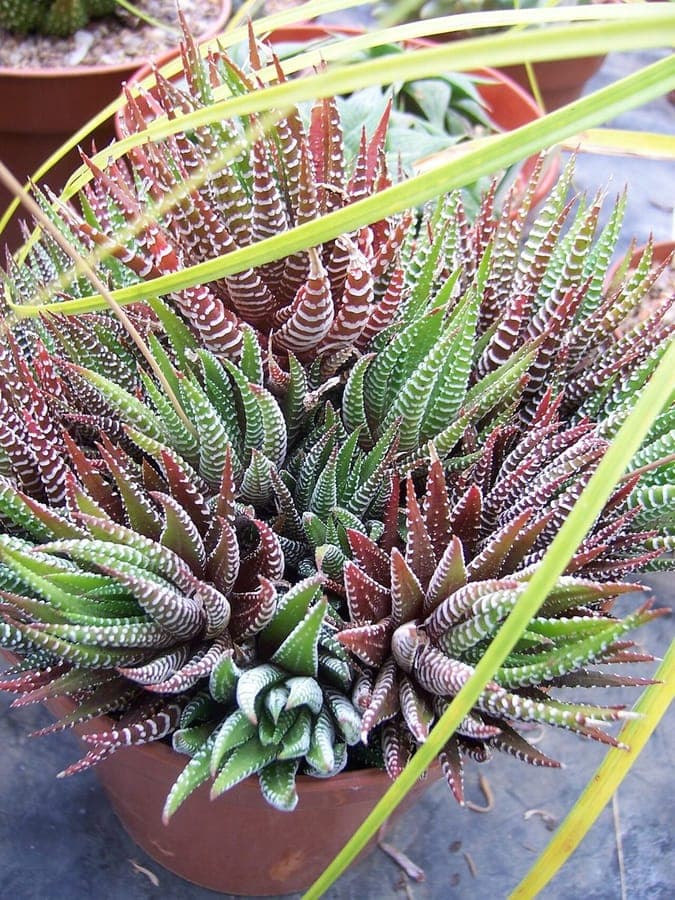
stephen boisvert from Chicago, United States / CC BY 2.0, via Wikimedia Commons
Zebra haworthia (Haworthiopsis attenuata): care guide
Haworthiopsis attenuata
Want to see Zebra haworthia (Haworthiopsis attenuata): care guide in your garden?
Full design in HD: €7.99
Look after your Zebra haworthia with the GardenWorld app
Identify plants with your camera and get a care calendar with reminders for this plant.


Overview
Haworthiopsis attenuata, better known as the zebra haworthia or zebra plant, is a small succulent from the Eastern Cape of South Africa. It turns up in almost every garden centre, often labelled with its old name Haworthia attenuata or, wrongly, as Haworthia fasciata. The common name comes from the raised white tubercles that run in horizontal bands across the dark green leaves, so each rosette looks as though someone has painted fine stripes on it by hand.
The plant belongs to the Asphodelaceae, the same family as Aloe and Gasteria. It stays small: a single rosette rarely grows wider than 10 to 15 cm or taller than 10 cm, but over the years it builds up dense clumps of dozens of rosettes. That makes it perfect for a windowsill, a desk or a shallow bowl of succulents. It tolerates far less light than most succulents, grows slowly and asks for very little. If you move it outdoors for the summer, you can have a garden design made on gardenworld.app for your patio, with a sheltered corner for pots of succulents.
Appearance and flowering
The leaves are thick, triangular in cross-section and taper to a sharp point. They reach 4 to 8 cm long and are packed tightly into a star-shaped rosette. The white tubercles appear on both faces of the leaf, which separates this species from the true Haworthiopsis fasciata, banded only underneath and smooth on top. In the trade, though, the two names are used almost interchangeably.
The leaf colour is dark green but turns red, bronze or purplish brown when the plant gets a lot of sun, drought or cold. This is a stress response rather than a disease. Give the plant slightly more shade and normal watering and it greens up again. The photo shows both colours side by side in the same pot.
Flowering is modest. Usually in late spring or summer a thin, wiry stem 20 to 40 cm long rises from the centre of a rosette, carrying loosely spaced white tubular flowers with greenish or brownish lines. They are more quirky than showy. Many growers cut the stem off once the flowers fade so the rosette puts its energy back into leaves.
Ideal location
Give Haworthiopsis attenuata a bright spot without harsh midday sun through glass. An east- or west-facing window is ideal. On a south-facing sill, keep the plant half a metre back from the glass or behind a net curtain. Too much sun leads to red or brown, scorched leaf tips. Too little light makes the rosette soft and pale, with leaves stretching towards the window. Turn the pot a quarter every few weeks so the clump grows evenly.
Normal room temperatures of 18 to 24 °C suit it well. In winter it is happy cooler, at around 10 to 15 °C, which gives it a rest period. Dry indoor air is not a problem. Avoid draughts from a door that opens often in winter, and do not stand it directly above a radiator.
From late May to mid-September the plant can go outdoors in a bright, sheltered spot under cover. Let it acclimatise in shade for a week first, or it will scorch. Keep it out of prolonged rain and bring it in before nights drop below 8 °C.
Compost and repotting
Roots sitting in wet compost rot quickly, so use a cactus and succulent compost, ideally with an extra third of perlite, pumice or grit mixed in. A pot with a drainage hole is essential. A shallow, wide terracotta pot works well, because Haworthiopsis mostly forms shallow roots and terracotta lets moisture evaporate.
Repot every two to three years in spring, once the clump is spilling over the rim. Choose a pot only a few centimetres wider. Ease the plant out, shake off the old compost and trim away any dead, brown roots. After repotting, wait a week before watering so that small wounds can dry and seal.
Repotting is also the moment to take the offsets, or pups, that form around the base. Pull them away with a few roots of their own, let them dry for a day or two and pot them in barely moist succulent compost. They root within a few weeks.
Free preview
Want to see Zebra haworthia (Haworthiopsis attenuata): care guide in your garden? Make a free preview of your design.
Watering and feeding
Water by the rule of soak and dry. In spring and early summer that means roughly every 10 to 14 days, depending on the pot and temperature. Water until it runs out of the bottom and tip away anything left in the saucer after fifteen minutes. Push a finger into the compost: only water again when it is dry right down.
In the height of summer the plant slows down and needs a little less. In winter, in a cool room, give a small drink once a month at most, just enough to stop the leaves shrivelling. Wrinkled, thin leaves mean too little water. Soft, translucent or brown leaf bases mean too much, and that is far more dangerous. Water onto the compost rather than into the heart of the rosette.
Feed sparingly: once a month from April to September with a cactus fertiliser at half strength. Give nothing during the rest period.
Pruning and propagation
There is no real pruning to do. Now and then pull off dried lower leaves by hand, as they usually come away easily. Cut spent flower stems off at the base.
If a clump becomes too crowded or a rosette rots in the centre, divide the plant when you repot. Throw away soft, rotten parts and keep only firm rosettes with healthy roots. Mealybugs can hide between the leaf bases, showing up as small white woolly tufts. Dab them off with a cotton bud dipped in surgical spirit and keep an eye on the plant for a few weeks.
Maintenance calendar
March-April: Growth resumes. Repot if needed, take pups and return to regular watering.
May-June: Full growth. Water as soon as the compost is dry and feed monthly. From late May the plant can go outside in a sheltered, partly shaded spot.
July-August: In hot spells growth slows. Water a little less and shield it from fierce midday sun.
September-October: Bring the plant in before cold nights. Stop feeding and water less often.
November-February: Rest period in a bright, cool place at around 10 to 15 °C. Water sparingly once a month at most. Check for mealybugs.
To see what needs doing in your garden and on your patio each month, use the plant calendar on gardenworld.app.
Temperature and hardiness
Haworthiopsis attenuata is not frost hardy. It copes briefly with temperatures around 5 °C if the compost is dry, but frost kills it. Keep it indoors over winter. A cool, bright room, a stairwell or an unheated but frost-free conservatory is ideal, as long as the temperature stays above 5 °C.
Toxicity to pets
Good news for cat and dog owners. The ASPCA lists the zebra haworthia as non-toxic to cats, dogs and horses. Note that the listing uses the name Haworthia fasciata, which is the name this species is often sold under. No poisonings by Haworthiopsis attenuata are known, and vets regard it as a safe succulent. It is not toxic to people either.
There are two caveats. A cat that eats a lot of leaves may still vomit or have diarrhoea, simply because thick plant tissue is hard to digest. The sharp leaf tips can also prick an inquisitive nose. More importantly, do not confuse this plant with Aloe vera, which looks similar at first glance but is toxic to cats and dogs. If you grow both in one bowl, place it out of reach of your animals. Always keep fertilisers and pesticides locked away.
Companion plants
In a shallow bowl, Haworthiopsis attenuata pairs well with other succulents that tolerate partial shade and sparse watering. Echeveria elegans adds a soft blue-grey rosette as a contrast to the striped leaves, though it prefers a little more light. Burro's tail (Sedum morganianum) trails attractively over the rim of a taller pot beside it.
The jade plant (Crassula ovata) and the panda plant (Kalanchoe tomentosa) make a varied windowsill alongside the haworthia. Be aware that Crassula, Kalanchoe and Aloe vera are all toxic to cats and dogs. If you have pets, keep the haworthia within reach and place the others high up or in a room the animals cannot enter.
Final thoughts
Haworthiopsis attenuata is an ideal succulent for anyone short on time or without a sunny windowsill. It stays small, slowly grows into an attractive clump, tolerates some shade and is safe around cats and dogs. The one thing to avoid is overwatering. Give it gritty compost, a bright spot out of scorching midday sun and a cool, dry winter, and these little striped rosettes will reward you for years. With all the pups it produces, you will always have a plant to pass on to friends.
Frequently asked questions about Zebra haworthia
Is Zebra haworthia winter hardy?
Haworthiopsis attenuata is not frost hardy. It copes briefly with temperatures around 5 °C if the compost is dry, but frost kills it.
When and how do you prune Zebra haworthia?
There is no real pruning to do. Now and then pull off dried lower leaves by hand, as they usually come away easily.
How much water does Zebra haworthia need?
Water by the rule of soak and dry. In spring and early summer that means roughly every 10 to 14 days, depending on the pot and temperature.
Where does Zebra haworthia grow best?
Give Haworthiopsis attenuata a bright spot without harsh midday sun through glass. An east- or west-facing window is ideal.

See it in your garden
See Zebra haworthia in your garden
One photo of your garden and a few questions. You see the result in about a minute.
Try it with a photoIdentify this plant in your own garden. Identify a plant
Similar plants
Aloe vera: complete guide
Aloe vera
Master aloe vera cultivation. Growing guide for placement, watering, and harvesting the precious medicinal gel.
Echeveria elegans: complete guide
Echeveria elegans
Echeveria elegans, known as Pearl Echeveria, is a beautiful rosette-forming succulent. Learn complete care guide, watering, soil and ideal locations.
Sedum morganianum: complete guide
Sedum morganianum
Burro's-tail succulent from Mexico: elegant trailing plant with watery-green, bead-like foliage. Perfect for hanging baskets and living walls.
