
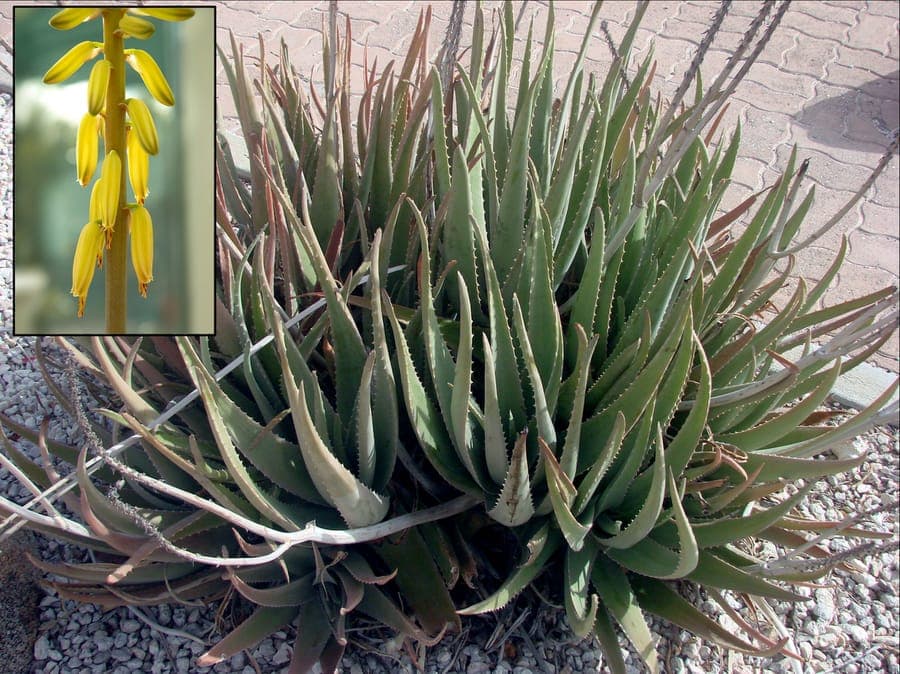
Collage by en:User:MidgleyDJ, original images from Wikimedia commons (Image:Aloe_vera_offsets.jpg and Image:Aloe_vera_C.jpg) / CC BY-SA 3.0, via Wikimedia Commons
Aloe vera: complete guide
Aloe vera
Want to see Aloe vera: complete guide in your garden?
1 minute, no credit card
Overview
Aloe vera, the true aloe, is arguably the world's most famous and valued succulent. Originating in Oman on the Arabian Peninsula, it now grows in virtually every tropical and temperate climate. The clear, healing gel extracted from leaves has been recognized as a natural remedy for millennia. Today, Aloe vera remains indispensable in households worldwide for burns, skin conditions, and general wellness. This species fundamentally differs from larger, structural aloe types. Aloe vera forms compact, clumping rosettes without distinct stems, grows rapidly, and produces numerous offset plants around the mother plant.
Due to its uncomplicated nature and medicinal benefits, Aloe vera suits beginner growers and families perfectly. This is the most forgiving aloe species, thriving on neglect and providing immediate practical value.
Appearance and Bloom
Aloe vera produces dense rosettes of elongated, fresh-green leaves reaching 40 to 60 centimeters in length with smooth surfaces and soft marginal teeth. Unlike many aloe species, leaves lack prominent spines, making handling considerably safer. This user-friendly aspect contributes to its household popularity.
Flowers are elegant if understated-pale yellow, tubular blooms emerge in slender spikes from the plant's center. In ideal conditions, Aloe vera blooms in spring. Blossoms attract pollinators but lack the dramatic presence of larger aloe flowers. Aloe vera's true treasure lies internally: the slippery, transparent gel containing moisture and healing compounds.
Ideal Location
Aloe vera thrives on very sunny positions requiring direct sunlight minimum six to eight hours daily. More sun is better-this plant loves brightness. Sunny windowsills or summer terraces are ideal. In extremely hot climates, afternoon shade in August prevents gel overheating. Indoors, south-facing windowsills work perfectly. Insufficient light causes rapid etiolation-the plant becomes tall, limp, and loses compactness. While not fatal, this appearance is undesirable.
Soil
Well-draining soil is critical. Standard succulent mix-equal parts potting soil, perlite, and sand-works excellently. Some growers use nearly pure sand with minimal organic matter. pH may be neutral to slightly acidic. Heavy, moisture-retentive soils cause root rot, the most common aloe vera failure cause. Always ensure adequate drainage holes. Repotting annually or biannually in fresh soil maintains plant health.
Free design
Want to see Aloe vera: complete guide in your garden? Make a free design now.
Watering
Watering is the crucial skill in Aloe vera cultivation. This plant stores water in thick leaves; overwatering is the primary threat. Water only when soil completely dries, usually every two to three weeks in summer, substantially less in winter. The classic rule applies: when in doubt, wait longer. Aloe vera survives extended drought remarkably well. Water too little rather than too much. In winter, reduce dramatically to perhaps once monthly or nothing at all during cold periods.
Pruning
Pruning is barely necessary. This naturally compact-growing plant requires minimal intervention. Remove only dead or damaged outer leaves by cutting near the base. This allows interior leaves room to expand. If the plant becomes leggy, carefully remove the top to stimulate branching from the break point. All cuttings propagate easily in dry sand.
Maintenance Calendar
January-March: Winter dormancy; minimal watering April-May: Growth resumes; gradually increase watering June-August: Peak season; regular (not excessive) watering; add fertilization September-October: Gradually reduce fertilizer November-December: Winter dormancy; sharply reduce water
Winter Hardiness
Aloe vera is NOT cold-hardy. This plant dies when temperatures fall below 10 degrees Celsius and suffers frost damage at 4-5 degrees. In temperate zones, Aloe vera must overwinter indoors on bright, dry windowsills or in greenhouses. Move indoors around October and return outside in late April. Dry, cool conditions (10-15 degrees Celsius) are acceptable; wet, cold conditions prove lethal.
Companion Plants
Aloe vera pairs attractively with other tropical succulents:
- Gasteria
- Haworthia
- Small Sedum varieties
- Jade plant (Crassula ovata)
- Echeveria for color
Avoid combining with water-demanding plants.
Conclusion
Aloe vera transcends ornamental plant status-it is a household essential. With simple requirements, rapid growth, and valuable gel, it deserves inclusion in every home. Maintain a pot on your sunniest windowsill, water more sparingly than intuition suggests, and enjoy years of healthy, productive plants. Use the gel for burns, dry skin, and numerous minor ailments. This plant repays investment many times over. Find Aloe vera at virtually every garden center worldwide. For succulent inspiration and design ideas, visit gardenworld.app and discover how this truly valuable plant enriches your living space.
Want to see Aloe vera: complete guide in your garden? Make a free design now.
Upload a photo, pick a style, and get a photorealistic design with plant list in under a minute.
No credit card required


Similar plants
Bitter aloe: complete guide
Aloe ferox
Everything you need to know about growing and caring for Aloe ferox: ideal conditions, watering, winter care, and companion planting for dry gardens.
Candelabra aloe: complete guide
Aloe arborescens
Everything you need to know about growing and caring for Aloe arborescens in temperate climates. Ideal conditions, watering, winter care, and more.
Broadleaf aloe: complete guide
Aloe maculata
How to grow Aloe maculata in temperate gardens. Sun, soil, watering & winter care. Use gardenworld.app for drought-tolerant designs.