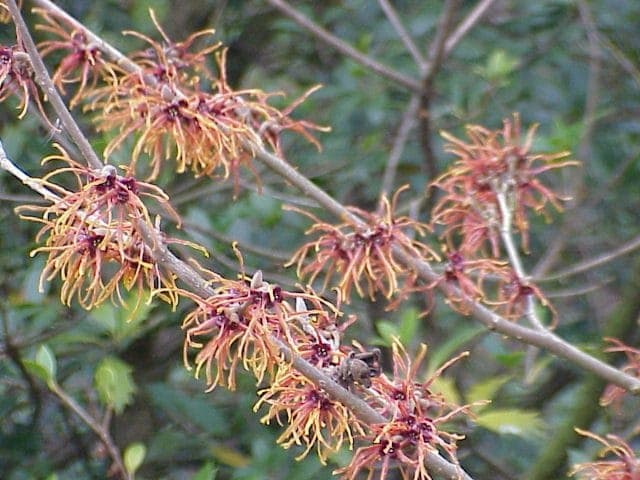
Kurt Stüber [1] / CC BY-SA 3.0, via Wikimedia Commons
Witch Hazel: complete guide
Hamamelis × intermedia
Want to see Witch Hazel: complete guide in your garden?
Full design in HD: €7.99
Look after your Witch Hazel with the GardenWorld app
Identify plants with your camera and get a care calendar with reminders for this plant.


Overview
Hybrid witch hazel (Hamamelis × intermedia) is the undisputed star of the winter garden. In the depths of January, when everything else is bare and grey, its branches are lined with curious, spidery flowers in yellow, orange or coppery red. Walk past one on a sunny winter's day and you will catch a sweet, spicy fragrance too. It is a plant that stays in the memory and surprises you all over again every year.
Hamamelis × intermedia belongs to the witch hazel family (Hamamelidaceae). It is a cross between two Asian species: Japanese witch hazel (Hamamelis japonica) and Chinese witch hazel (Hamamelis mollis). From the Chinese parent it inherited large flowers and scent; from the Japanese one, a range of colours and vigorous growth. The hybrid was developed mainly during the twentieth century, notably at the Arnold Arboretum in Boston and at Kalmthout Arboretum in Belgium.
Kalmthout's contribution is remarkable. It produced 'Jelena', with coppery orange flowers, and 'Diane', one of the best red-flowered varieties. Other well-known cultivars include 'Arnold Promise' (bright yellow, late), 'Pallida' (sulphur yellow, strongly scented), 'Westerstede' (pale yellow) and 'Aphrodite' (orange). The plant in the photo shows the coppery red to orange flowers typical of varieties such as 'Jelena' and 'Diane'.
Appearance and flowering season
Witch hazel grows into a broad, vase-shaped shrub with ascending branches. It is slow, adding 20 to 30 cm a year, and after many years reaches 3 to 4 metres in height and spread. The leaves resemble those of hazel: rounded to broadly oval, 8 to 15 cm long, with a wavy edge.
Flowering usually runs from January to March, occasionally starting in December in a mild winter. Each flower has four narrow, crimped petals 1.5 to 2 cm long, which spring like ribbons from a red-brown calyx. They are carried in small clusters along the bare stems. In frost the petals curl up for protection, unfurling again when the weather softens, so a single plant often stays in flower for four to six weeks.
Scent varies by variety. Yellow forms such as 'Pallida' and 'Arnold Promise' are generally the most fragrant, while the red and orange ones are more subtle. Autumn brings a second highlight, when the leaves turn yellow, orange or scarlet depending on the cultivar.
Incidentally, the familiar witch hazel lotion and distilled water sold in chemists come from a related North American species, Hamamelis virginiana.
Ideal position
Plant witch hazel in sun or light shade. In a sunny spot it flowers most generously and colours best in autumn; in too much shade the flowers become sparse. Choose a site sheltered from cold, drying easterly winds, and one where you can enjoy it in winter: near the patio, beside a path or in view of a window. A dark backdrop of evergreen shrubs makes the flowers glow.
Allow plenty of room. A mature witch hazel needs at least 3 metres across, and it resents being moved, so plant it in its final position from the start.
Soil requirements
Hamamelis × intermedia likes a humus-rich soil that holds moisture yet drains well. Slightly acid to neutral ground is ideal; a little lime is tolerated, but it struggles on thin, chalky soils. Heavy, waterlogged clay and very dry sand are both less suitable.
Improve the soil before planting with leaf mould or well-rotted compost. Plant in autumn or early spring, no deeper than it sat in its pot. Almost all witch hazels on sale are grafted onto a rootstock of Hamamelis virginiana, and the graft union should stay above ground. A 5 to 7 cm mulch of leaf mould or wood chips keeps the roots cool and moist.
Free preview
Want to see Witch Hazel: complete guide in your garden? Make a free preview of your design.
Watering
For the first two or three years after planting, witch hazel needs regular watering, especially during dry spells in spring and summer. Give a generous can of 10 to 15 litres once a week. Summer drought costs not only leaves but also flower buds for the following winter.
Once well established it is more self-sufficient, though extra water during long heatwaves remains worthwhile. An annual spring mulch reduces evaporation. Feeding is hardly necessary: a layer of compost in March is enough.
Pruning
Witch hazel naturally develops an attractive shape and needs very little pruning. In fact it dislikes hard cutting and responds with slow or uneven regrowth. Limit yourself to a light tidy straight after flowering, in March: remove dead, damaged or crossing branches and perhaps a stem that spoils the outline.
Do keep an eye out for suckers from the rootstock. These appear below the graft or from the ground, have different leaves and produce small yellow flowers in autumn. Cut or pull them off as low as possible, or they will eventually take over.
A few flowering stems cut for a vase indoors look lovely, and the warmth releases their scent even more.
Care calendar
January to February: Peak flowering. Look, smell and enjoy; there is nothing to do.
March: Light pruning after flowering, only where needed. Remove rootstock suckers and spread a layer of compost.
April to May: The leaves emerge. Top up the mulch and water young plants in a dry spring.
June to August: Flower buds for next winter are forming. Water during prolonged drought, particularly in the first years.
September to October: Autumn colour, with leaves turning yellow, orange or red.
November: The ideal time to plant new witch hazels. Prepare the planting hole well with leaf mould. The plant calendar at gardenworld.app reminds you month by month of what needs doing in the garden.
December: In mild winters the first flowers already appear.
Hardiness
Hamamelis × intermedia is fully hardy and copes with temperatures down to about -25 °C. The flowers are remarkably frost resistant thanks to their curling petals. No protection is needed in Britain or the Low Countries.
Young plants in containers need some care in severe winters: move the pot to a sheltered spot and wrap it in hessian. Witch hazels can live in a large container for a few years, but in the long run they belong in open ground.
Companion plants
Witch hazel is the heart of a winter garden, and underplanting completes the picture. Snowdrops (Galanthus nivalis) and winter aconites (Eranthis hyemalis) flower at the same time, forming a white and yellow carpet beneath the shrub. Christmas roses (Helleborus niger) are a perfect match.
For winter contrast, add red-barked dogwood (Cornus alba): red stems beside orange or yellow flowers create a warm scene. In autumn a Japanese maple (Acer palmatum) is a fine partner, as both colour brilliantly at the same time. Evergreens such as Skimmia or Sarcococca add structure and a dark backdrop.
Would you like a garden that holds interest all year, winter included? At gardenworld.app you can have a garden design made in which a witch hazel takes centre stage alongside the right winter-flowering plants.
Final thoughts
Witch hazel asks for patience, since it grows slowly, but it rewards you every year with colour and scent in the darkest months. Give it space, humus-rich soil and water in its early years, and keep the secateurs away as much as possible. In return, Hamamelis × intermedia will be the pride of your winter garden for decades.
Frequently asked questions about Witch Hazel
Is Witch Hazel winter hardy?
Hamamelis × intermedia is fully hardy and copes with temperatures down to about -25 °C. The flowers are remarkably frost resistant thanks to their curling petals.
When and how do you prune Witch Hazel?
Witch hazel naturally develops an attractive shape and needs very little pruning. In fact it dislikes hard cutting and responds with slow or uneven regrowth.
How much water does Witch Hazel need?
For the first two or three years after planting, witch hazel needs regular watering, especially during dry spells in spring and summer. Give a generous can of 10 to 15 litres once a week.
What soil does Witch Hazel need?
Hamamelis × intermedia likes a humus-rich soil that holds moisture yet drains well. Slightly acid to neutral ground is ideal; a little lime is tolerated, but it struggles on thin, chalky soils.

See it in your garden
See Witch Hazel in your garden
One photo of your garden and a few questions. You see the result in about a minute.
Try it with a photoIdentify this plant in your own garden. Identify a plant
Similar plants
Christmas-rose: complete guide
Helleborus niger
The Christmas-rose (Helleborus niger) is an elegant winter-flowering perennial blooming from December to April. Perfect for shady borders and woodland gardens.
Common snowdrop: complete guide
Galanthus nivalis
Common snowdrop growing guide. The world's most familiar snowdrop with delicate white pendant flowers.
Siberian Dogwood: complete guide
Cornus alba
Learn how to grow and care for Cornus alba (Siberian Dogwood) in your garden. Ideal conditions, pruning, winter color and companion plants explained.
